The Cockroach Janta Party is not a party. That is the point of it and also the problem with it.
Founded on 16 May 2026 by Abhijeet Dipke, a political communications strategist, the CJP emerged as a satirical response to remarks attributed to Chief Justice Surya Kant, who reportedly compared unemployed youth to "cockroaches" and "parasites of society" during a Supreme Court hearing. Within days, it was everywhere. The CJP Instagram account gained more than 20 million followers in less than a week — more than double the number boasted by the BJP, which has been around for over 40 years, and well over the 13 million followers of the Indian National Congress.
The numbers are real. The grievances underneath them are real. The question — the one that is not being asked loudly enough — is who is steering the vehicle.
The man behind the mascot
Between 2020 and 2023, Dipke worked with the Aam Aadmi Party's social media team, helping on online political campaigns and meme-based digital outreach around the 2020 Delhi Legislative Assembly election led by Arvind Kejriwal. After that, he served as a communications advisor connected to the Delhi government's education department. This is not incidental background. It is the entire frame.
Between 2020 and 2023, AAP ran a kind of always-on newsroom: rapid-response graphics, hashtag squads, hyper-local meme pages, and a relentless pivot from outrage to ask. Dipke was not a senior strategist — by his own account, a foot-soldier. But the muscle memory shows.
The CJP's construction bears this out. The movement launched with a website, a manifesto, a mock election symbol, a named convenor, and a functioning social media strategy — all on day one. This is not how spontaneous youth movements are built. This is how political communications professionals build viral campaigns. The joke about the cockroach was the trigger. The infrastructure was already understood.
What the opposition did next
The ruling establishment's anxiety about CJP was visible and, from a purely tactical standpoint, understandable. The CJP's X account was blocked in India within days of its launch. That suppression was a mistake — it handed the movement exactly the martyrdom narrative it needed.
But the opposition's conduct was its own kind of tell.
Samajwadi Party chief Akhilesh Yadav was among the first major political leaders to acknowledge the trend. Posting on X, he wrote "BJP banam CJP" — BJP versus CJP — turning the viral satire into a direct political jab against the ruling party. TMC MPs Mahua Moitra and Kirti Azad publicly asked to "join" the Cockroach Janta Party through posts on X. Moitra also posted that she was already a "card-carrying member" of the "Anti-National Party."
This is not solidarity. This is colonisation. Established politicians with their own institutional interests inserting themselves into a youth movement is the oldest trick in the playbook — and it tends to corrode whatever authenticity the movement had. The youth protesting exam irregularities at Jantar Mantar are not constituents of Akhilesh Yadav's Samajwadi Party or Mahua Moitra's Trinamool Congress. When Yadav posts "BJP banam CJP," he is not amplifying student grief. He is harvesting it.
The follower question
BJP leaders argued that many of CJP's followers were bots or fake accounts from Pakistan. Dipke replied with analytics indicating that 94.7% of the users were from within India. The specific BJP claim — that 49% of CJP's followers were from Pakistan, 14% from the United States, and 14% from Bangladesh, with only 9% from India — was amplified by BJYM secretary Tajinder Bagga and found to be false.
The BJP's counter-narrative was, in this instance, demonstrably manufactured. But the underlying question about the organic nature of 20 million Instagram followers accumulating in under a week is not answered simply by showing most of them are Indian. Indian bot farms exist. Social media amplification can be purchased. There were reports of strange follower behaviour — accounts from tiny towns like Topeka, Kansas, or users appearing for a few days before disappearing. Dipke has not addressed these specifics. The CJP's own website — which is also where these counter-analytics are published — is not a neutral source.
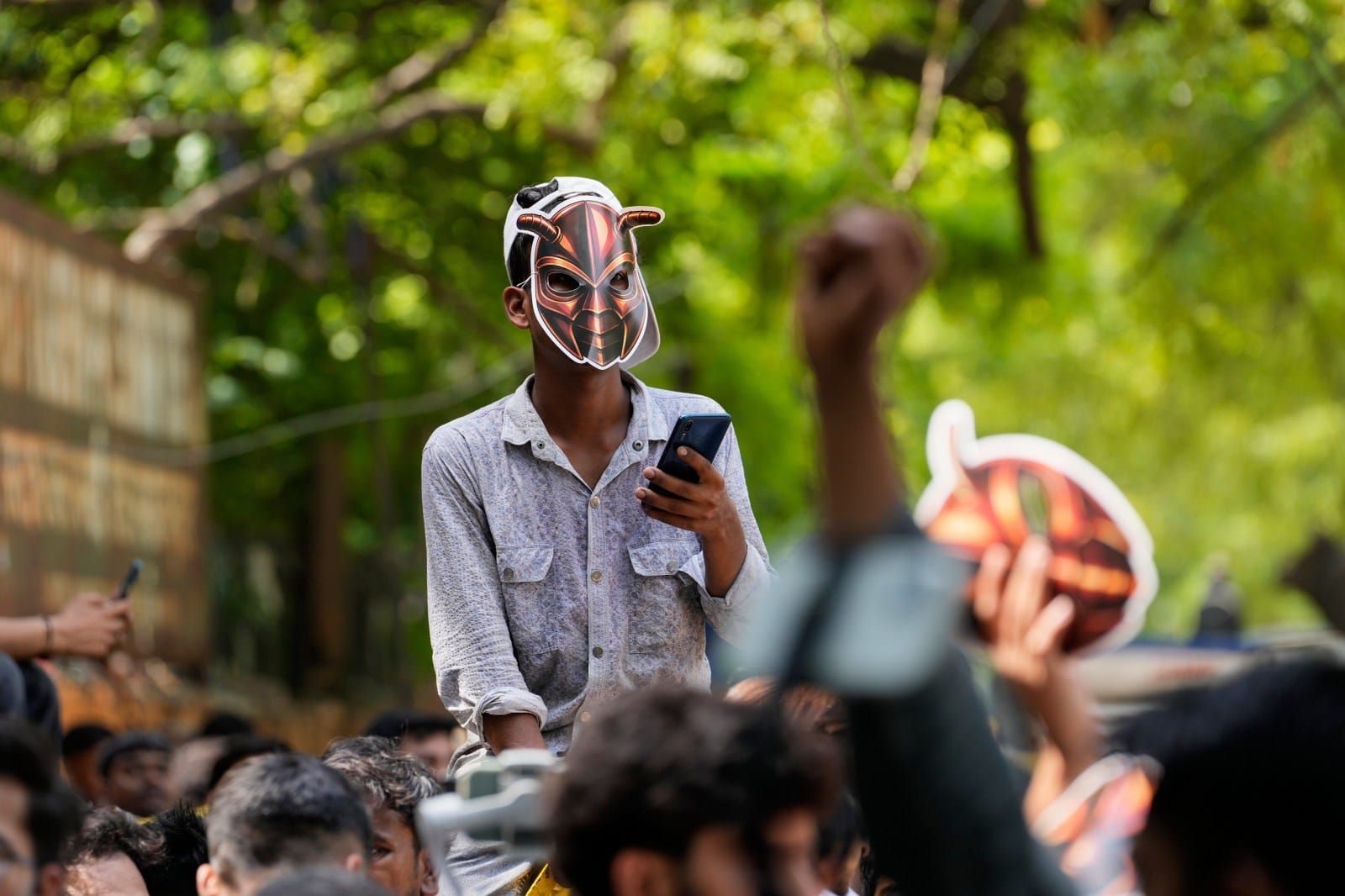
None of this means the movement is hollow. Hundreds of young students gathered at Jantar Mantar on June 6, in cockroach masks, calling for Education Minister Dharmendra Pradhan's resignation over question paper leaks and exam irregularities affecting millions of students. That anger is real and the underlying failures are documented. But 20 million Instagram followers and several hundred protesters at a rally is a gap that warrants scrutiny, not celebration.
What the manifesto is actually saying
CJP's mock manifesto raises questions on disenfranchisement, press freedom, and controversial political practices including the appointment of retired judges to Parliament. These half-serious demands notably echo criticisms of and allegations against Prime Minister Modi's administration in recent times.
That alignment could simply mean the movement is tapping real discontent with a real government. It could also mean the manifesto was written with the opposition's talking points as a template. Both can be true simultaneously. What is notable is the precision of the fit — not a vague youth frustration, but a fairly specific checklist of grievances that maps onto the INDIA bloc's political agenda. Youth unemployment and exam fraud are genuine national problems. Judicial appointments and press freedom also happen to be the exact terrain on which AAP, SP, and TMC have been fighting the BJP for years.
The distinction that matters
The question is not whether Chief Justice Surya Kant's remarks were offensive — the court's own subsequent clarification suggested he recognised the damage. Kant tried to put a lid on the backlash, insisting he hadn't referred to unemployed youth in general as vermin, just those who get jobs by faking degrees. The question is whether a youth movement with a legitimate grievance is being instrumentalised by established political actors who have their own reasons to destabilise the current dispensation.
The evidence does not prove orchestration. It does not need to. What it shows is a founder with deep AAP operational roots, a movement whose manifesto mirrors opposition talking points with unusual precision, and senior opposition politicians who moved with extraordinary speed to attach themselves to the CJP brand. That is not proof of a conspiracy. It is proof of political opportunity being recognised and exploited.
India's unemployed graduates deserve better than to be a meme vehicle for the INDIA bloc's next cycle. The Jantar Mantar protest was real. The exam failures that drove students there are real. The grief underneath the cockroach masks is real. Whether the infrastructure behind the movement serves those students, or serves Akhilesh Yadav's electoral arithmetic and Mahua Moitra's social media presence, is the question that the movement's own admirers should be asking — before the opposition has finished answering it for them.