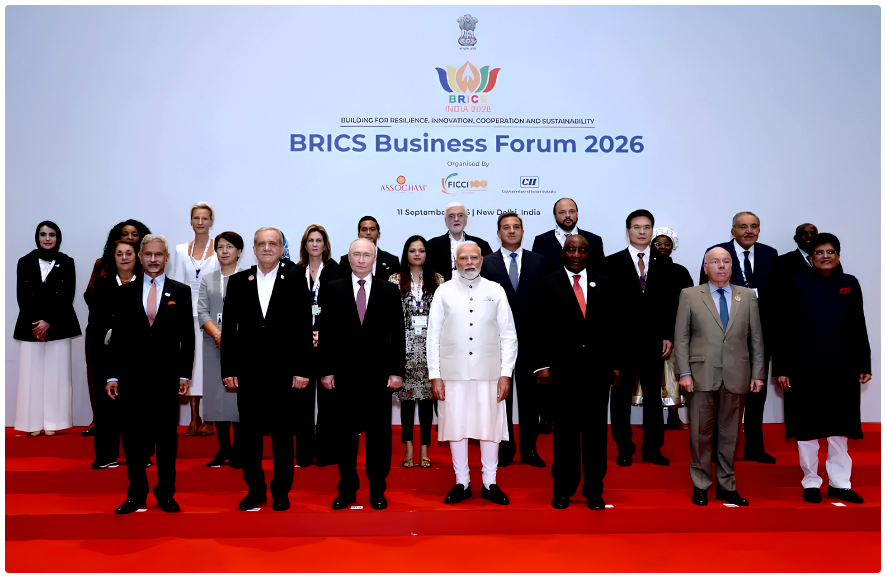
BRICS negotiators have reached agreement on a joint declaration after overcoming deep differences between Iran and the United Arab Emirates over the war in West Asia, clearing one of the biggest diplomatic hurdles facing the summit in New Delhi.
The breakthrough came after intensive negotiations that reportedly continued until around 4 a.m. on Saturday, just hours before BRICS leaders gathered in the Indian capital. Sources familiar with the discussions told Reuters that negotiators had agreed on the text, which is now expected to be formally approved by the leaders.
The compromise is significant because the same disagreement had defeated diplomats only four months ago.
At the BRICS foreign ministers' meeting in New Delhi in May, Iran and the UAE clashed over how the grouping should describe the war involving Iran, Israel and the United States. Tehran wanted stronger condemnation of the military campaign against it and accused the UAE of involvement in operations against Iran. Abu Dhabi categorically rejected those allegations and accused Tehran of launching attacks against Emirati territory. The dispute became so serious that BRICS could not produce a consensus joint statement, forcing India to issue a chair's statement instead.
That made the Delhi summit a test not simply of BRICS unity, but of India's ability to manage increasingly difficult relationships inside an expanded bloc.
This time, negotiators appear to have found a formula both sides can live with.
According to Reuters, the declaration is unlikely to name individual countries while condemning unilateral warfare. Indian negotiators had been pushing for language centred on broader principles, including opposition to unprovoked aggression, respect for the United Nations Charter, protection of civilians and freedom of navigation, rather than wording that directly blamed one side.
The agreement matters because Iran and the UAE are not dealing with an abstract diplomatic disagreement. The UAE has been struck by Iranian missiles during the six-month-old conflict and suspended trade and financial transactions with Tehran in August. Iran, meanwhile, remains at war with the United States and Israel, while fighting has resumed after a relative pause during much of August.
India found itself unusually well positioned to mediate between the two.
New Delhi maintains close relations with Iran while simultaneously enjoying a rapidly expanding strategic and economic partnership with the UAE. Prime Minister Narendra Modi met Iranian President Masoud Pezeshkian in Delhi on Friday and reiterated India's position that disputes should be resolved through dialogue and diplomacy while stressing freedom of navigation and commerce.
The declaration is expected to go considerably beyond West Asia. Negotiators have also worked on common positions on terrorism, reform of global institutions including the United Nations, World Bank, IMF and WTO, unilateral sanctions, trade in national currencies and strengthening supply chains. India has also pushed for stronger language on counterterrorism and reform of the UN Security Council.
For BRICS, reaching agreement is important precisely because the organisation has become more difficult to manage as it has expanded. Brazil, Russia, India, China and South Africa are now joined by countries including Iran, the UAE, Egypt, Ethiopia and Indonesia, bringing together governments with very different alliances, security interests and relationships with the West.
That diversity gives BRICS greater global weight, but it also makes consensus harder.
The Delhi Declaration will not end the Iran war or resolve the differences between Tehran and Abu Dhabi. But that was never the immediate test.
The test was whether a grouping that wants a greater voice in the international order could keep its own members at the same table when two of them were divided by an active regional war.
In New Delhi, after negotiations that stretched deep into the night, BRICS appears to have found a way.