Chinese technology giant Huawei is going on trial in New York in one of the most consequential corporate criminal cases in the long-running technology confrontation between the United States and China.
Jury selection begins Tuesday in federal court in Brooklyn, where US prosecutors will attempt to prove that Huawei engaged in a years-long racketeering conspiracy involving trade-secret theft, bank and wire fraud, sanctions violations and obstruction of justice.
Huawei has pleaded not guilty and denies wrongdoing.
At the heart of the case is an extraordinary allegation: that Huawei's rise into one of the world's largest telecommunications companies was aided by a systematic effort to obtain technology belonging to American competitors.
US prosecutors allege that Huawei and its subsidiaries sought confidential information from six American technology companies, including technology involving internet routers, smartphone antennas and phone-testing robots.
The Justice Department has previously alleged that Huawei employees who obtained valuable confidential information from competitors could receive bonuses.
But the case extends far beyond intellectual property.
A major part of the prosecution concerns Huawei's business activities in Iran.
US authorities allege that Huawei concealed its relationship with Skycom Tech, a Hong Kong company that operated in Iran, while presenting the business as an independent partner.
Prosecutors say Huawei's representations allowed financial transactions connected to its Iranian operations to pass through international banks, including the US financial system, despite American sanctions.
A federal judge previously ruled that prosecutors had sufficiently alleged that more than $100 million moved through the US financial system in connection with Skycom's operations.
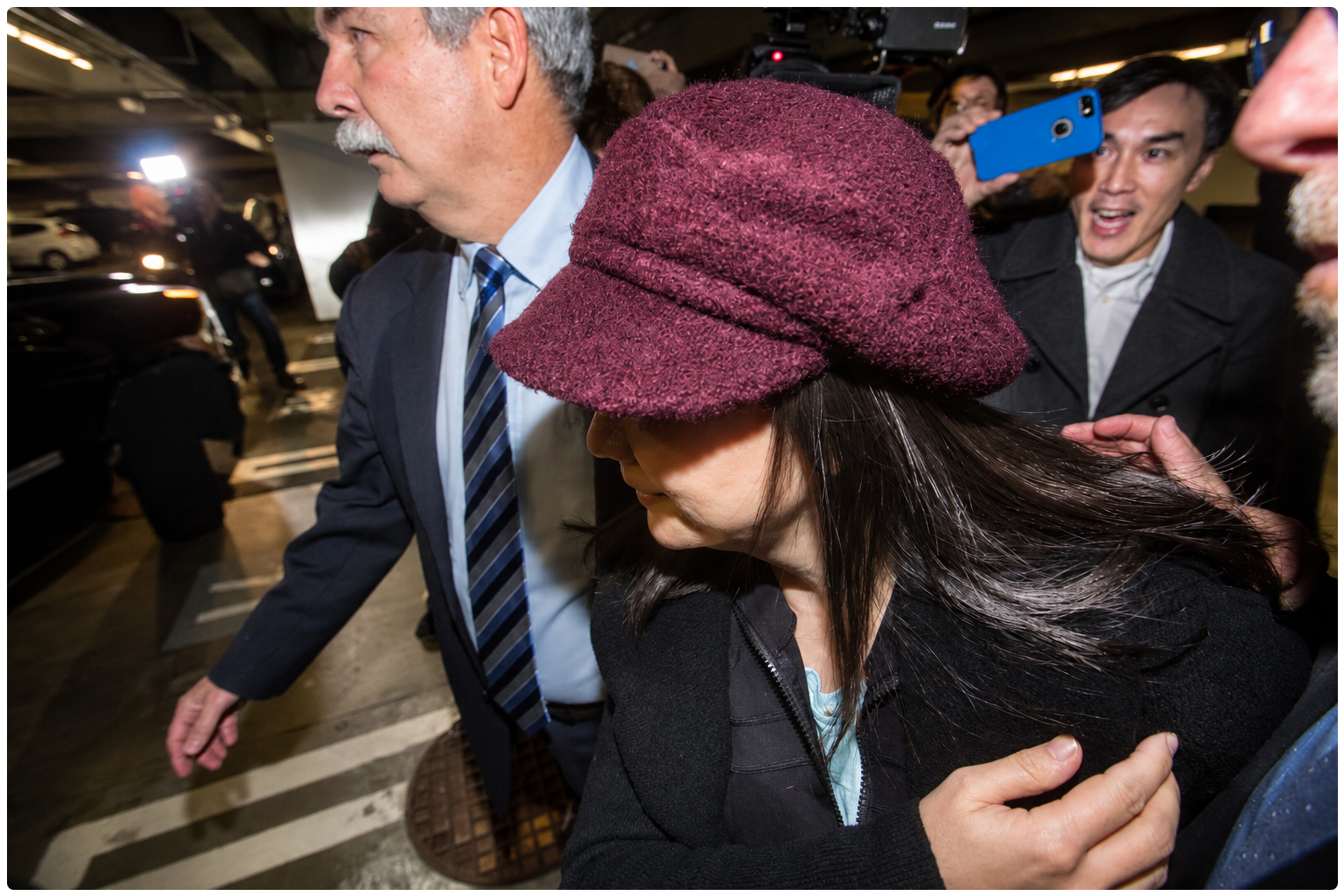
The Iran allegations were central to the arrest of Huawei Chief Financial Officer Meng Wanzhou in Canada in December 2018.
Meng, the daughter of Huawei founder Ren Zhengfei, was detained on a US extradition request while changing flights in Vancouver.
Her arrest triggered an extraordinary diplomatic confrontation involving China, Canada and the United States.
Meng spent nearly three years fighting extradition before reaching a deferred prosecution agreement with US authorities in 2021.
As part of that agreement, she acknowledged making false statements to a financial institution about Huawei's relationship with Skycom and its activities in Iran. She was subsequently allowed to return to China, and the charges against her were eventually dismissed.
The criminal case against Huawei itself, however, continued.
Prosecutors expanded the indictment in 2020 to include allegations under the Racketeer Influenced and Corrupt Organizations Act, better known as RICO, the legislation originally designed to combat organised criminal enterprises.
The government also alleges that Huawei conducted business in North Korea in violation of US sanctions and that equipment supplied through Skycom assisted Iranian authorities in conducting domestic surveillance, including during anti-government demonstrations in Tehran in 2009.
Huawei rejects the broader picture presented by Washington.
The company has argued that the prosecution is politically motivated and part of a wider American effort to weaken one of China's most successful technology companies.
It previously attempted to have most of the indictment dismissed, arguing among other things that prosecutors were improperly applying American criminal law to overseas conduct.
US District Judge Ann Donnelly rejected that effort, allowing the case to proceed to trial.
The courtroom battle arrives against the backdrop of a much larger US campaign against Huawei.
Washington has restricted the company's access to American technology since 2019, citing national-security concerns. The United States also pressured allies to restrict Huawei equipment from their 5G telecommunications networks.
Those measures initially dealt a major blow to Huawei's smartphone and telecommunications businesses.
But the company has increasingly rebuilt its technological capabilities, investing heavily in domestic semiconductor development and positioning itself at the centre of China's effort to reduce dependence on American technology.
That gives the Brooklyn trial significance well beyond the criminal charges themselves.
For prosecutors, it is an attempt to prove that Huawei's global expansion involved a pattern of criminal conduct spanning intellectual-property theft, sanctions evasion and financial deception.
For Huawei and Beijing, the case sits inside a much larger struggle over whether American law, sanctions and export controls are being used to contain China's technological rise.
After nearly eight years of indictments, diplomatic confrontations and legal battles, those competing narratives are finally heading before an American jury.