Karnataka has never been a stranger to political intrigue. Governments have collapsed over defections, powerful ministers have fallen after the circulation of intimate recordings, and accusations of surveillance have followed some of the state's most influential political figures. For decades, the struggle for power in Bengaluru has involved far more than elections, legislative numbers and ideological disagreements.
In August 1988, Chief Minister Ramakrishna Hegde resigned amid a telephone-tapping scandal involving allegations of surveillance of political figures. Hegde denied personal involvement but accepted moral responsibility. The resignation was acknowledged in Parliament, where concerns about the surveillance of legislators and violations of privacy were being debated.
Technology has changed dramatically since then. Telephone interception has been joined by miniature cameras, covert recordings and instantaneous digital distribution. The fundamental political danger, however, remains recognisable: private information can become a weapon in the struggle for political power.
A controversy that is now engulfing Chief Minister D.K. Shivakumar raises a question that strikes at the legitimacy of the office itself: could a sitting chief minister have been forced to surrender power because someone possessed compromising material against him?
Former chief minister and Union Minister H.D. Kumaraswamy believes that is precisely what happened.
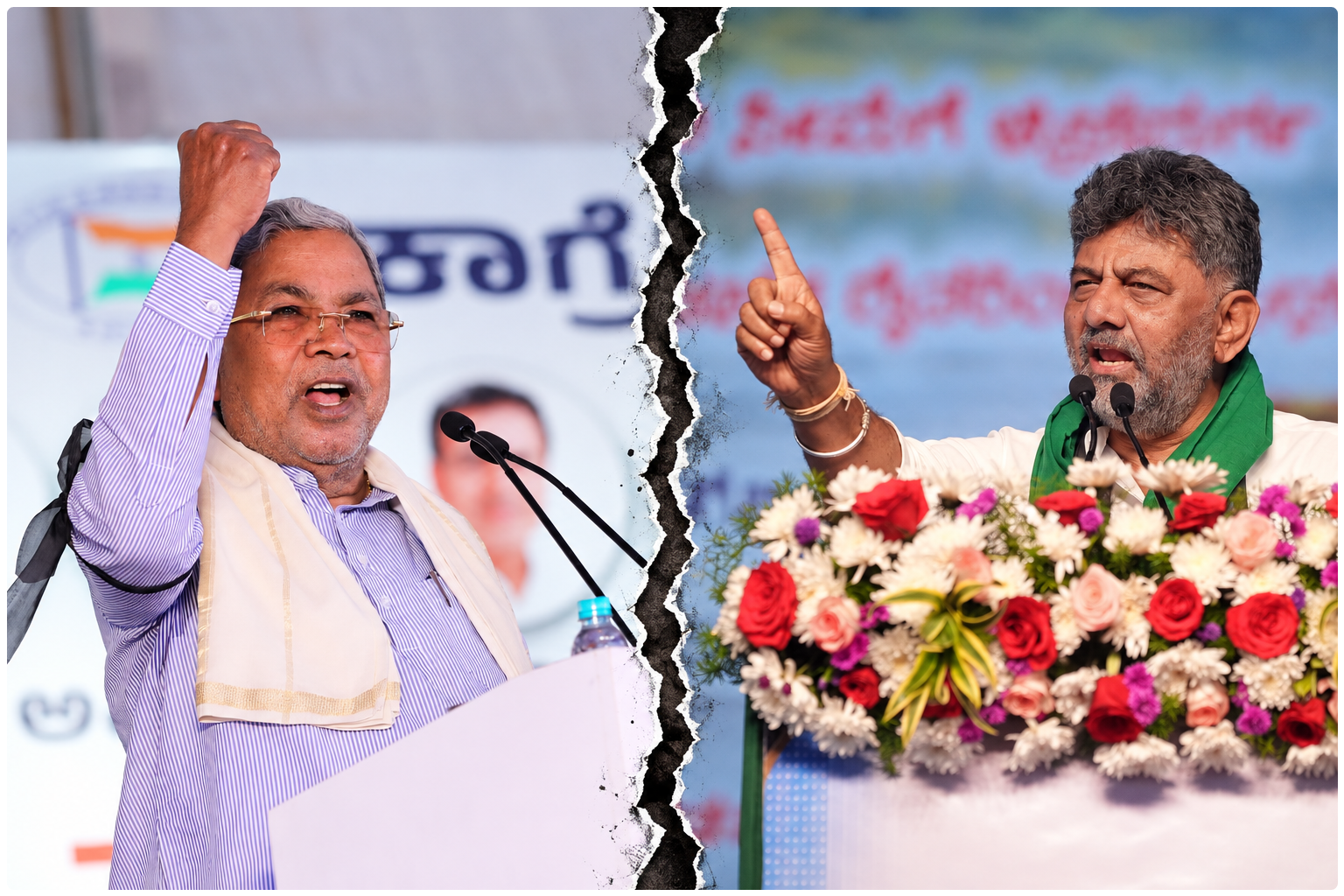
His allegation is extraordinary. Kumaraswamy claims that Shivakumar orchestrated a sting operation targeting his predecessor, Siddaramaiah, and that the resulting material was used to pressure the Congress leadership into replacing him in June 2026.
A leadership transition under a new cloud
When the Congress returned to power in Karnataka in May 2023, the rivalry between Siddaramaiah and Shivakumar was already evident. Siddaramaiah had the experience, administrative credentials and a formidable support base among backward classes, Dalits and minorities. Shivakumar brought organisational influence, financial resources and a reputation as a political troubleshooter who had helped the Congress navigate difficult electoral battles.
Siddaramaiah became chief minister, while Shivakumar accepted the deputy's position. However, speculation about an eventual transfer of power persisted throughout their partnership.
That speculation eventually became reality in 2026, when the Congress leadership moved to settle the prolonged contest for the chief minister's chair. Siddaramaiah stepped down on May 29, clearing the way for Shivakumar to be sworn in on June 3. Siddaramaiah maintained that he had resigned at the direction of the party leadership, presenting the transition as an internal political decision rather than one forced upon him.
But the circumstances surrounding his departure have since come under scrutiny, with former chief minister H.D. Kumaraswamy alleging that the leadership change was not merely the outcome of negotiations within the Congress, but that Siddaramaiah had been subjected to pressure involving a secretly recorded video.
Speaking on October 7, Kumaraswamy claimed that Siddaramaiah had been summoned to New Delhi ostensibly for discussions about Cabinet expansion. Instead, according to Kumaraswamy, he was confronted with material from a sting operation and pressured into relinquishing his position.
Kumaraswamy's account goes further than the alleged confrontation in Delhi. He has accused Shivakumar of being behind the operation and claimed that people associated with a media organisation, along with figures within the Congress leadership, were involved. He maintains that his information came from sources within the Congress, suggesting that the circumstances surrounding Siddaramaiah's departure were known to people inside the party. His allegations raise questions about whether the leadership transition was entirely a political arrangement or whether the alleged recording played a part in the negotiations that preceded it.
Political parties routinely replace chief ministers because of internal agreements, electoral calculations and leadership disputes. But if secretly obtained or manufactured material was used to compel Siddaramaiah's departure, Karnataka would be confronting something fundamentally different: the possibility that private coercion helped determine who governed the state.
What actually happened in the alleged sting operation?
The recording at the centre of the controversy reportedly dates to 2023, shortly before the Karnataka Assembly elections. The footage is described in court proceedings as a concealed-camera conversation involving two men and a woman. The discussion concerns an alleged incident from around 2011, when Siddaramaiah was serving as Leader of the Opposition in the Karnataka Legislative Assembly.
During the conversation, an unidentified woman was prompted to describe an alleged sexual encounter involving Siddaramaiah. According to Kumaraswamy's public description of the footage, she was questioned about how much time she had spent with him and whether she could identify particular marks on his body. The apparent purpose of these questions was to obtain details that might make her accusation appear credible.
Those questions have since led investigators to examine who arranged the conversation and why it was recorded in the first place. Among the individuals named in the controversy are Power TV managing director Rakesh Shetty and Congress functionary Kripa Alva. According to statements reported during the investigation, Shetty acknowledged conducting a sting operation, while Alva told police that she had accompanied him because he wanted to expose certain individuals. She reportedly maintained, however, that she was unaware the conversation was being secretly recorded and did not know the woman whose allegations were being documented.
It is Alva's political ambitions that have attracted particular attention in this matter. On October 23, Siddaramaiah's son and Karnataka minister Yathindra Siddaramaiah alleged that a woman Congress leader appearing in the recording had wanted the party's ticket to contest the Assembly election from Puttur. He suggested that an attempt to secure that nomination might have been connected to the sting operation. Although Yathindra initially avoided naming her, Siddaramaiah subsequently identified Kripa Alva as the Congress leader allegedly involved, alongside Shetty.
The timing presents a further puzzle. The alleged incident was said to have occurred around 2011. The recorded conversation reportedly took place approximately twelve years later, in 2023. Yet the footage was not publicly circulated until September 2026, several months after Siddaramaiah had already relinquished the chief minister's position.
What happened to the recording during those intervening years? Who kept it, who was able to access it, and whether it was privately shown to political figures before becoming public remain unanswered questions.
The first publicly reported circulation occurred on September 27, 2026, when an unidentified operator of a YouTube channel called Karnataka Honey Trap allegedly uploaded the material. A television broadcast followed on October 2, bringing the recording into a much wider political debate. Siddaramaiah lodged a police complaint on October 6, describing the video as fabricated and alleging that it had been circulated to blackmail him and damage his reputation.
The investigation has since produced a significant development concerning the central accusation. According to information attributed to Bengaluru Central Crime Branch investigators on October 28, the unidentified woman who made the allegation in the recording told police that she had never met Siddaramaiah. She reportedly said that a group of people approached her in 2023, paid her money and instructed her on what to say during the recording. Investigators also reported that she acknowledged meeting Shetty and Alva.
If her account is corroborated, the implications would extend beyond a disputed sexual misconduct allegation. It would raise the possibility that the recording was deliberately constructed to create damaging material against Siddaramaiah, rather than to document an actual encounter. That would make the identity of those who recruited and instructed her central to understanding the operation.
Ramesh Jarkiholi Controversy
Karnataka's latest controversy recalls the political storm that forced BJP minister Ramesh Jarkiholi out of the B.S. Yediyurappa government in March 2021. A video purportedly showing him in an intimate encounter with a woman surfaced on March 2, accompanied by allegations that he had sexually exploited her after promising a government job. Within a day, Jarkiholi resigned as Water Resources Minister, denying wrongdoing and describing the episode as a conspiracy to destroy his political career.
The woman subsequently filed a police complaint alleging sexual exploitation and intimidation, while Jarkiholi countered that he had been targeted through a planned honey-trap and extortion operation. The Karnataka government constituted a Special Investigation Team to examine the competing allegations. In February 2022, the SIT filed a closure report in the sexual assault case, citing insufficient evidence to prosecute him.
As the investigation unfolded, Jarkiholi began accusing D.K. Shivakumar, then Karnataka Congress president, of involvement in the alleged conspiracy. In January 2023, he demanded a CBI investigation, claiming that a network was collecting compromising recordings of politicians. Two months later, he went further, alleging that Shivakumar was using such recordings to pressure BJP legislators into defecting to the Congress.
The allegations resurfaced in March 2025 when BJP MLA Munirathna accused Shivakumar and his brother D.K. Suresh of involvement in honey-trapping politicians, including Jarkiholi. His accusations followed Karnataka minister K.N. Rajanna's claim that as many as 48 legislators had been targeted through similar operations.
The parallels with the present controversy are difficult to overlook. In 2021, a compromising recording preceded a minister's resignation, followed by accusations of political blackmail. Now Kumaraswamy alleges that another recording was used to pressure Siddaramaiah into surrendering the chief minister's position. Both episodes raise questions about who commissions such recordings, who controls them and whether they are subsequently used as political leverage.
If the allegations are proved, can Shivakumar remain chief minister?
There is a difference between a politician using aggressive tactics to win influence and a politician conspiring to manufacture compromising allegations against a colleague to capture the highest executive office in a state.
The first may be the unpleasant reality of competitive politics. The second, if established, would represent a profound abuse of political power.
If evidence demonstrates that Shivakumar commissioned or knowingly used fabricated material to coerce Siddaramaiah's resignation, his continued occupancy of the chief minister's office would become politically and morally indefensible.
An inquiry worthy of public confidence would need to establish the recording's original purpose, identify everyone who arranged and financed it, trace its custody between 2023 and 2026, examine whether it was presented to Congress decision-makers, and determine whether any pressure arising from it influenced Siddaramaiah's resignation.
The inquiry should also examine Kumaraswamy's allegations of surveillance and the alleged targeting of JD(S) workers. An investigation conducted solely to punish those who circulated the recording, without examining those who created or commissioned it, would leave the central political questions unanswered.
There is a further problem for Shivakumar. Even if he had no involvement whatsoever, a controversy that directly implicates the sitting chief minister creates an obvious question about the perceived independence of an investigation conducted under his government.
A legally constituted independent inquiry, insulated from political influence and empowered to examine the recording's origin, custody and alleged use, should be formed. Such an investigation must be free to question political leaders, media figures and other individuals whose involvement may be relevant.
And for Karnataka, the most disturbing possibility is not merely that another politician may have been secretly recorded. It is that the state's political system may have become vulnerable to a form of coercion in which the person holding the most damaging recording can wield more influence than the person holding the democratic mandate.