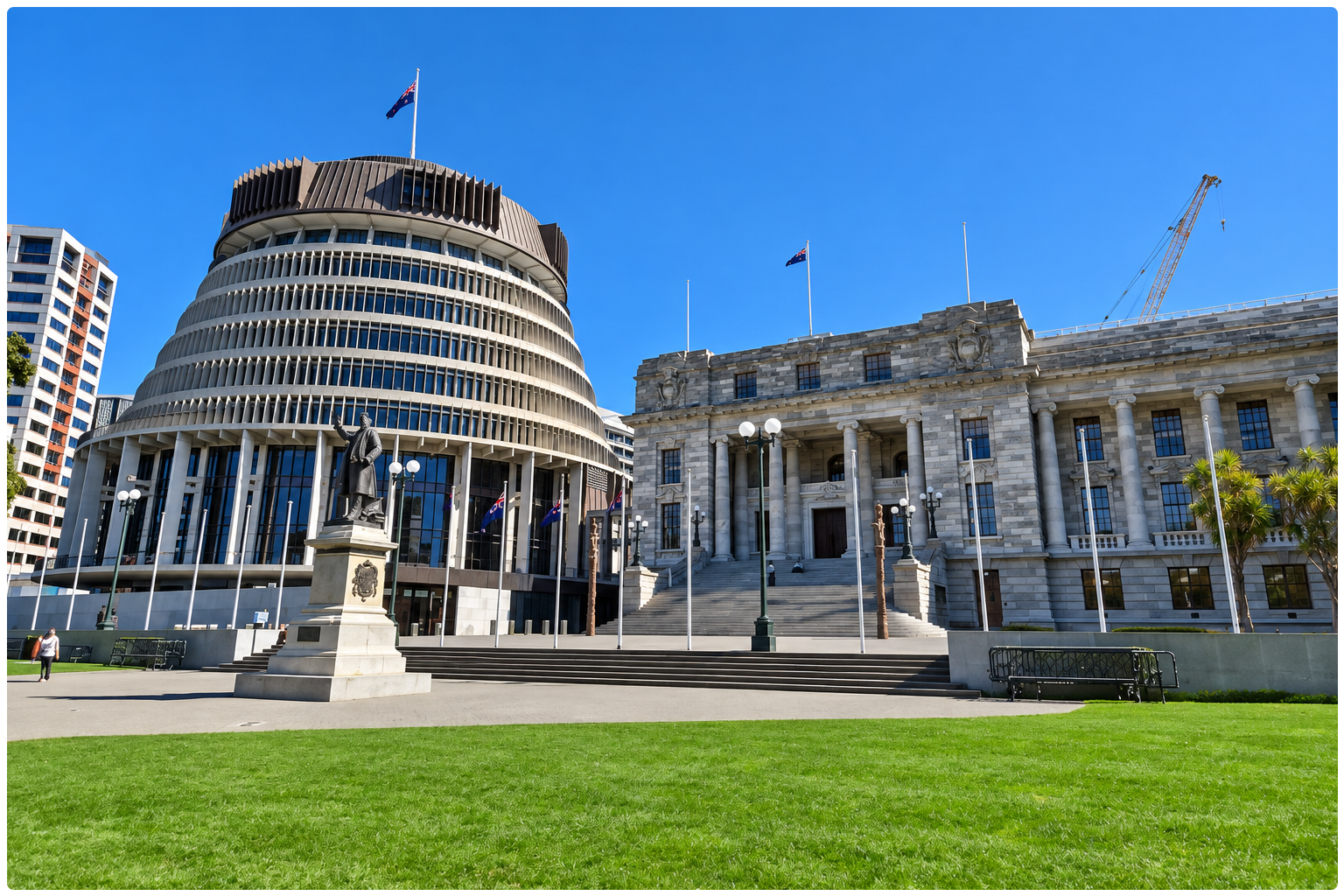
New Zealand’s Parliament has approved legislation to implement its free-trade agreement with India, clearing the biggest domestic hurdle before the deal can come into force and opening the way for sweeping tariff reductions on goods traded between the two countries. The legislation passed on September 16 by 93 votes to 29, with support from both the governing coalition and the opposition Labour Party. The deal was signed in New Delhi on April 27 and will enter into force once both countries complete their remaining ratification procedures and exchange formal notifications.
The tariff changes are substantial. From the first day the agreement takes effect, 57% of New Zealand’s exports to India will become duty-free, and over time tariffs will be eliminated or significantly reduced on around 95% of its current exports to the Indian market. New Zealand exporters of sheep meat, wool and several forestry products will receive immediate relief, while seafood tariffs will be phased out and apples and kiwifruit will gain preferential quota access. India, meanwhile, has secured 100% duty-free access for its exports to New Zealand across all tariff lines, benefiting sectors such as textiles, apparel, leather and footwear, engineering goods, automobiles and auto components, pharmaceuticals, chemicals, electronics, processed foods and gems and jewellery.
India has been much more cautious in opening its own market. New Delhi has offered concessions on roughly 70% of tariff lines while keeping nearly 30% excluded. Sensitive sectors including most dairy products, onions, pulses, sugar, almonds and several other agricultural products remain protected. Dairy was one of the most politically sensitive parts of the negotiations because New Zealand is a major dairy exporter, while India has long resisted opening the sector to large-scale foreign competition.
The agreement also goes well beyond goods. New Zealand has offered India market access across 118 service sectors and Most-Favoured-Nation commitments across 139 sub-sectors, potentially improving opportunities for Indian professionals in areas such as IT, engineering, healthcare, education and construction. The deal also includes provisions covering specialised service providers, including chefs and yoga instructors. Investment is another major pillar, with India pointing to a New Zealand investment commitment of $20 billion over 15 years. Both governments have also set a goal of doubling bilateral trade by 2030.
The trade relationship remains modest compared with India’s commerce with the United States, China or the European Union, but both governments see considerable room for expansion. For India, the FTA provides full duty-free access to a developed market while shielding politically sensitive agricultural sectors at home. For New Zealand, it offers deeper access to one of the world’s largest consumer markets. With Parliament’s vote, the agreement is now much closer to becoming operational.