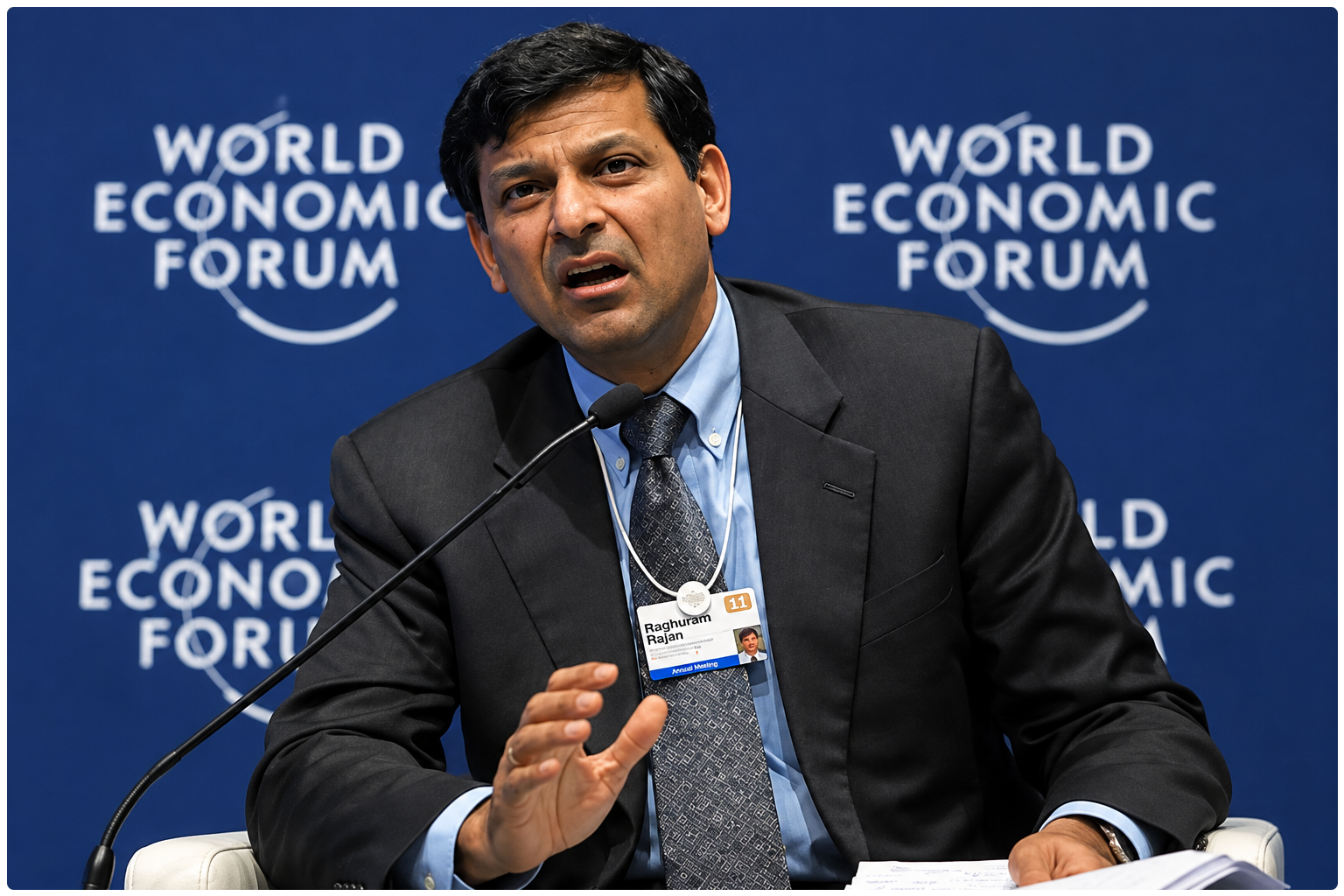
Former Reserve Bank of India governor Raghuram Rajan's questions over India's economic growth have triggered a wider public debate, drawing criticism from Zoho founder Sridhar Vembu and veteran journalist Sandipan Deb over the country's economic performance and the policies needed to create better-paying jobs.
The controversy followed the release of India's latest GDP figures, which showed the economy expanding 7.8% year-on-year in the April-June quarter of FY2026-27, above market expectations.
Rajan subsequently clarified that he had neither questioned nor endorsed the latest GDP figures. Instead, he said his broader concern was why India's strong headline growth had not been accompanied by similarly strong private investment, foreign direct investment and creation of quality jobs.
“If we are growing so fast, why are we not seeing more private investment? Why are we not seeing more FDI? Why are we not seeing more decent jobs?” Rajan asked. He said such questions should not be interpreted as a claim that the government's GDP calculations were incorrect.
The debate took an unusual turn when journalist Sandipan Deb, who attended IIT Delhi and IIM Ahmedabad around the same period as Rajan, criticised the former RBI governor's economic commentary.
Deb pointed to their IIT-JEE results, noting that Rajan secured All-India Rank 100 in 1980, while Deb ranked 218 and his wife ranked 76. He said the shared academic background gave him reason to be particularly disappointed with Rajan's recent economic views. The post subsequently attracted widespread attention on social media.
Separately, Zoho founder and chief scientist Sridhar Vembu challenged Rajan over a more fundamental question: how India should create high-paying jobs and develop its manufacturing capabilities.
Rajan had questioned India's industrial policy, including its push to develop a domestic semiconductor industry. He argued that many assembly and manufacturing jobs currently being created offer relatively low wages and questioned whether government subsidies directed towards selected industries represent the best use of public resources.
Vembu countered that India cannot simultaneously complain about low-paying manufacturing jobs while opposing the industrial policies required to move domestic companies into higher-value activities.
He argued that India's problem is not simply whether multinational companies employ Indian engineers or manufacture products in the country, but whether Indian companies own the technology and intellectual property behind those products.
Vembu used companies such as Nvidia and Microsoft to illustrate his argument. Both employ significant numbers of engineers in India, he said, but much of the economic value generated from their intellectual property ultimately accrues to their foreign parent companies rather than being captured within India's economy.
Vembu characterised Rajan's approach as influenced by the “Chicago School” of economics, associated with economists such as Milton Friedman and generally sceptical of governments attempting to direct industrial development.
Following such an approach, Vembu argued, could leave India resembling Mexico — a significant manufacturing base that nevertheless depends heavily on foreign technology and intellectual property — rather than economies such as Japan, South Korea, Taiwan and China, which used industrial policy to build domestic technological capabilities.
The dispute therefore goes beyond the latest GDP number. Rajan's central question is whether India's reported economic growth is translating sufficiently into investment and well-paying employment. Vembu's response is that achieving those outcomes requires India to actively build domestic manufacturing, technological know-how and intellectual property rather than relying predominantly on services exports or foreign-owned production.
The increasingly public debate reflects a larger argument over the next stage of India's development: whether the country should rely primarily on market-led allocation of capital or use industrial policy to deliberately build domestic capabilities in strategic sectors such as semiconductors, electronics and advanced manufacturing.