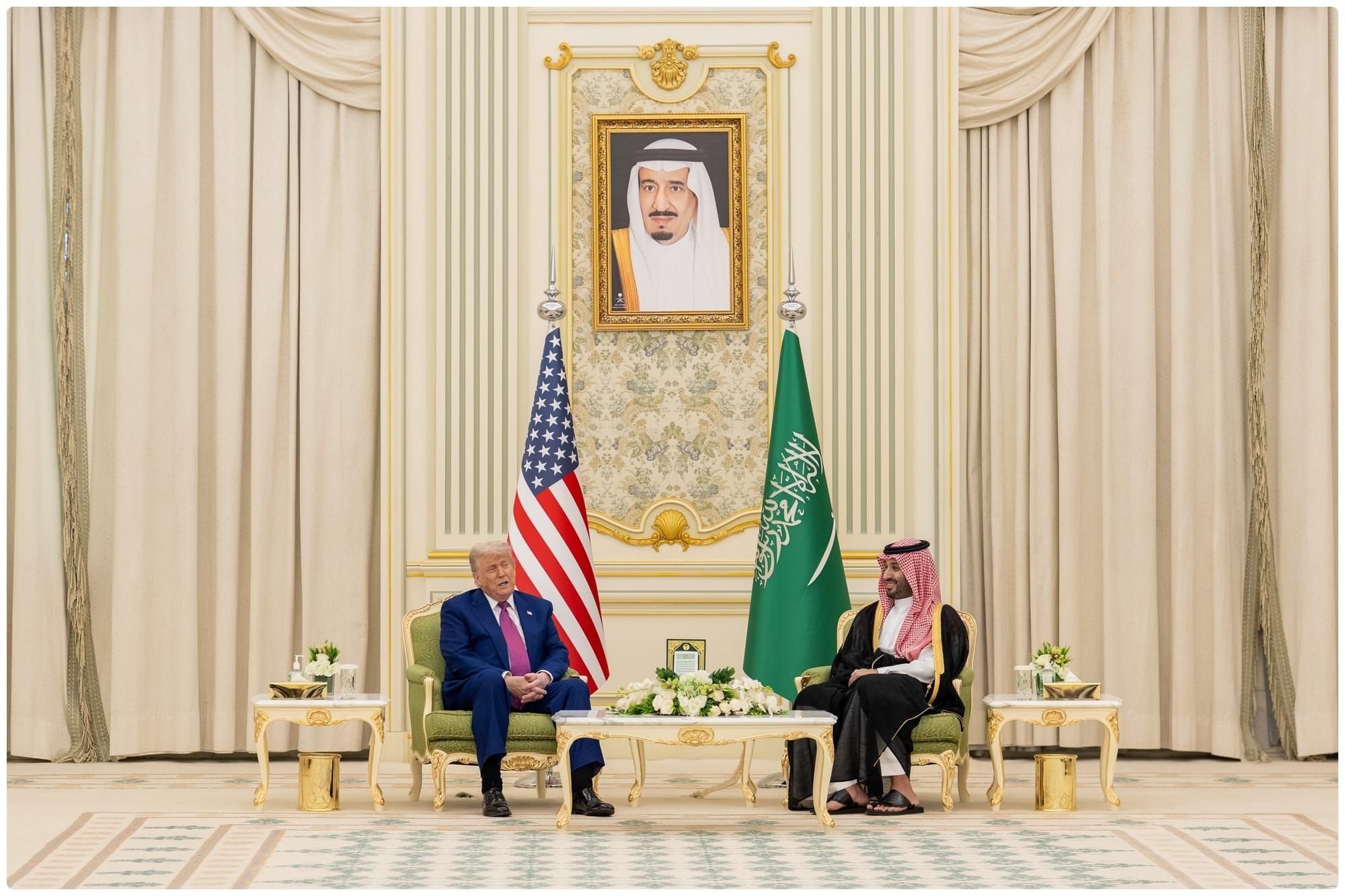
The United States has approved a potential $5 billion sale of bombs and precision-guidance equipment to Saudi Arabia as the continuing conflict with Iran places growing pressure on regional military stockpiles, energy markets and Washington's Gulf allies.
The US State Department cleared the proposed Foreign Military Sale on Friday, with the package including just over 10,000 extended-range Joint Direct Attack Munition, or JDAM-ER, guidance kits and a similar number of bombs.
The munitions include nearly equal numbers of 500-pound and 2,000-pound bombs that can be converted into precision-guided weapons using the JDAM kits. Boeing would be the principal contractor. The proposed transaction still requires the congressional notification process and its final value and quantities could change during negotiations.
Washington also approved a separate potential $750 million sale of 60 AGT-1500 engines used in Saudi Arabia's M1 Abrams tanks. Additional military sales announced for the region included F-16 sustainment services for Oman and helicopters for Iraq, bringing the value of the latest approvals to roughly $6.1 billion.
The Saudi package comes as months of conflict with Iran have increased demand for precision munitions across the Middle East. Riyadh's planned acquisition would significantly expand its stockpile at a time when Gulf states face continuing concerns over Iranian missiles and drones.
US President Donald Trump, however, has publicly played down the scale of Washington's confrontation with Tehran.
Trump described the fighting as “small potatoes” for the United States and stopped short of calling it a war. “I call it a military conflict because it's small potatoes for us,” he said, adding that the fighting was “very intermittent.”
His comments come despite six months of military operations that have killed 18 US service members and consumed substantial quantities of American missiles and other advanced weapons.
Concerns about those weapons stockpiles have also triggered an unusually aggressive leak investigation inside the Pentagon. Several dozen senior military and civilian officials, including US Central Command personnel and other combatant commanders, were subjected to polygraph examinations after classified information concerning American munitions inventories appeared in media reports.
CBS News reported that the mass testing was considered highly unusual. Officials said no one failed the questions designed to determine whether they had leaked the information. The investigation followed reports that the Iran conflict was rapidly consuming some of America's most sophisticated finite munitions.
While Trump has downplayed the current fighting, his administration is reportedly considering a much broader strategy for the region once the conflict ends.
Trump has told confidants he is working on “something much bigger” for the Middle East. Reported proposals include strengthening a regional alignment against Iran, expanding the Abraham Accords and ultimately pursuing normalisation between Saudi Arabia and Israel. The plans remain under development and their implementation would depend heavily on how the current conflict ends.
Iran, meanwhile, is confronting growing pressure at home.
President Masoud Pezeshkian has called for national unity as US sanctions and restrictions on Iranian oil exports deepen the country's economic difficulties. Washington announced what it called an “Economic D-Day” against Tehran last month, aimed at cutting economic lifelines supporting the Iranian government and Islamic Revolutionary Guard Corps.
“Through war, blockade and sanctions, the enemies seek to create division, fissures and unrest inside the country,” Pezeshkian told officials on Friday.
The Iranian rial has fallen to a record low of more than 2.25 million to the US dollar, while inflation, energy shortages and proposed changes to subsidised petrol prices are adding to domestic pressure. Iranian security officials have increasingly warned that the country's adversaries could seek to turn economic discontent into renewed anti-government protests.
The confrontation is also continuing to affect global energy markets. Brent crude settled at $95.63 a barrel on Wednesday amid renewed US-Iran strikes and concerns about shipping through the Strait of Hormuz. Analysts have warned that prices could move sustainably above $100 if another two to three million barrels of daily supply are removed from the market.
That poses a particular risk for India, which imports close to 90% of its crude requirements. Sustained oil prices around or above $100 could increase India's import bill, put downward pressure on the rupee and eventually feed into transport costs and broader inflation.
The combination of new weapons sales, depleted military stockpiles, tougher sanctions and volatile oil markets shows that even as Trump publicly describes the Iran conflict as relatively limited, its military and economic consequences are spreading well beyond the immediate battlefield.