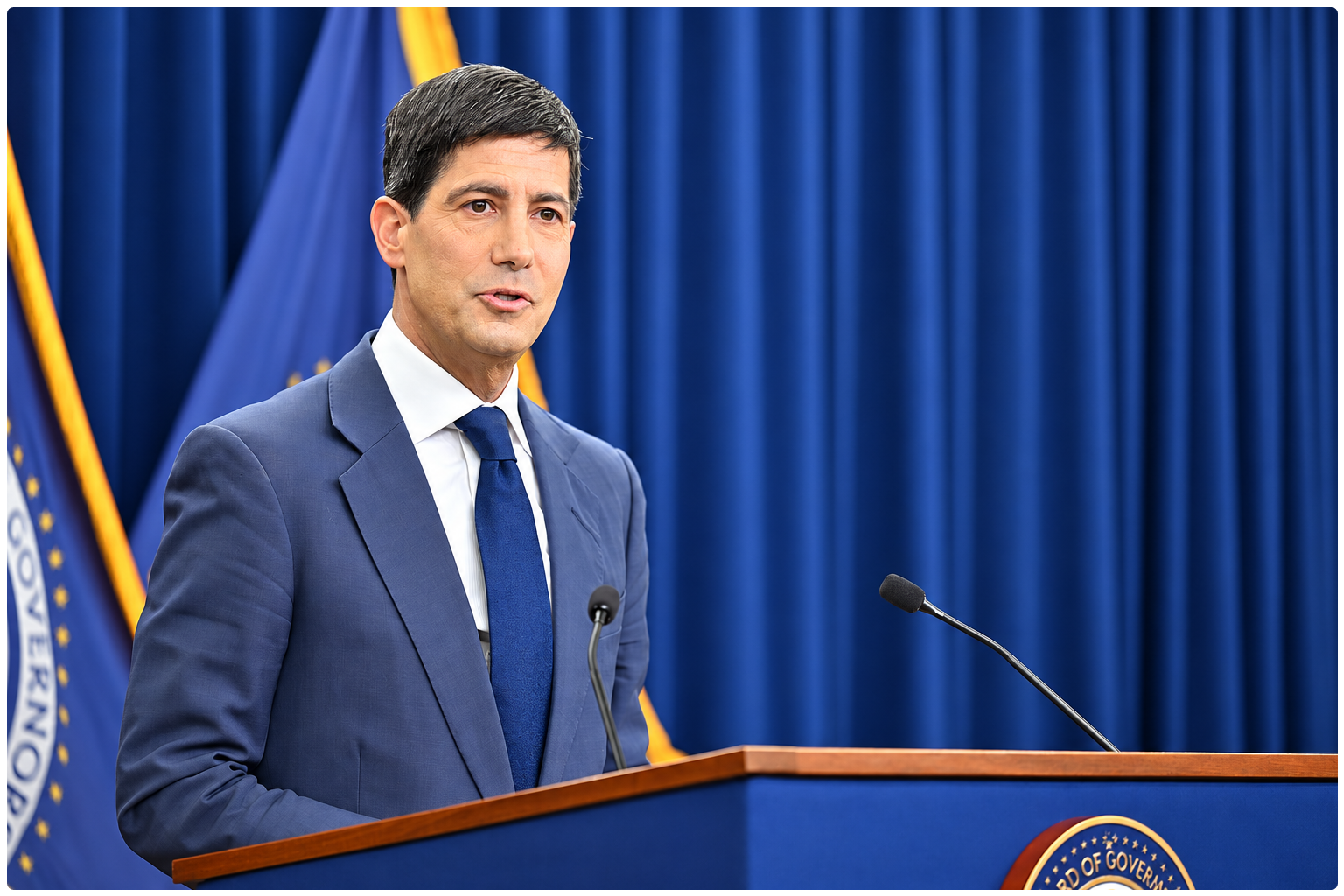
Five months ago, Federal Reserve Chair Kevin Warsh would have struggled to imagine the global economy holding up as well as it has. Energy prices have surged, borrowing has become more expensive and geopolitical conflicts have disrupted trade, yet economic activity across much of the world has continued to grow.
Warsh acknowledged his surprise during a discussion with International Monetary Fund Managing Director Kristalina Georgieva in Bangkok on Friday, October 16. After meeting central bankers attending the IMF-World Bank annual meetings, he said economic resilience was evident across countries confronting many of the same pressures.
The optimism comes with an uncomfortable complication for policymakers. Economies have proved capable of absorbing successive shocks, but inflation has remained stubbornly high. Warsh described rising prices as a common challenge that has prompted central banks to tighten monetary policy across much of the world.
The IMF's latest World Economic Outlook projections offer a measure of that resilience. Global output is expected to expand by 3.1% in 2026 and 3.4% in 2027, despite the disruption caused by the Middle East conflict and higher energy costs.
Those forecasts conceal considerable differences between economies. Countries benefiting from technology investment and strong export demand have continued expanding, while energy-dependent and lower-income nations face considerably greater pressure. IMF Managing Director Kristalina Georgieva warned earlier this week that governments are exhausting the financial and energy reserves that helped cushion earlier shocks.
Warsh sees particular strength in American business investment. Although artificial intelligence has attracted much of the attention, he indicated that capital spending is spreading beyond the technology sector, giving the US economy a broader source of momentum.
He also sees AI as a potentially powerful driver of productivity. Companies are already investing heavily in the equipment and infrastructure required to develop the technology, while the full benefits to efficiency, employment and production remain uncertain.
For the Federal Reserve, such investment strength is encouraging, but it does not eliminate the need to control prices.
The central bank raised its benchmark interest-rate range by 0.25 percentage points in September to 3.75%–4.00%, its first increase in three years. Warsh reiterated the commitment to price stability in Bangkok without indicating whether another increase would follow later this month.
The latest US inflation figures provide little room for complacency. Consumer prices rose 3.7% over the year to September, accelerating from 3.4% in August. Gasoline prices alone increased 9.1% during the month, reflecting the continuing economic cost of expensive energy.
Warsh's remarks were therefore more reassuring about the economy's capacity to withstand pressure than about the outlook for interest rates. Growth has continued despite higher borrowing costs, leaving the Fed to determine how much further it must tighten monetary policy to contain inflation.