For decades, the world's most accurate clocks have relied on the behaviour of electrons surrounding atoms. Now, scientists have demonstrated that an even smaller part of matter, the atomic nucleus, can serve as the foundation of a working clock. The achievement could eventually transform how precisely humanity measures time and offer physicists a new way to investigate the fundamental laws of nature.
Two independent research teams, working in Austria and China, reported the first operational nuclear clocks in separate papers published in Nature on October 7, 2026. The European team's experiment and the Chinese team's independent demonstration represent the culmination of decades of research into an unusual property of thorium-229, a radioactive isotope whose nucleus can be excited using laser light.
Conventional atomic clocks measure time by tracking transitions between energy levels of electrons. These transitions occur at extraordinarily consistent frequencies, allowing modern optical atomic clocks to achieve remarkable precision. Nuclear clocks apply the same principle to energy transitions within the nucleus, where protons and neutrons are held together by the strong nuclear force.
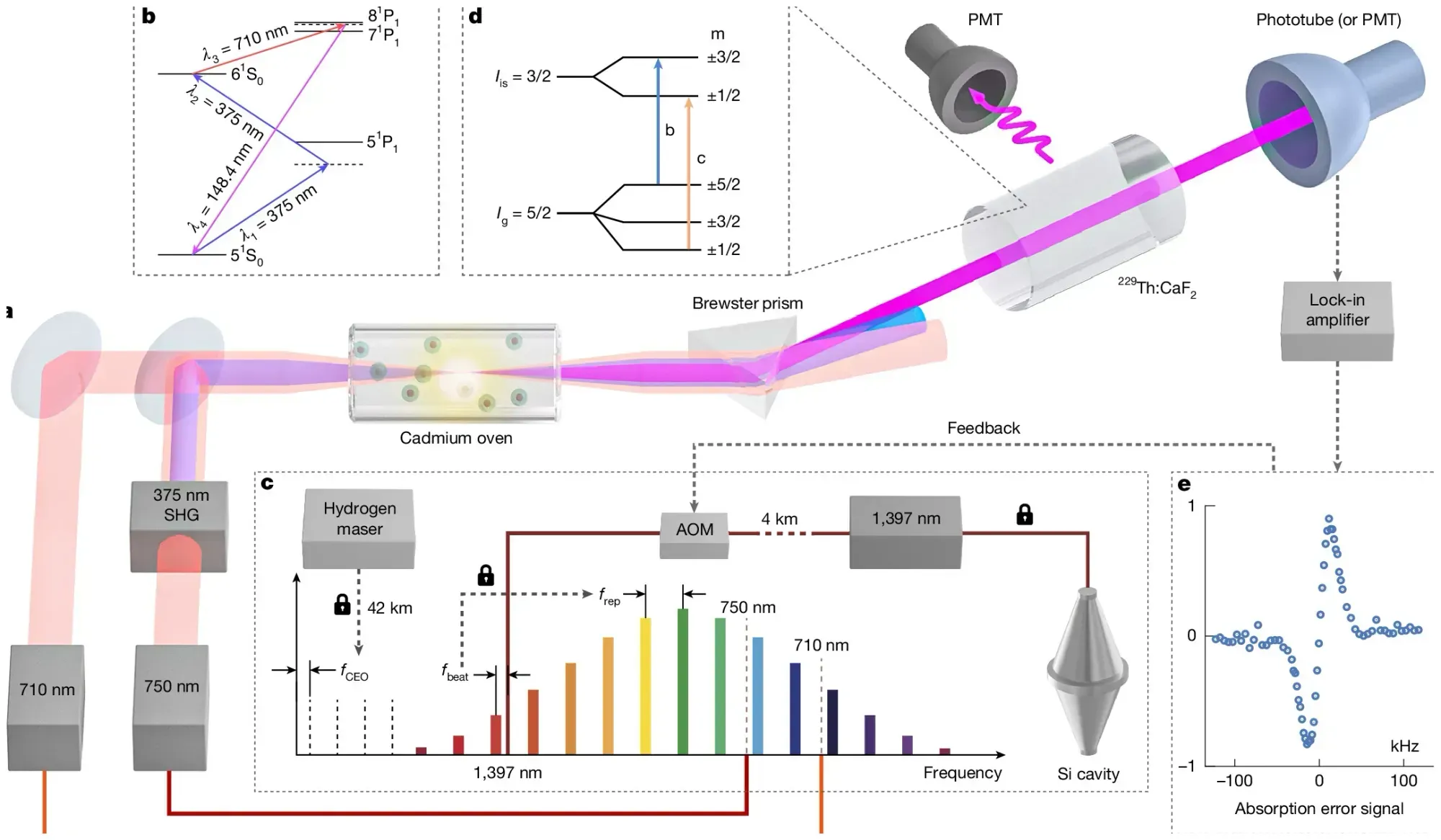
The difficulty is that most nuclear transitions require far more energy than conventional lasers can deliver. Thorium-229 is an exceptional case. Its nucleus possesses two energy states separated by an unusually small gap of approximately 8.4 electron volts, corresponding to ultraviolet light with a wavelength near 148 nanometres.
Physicists Ekkehard Peik and Christian Tamm proposed exploiting this property for nuclear timekeeping in 2003. Subsequent experiments gradually established the transition's energy, and researchers achieved direct laser excitation of thorium nuclei in 2024. But observing a nuclear transition was not the same as building a clock that could continuously regulate itself.
That distinction makes the latest experiments important.
At TU Wien in Austria, researchers working with collaborators including Germany's Physikalisch-Technische Bundesanstalt embedded thorium-229 nuclei inside a calcium fluoride crystal. They directed ultraviolet laser light through the material and measured how the nuclei absorbed it. The resulting signal allowed an automated feedback system to correct the laser's frequency, keeping it aligned with the nuclear transition.
The clock operated for more than 24 hours, demonstrating that nuclear transitions could provide a sustained frequency reference rather than merely an experimental measurement.
Meanwhile, researchers in Beijing developed a separate nuclear clock using a different laser system and thorium-containing crystals. Their device also successfully stabilised laser frequency against a nuclear transition. The independent demonstrations strengthen confidence that nuclear clocks can be realised using different experimental designs.
Neither device has yet surpassed the world's best optical atomic clocks. The researchers still need to improve stability, reduce measurement uncertainties and develop more practical systems before nuclear clocks can compete as everyday precision standards.
Their scientific value, however, extends beyond timekeeping. Because thorium's nuclear transition depends on fundamental physical interactions, exceptionally precise measurements could reveal whether certain physical constants change over time or respond to hypothetical dark matter.
The Vienna researchers have already used their clock to search for fluctuations associated with ultralight dark matter. They found no evidence of such a signal, but demonstrated that the instrument could place meaningful constraints on theoretical models. The work illustrates how precision instruments can illuminate questions in fundamental physics, much as other experimental methods are expanding our understanding of the universe, including new techniques for studying distant planets.
For now, nuclear clocks remain laboratory prototypes rather than replacements for established atomic clocks. Their significance lies in something more fundamental: scientists have turned a transition inside an atomic nucleus into a functioning reference for time, creating a new instrument with which to measure the universe.