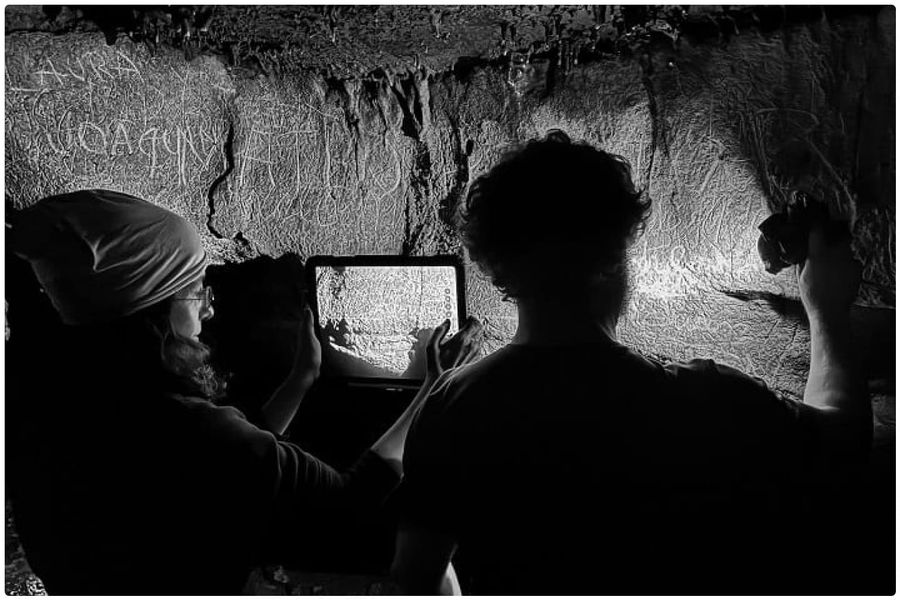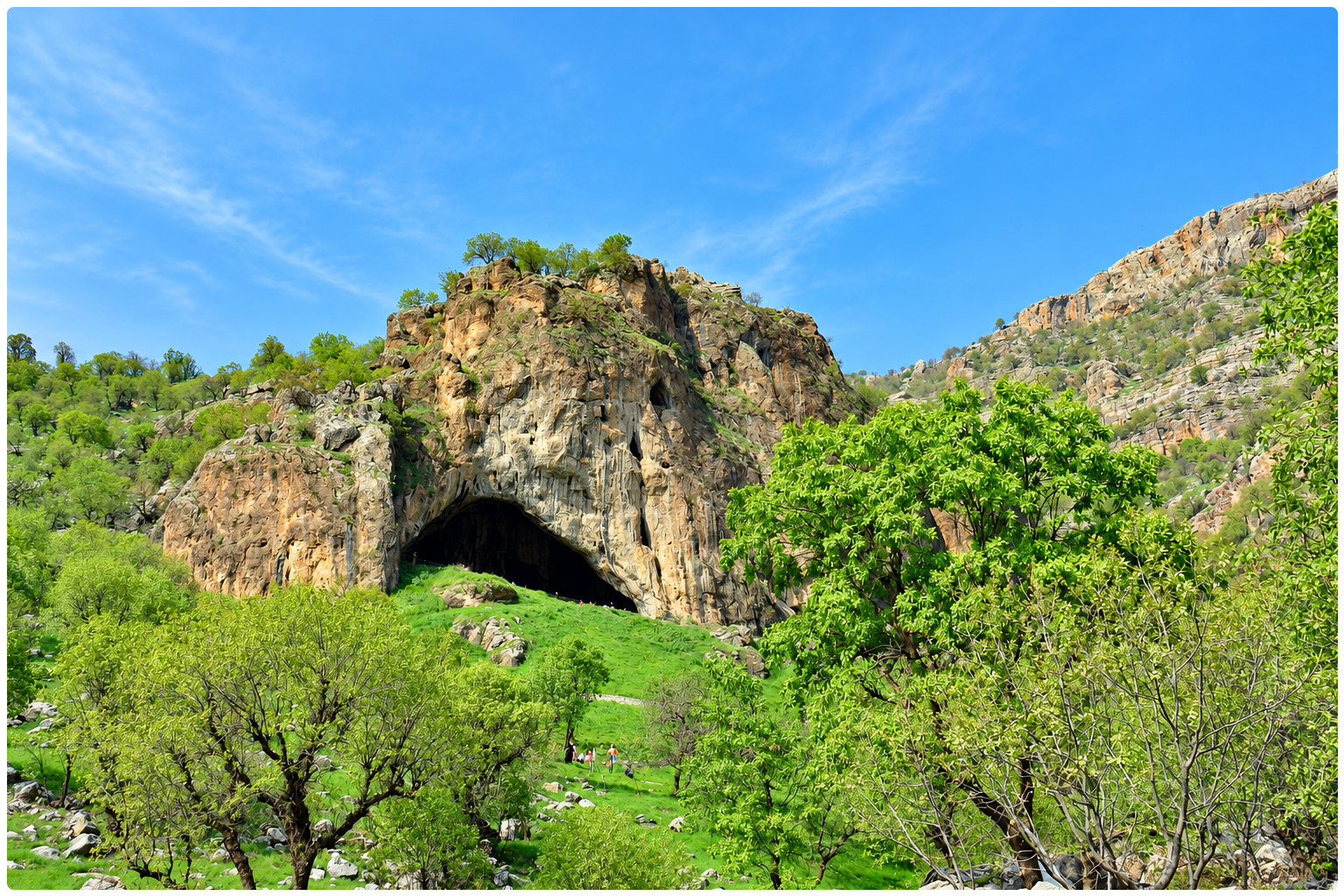
A small, almost perfectly circular hole in an ancient shoulder blade may preserve evidence of a killing that took place 75,000 years ago. The bone belonged to a Neanderthal who lived in the mountains of what is now northern Iraq. Although the weapon has long since disappeared, the injury it may have caused has survived.
The remains were recovered from Shanidar Cave, an archaeological site in Iraqi Kurdistan that has transformed scientific understanding of Neanderthal life. Researchers believe the individual, designated Shanidar A, may have died after being struck by a sharpened wooden spear, potentially providing one of the earliest examples of lethal violence involving such a weapon in the human fossil record.
Yet the same skeleton tells another story. Long before the suspected fatal injury, this Neanderthal survived severe damage to the front teeth and possibly the jaw, an ordeal that may have required assistance from others.
The findings, published in Scientific Reports on 15 October 2026, present evidence of both possible violence and care within a prehistoric community.
Led by Emma Pomeroy of the University of Cambridge, the international research team examined skeletal remains excavated in 2019 and 2022. They included an exceptionally well-preserved left shoulder blade, several ribs, bones from the right hand and teeth. Dental wear suggested the individual was approximately 45 years old, relatively old by Neanderthal standards.
The shoulder blade contained a perforation measuring about 15 millimetres across. Researchers used microscopy and three-dimensional micro-CT scans to examine its shape, surrounding fractures and fragments of bone displaced beneath it.
The results suggested a penetrating injury inflicted around the time of death. The hole's rounded outline was particularly significant: experiments involving prehistoric weapons have shown that sharpened wooden spears can produce circular punctures, whereas stone-tipped weapons often leave more angular damage.
75,000 years ago, in Shanidar Cave in Iraqi Kurdistan, a Neanderthal died with a spear through the chest. The evidence is a hole in the left shoulder blade. Almost perfectly round, 15 millimeters wide, beveled on the back like an exit wound. Chips of bone from that hole still lay in the soil beneath it. A stone point leaves an angular hole. This one matches a sharpened wooden spear, making it the oldest known wound of its kind. The same person, around 45, had already survived a blow to the face that split a front tooth in half. They lived on for at least a year, almost certainly fed and helped by others. After death they were placed behind a great boulder. In the years that followed, four more Neanderthals were laid in that same small space. Cared for in life. Speared in death. Buried among their own. Hunting accident or murder? The researchers leave that question open. The fatal wound of Shanidar A, a Neanderthal from Shanidar Cave, Iraqi Kurdistan, about 75,000 years old. A 3D micro-CT rendering of the hole in the shoulder blade, with bone fragments still embedded in the soil beneath it. 3D rendering by T. Van-Parys and E. Pomeroy, Pomeroy et al., Scientific Reports (2026), CC BY 4.0
— Ancient Content (@HistContent) October 16, 2026
The direction of the fracture also suggested that the weapon entered from the front and passed through the chest. Such a trajectory could have damaged a lung and major blood vessels, causing rapid death.
As the University of Cambridge's account of the discovery explains, the evidence raises the possibility of deliberate violence. Nevertheless, the researchers cannot determine whether the injury resulted from an attack or an accident, and no weapon was recovered.
The individual's teeth provide a different kind of evidence. Several were severely damaged or displaced, including an incisor that had split lengthwise. Mineral deposits and subsequent wear showed that the Neanderthal survived the earlier injury for a considerable period, probably at least a year.
Eating with such extensive dental damage would have been difficult. The researchers suggest that assistance from other group members may have helped the individual survive, although direct evidence of caregiving is unavailable.
The burial context offers further clues. Shanidar A was found within a small area containing the remains of at least four other Neanderthals, deposited over separate occasions near a prominent rock formation. The repeated use of this location strengthens the possibility that Neanderthals intentionally placed their dead in particular areas.
Shanidar Cave has been central to this debate since excavations in the 1950s and 1960s uncovered individuals with severe disabilities and the remains associated with the famous, though disputed, Neanderthal flower burial.
The new findings add to a growing understanding of Neanderthal behaviour, but they do not establish murder, organised warfare or formal burial rituals.
Instead, they reveal how much can be learned from a handful of surviving bones. The same individual may have experienced devastating violence and prolonged dependence on others, two experiences often treated as defining features of human societies.
What happened during Shanidar A's final moments remains unknowable. The fossils preserve traces of injury and survival, but the circumstances that connected them have disappeared with the people who lived through them.