Two million years ago, the landscape of southern Africa was home to more than one kind of ancient human relative. Some were developing the physical characteristics that would eventually distinguish our own evolutionary lineage. Others were evolving powerful jaws and enormous teeth, following a different path to survival.
A collection of fossils from South Africa is now offering a clearer picture of that distant world, including new evidence that Homo erectus, one of the most important species in human evolution, was already present around two million years ago.
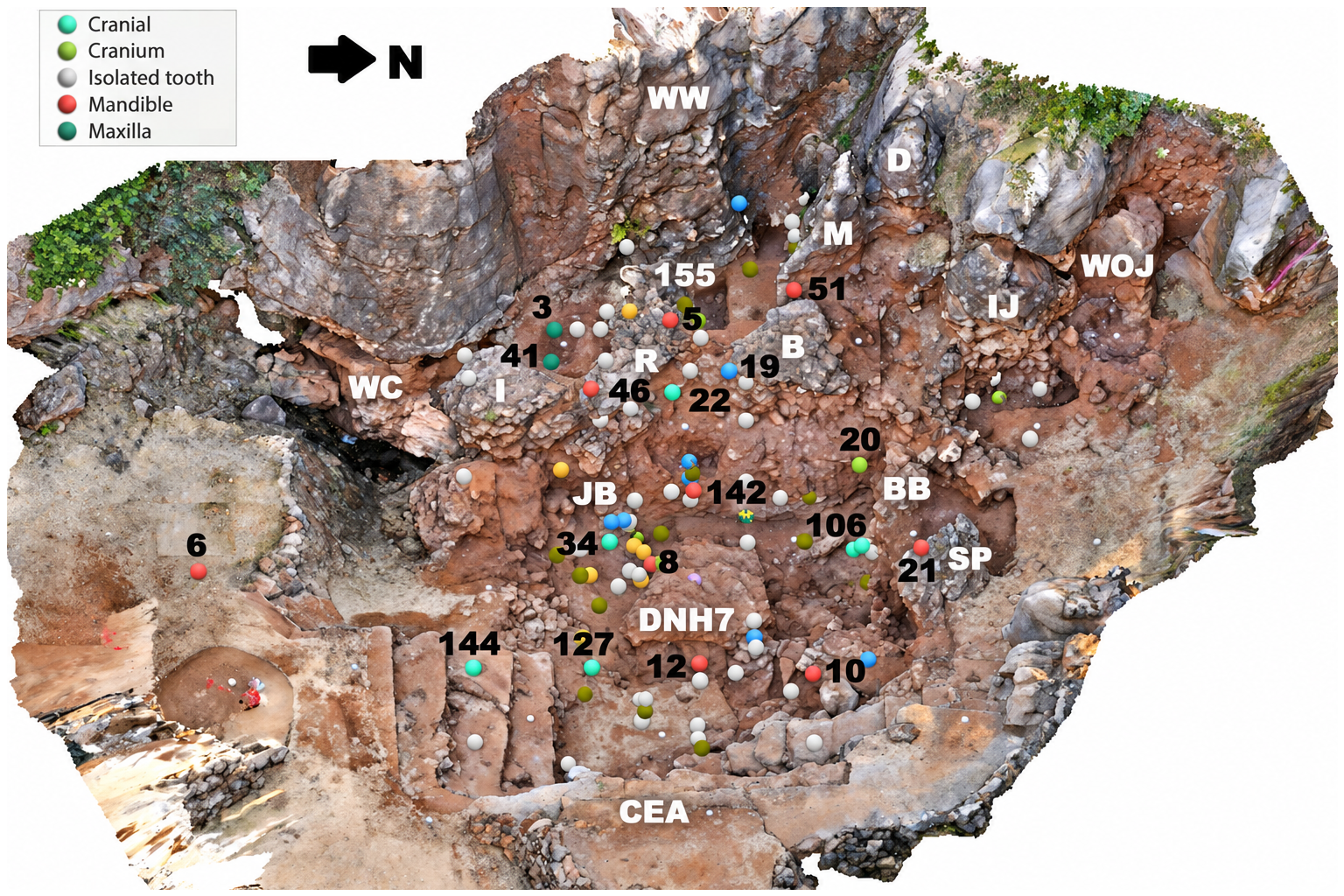
The findings, published in Annals of Human Biology on 25 September 2026, come from Drimolen Main Quarry, a fossil-rich cave site within South Africa's UNESCO-listed Cradle of Humankind. Researchers examined 18 previously undescribed fossils recovered between 1992 and 2019, some of which had remained scientifically unpublished for more than three decades.
Among them was a fragment of an adult skull, catalogued as DNH 127, which researchers identified as belonging to Homo erectus. Its importance lies in what it adds to an earlier discovery.
In 2020, researchers had reported another Homo erectus skull from Drimolen, DNH 134, dating to approximately 2.04 million years ago. That specimen belonged to a child estimated to have been between two and four years old. Because juvenile skulls can differ considerably from adult skulls, questions remained about how confidently the fossil could be assigned to the species.
The newly described adult fragment provides independent anatomical support for that identification. Together, the specimens strengthen the case that Homo erectus inhabited southern Africa between approximately 2.04 and 1.95 million years ago, earlier than the roughly 1.8-million-year-old adult fossils known from places such as Dmanisi in Georgia.
The study does not establish precisely when or where Homo erectus first evolved. But it reinforces the possibility that the species emerged earlier than much of the better-preserved fossil record had suggested.
A new 2 million-year-old adult Homo erectus fossil confirms that our ancestors were in South Africa 200,000 years before anywhere elsewhere. https://t.co/B31UEJvDLn https://t.co/3kANUkY81J
— IFLScience (@IFLScience) October 8, 2026
The research, led by Jesse Martin of Australia's La Trobe University, involved scientists from South Africa and the United States. Rather than relying on a new genetic test, the team examined the preserved anatomy of skull and jaw fragments, comparing their shapes and measurements with fossils from other ancient populations.
The results revealed another important story.
Of the 18 fossils, 14 were assigned to Paranthropus robustus, an extinct human relative that occupied the same region as Homo erectus. Three could not be confidently assigned to a particular genus or species.
Unlike Homo erectus, which is associated with evolutionary trends towards larger brains and reduced molar size, Paranthropus robustus possessed exceptionally large chewing teeth and powerful jaws.
Comparisons between fossils from Drimolen and the younger Swartkrans deposits suggest that P. robustus underwent gradual anatomical changes over approximately 200,000 years. Later populations developed larger teeth and more substantial chewing structures, potentially reflecting adaptation to changing environmental conditions.
These findings support the idea that evolution was not a single progression towards modern humans. Different hominin populations lived alongside one another, developing distinct anatomical adaptations as environments changed.
There are still important uncertainties. The newly described Homo erectus fossil is fragmentary, and its age comes from the established geological dating of the site rather than a new direct measurement of the bone. The evolutionary relationships among early Homo populations also remain debated.
Nevertheless, Drimolen preserves something unusually valuable: evidence of different human relatives living in the same ancient landscape. Their fossils reveal that the history of humanity was shaped not by one inevitable evolutionary journey, but by several competing and overlapping possibilities.