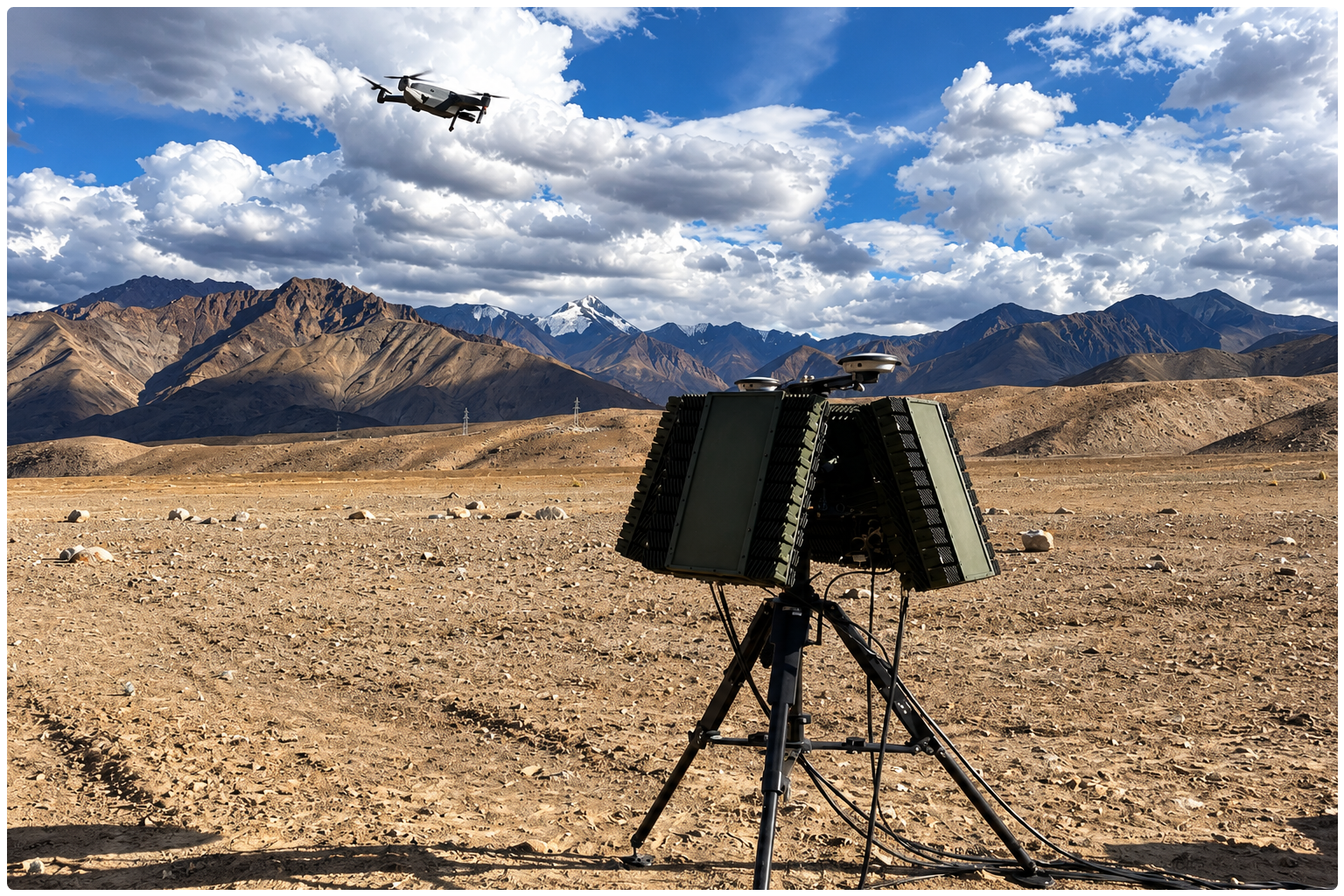
India's effort to strengthen its defences against small, low-flying drones has received a fresh procurement commitment, with the Ministry of Defence signing a contract worth approximately ₹770 crore with Bharat Electronics Limited (BEL) for improved surveillance radars for the Indian Army.
The agreement, signed in New Delhi on October 21 in the presence of Defence Secretary Rajesh Kumar Singh, covers the Improved Low Level Light Weight Radar (LLLR-I). According to the Ministry of Defence's official announcement, the system is designed to detect and track fighter-sized aircraft as well as mini and micro drones, with the additional ability to prioritise aerial targets.
BREAKING 🇮🇳 A Major Boost to India’s Defence Capabilities! The Ministry of Defence has signed a ₹770 crore contract with Bharat Electronics Limited (BEL) for the supply of Improved Low Level Light Weight Radar systems to the Indian Army. Equipped with advanced pulse-Doppler technology, these lightweight and transportable radar systems are designed to detect and track fighter-sized targets and mini drones, strengthening surveillance and enhancing situational awareness across plains, deserts and high-altitude areas. This strategic acquisition will further strengthen the Indian Army’s counter-drone capabilities while advancing indigenous defence manufacturing and reducing dependence on foreign technology. It reflects India’s commitment to modernising its Armed Forces through innovation, technological advancement and self-reliance. From advanced radar technology to a stronger, more self-reliant defence ecosystem, India is steadily advancing towards Viksit Bharat @2047. 🚀 @adgpi #IndianArmy #MinistryOfDefence #BharatElectronics #BEL #AatmanirbharBharat #MakeInIndia #DefenceModernisation #CounterDrone #RadarTechnology #DefenceManufacturing #IndianDefence #ViksitBharat2047 #JaiHind 🇮🇳
— Ravindra Sanyal (@Col_Sanyal) October 22, 2026
The Army's requirement reflects a problem that has become increasingly apparent in modern conflicts. Small unmanned aircraft can operate at low altitudes, where terrain and the curvature of the Earth restrict the coverage of conventional surveillance radars. Their relatively small radar signatures also make them harder to detect and distinguish from background clutter.
The LLLR-I is intended to strengthen surveillance in this difficult part of the airspace. Its ability to prioritise detected targets could help air-defence personnel distinguish more urgent threats when several aircraft or drones are present simultaneously.
India's operational experience has reinforced the demand for such equipment. During the May 2025 military confrontation with Pakistan, Indian authorities reported attempted drone and missile attacks against military installations across northern and western India. The government's subsequent assessment of Operation Sindoor described the use of integrated counter-unmanned aerial systems, electronic warfare equipment and layered air-defence weapons to respond to those threats.
The Army had already been evaluating comparable capabilities. In May 2025, the Defence Ministry announced field demonstrations involving low-level lightweight radars, integrated drone detection and interdiction systems, and other counter-drone technologies under simulated operational conditions.
BEL's latest contract also follows a separate ₹1,950-crore agreement signed in March 2026 to supply two indigenous mountain radars to the Indian Air Force. Those systems, developed by the Defence Research and Development Organisation's Electronics and Radar Development Establishment, are intended to improve air surveillance in mountainous terrain. The earlier procurement illustrates the wider investment in domestically produced radar technology across India's armed forces.
The new Army radars will contribute to the detection and tracking component of air defence, but they are not interception weapons. Their effectiveness against hostile drones will also depend on their integration with command networks, electronic warfare systems and weapons capable of engaging identified threats.
The Defence Ministry has not disclosed how many LLLR-I units will be delivered, their technical detection ranges or the delivery schedule. The contract establishes a procurement commitment, while the operational improvement will depend on subsequent production, deployment and integration.