China is accelerating efforts to prepare humanoid robots for future warfare, with military researchers testing the machines for reconnaissance, logistics, infiltration and potentially direct combat alongside soldiers.
A Reuters investigation of more than 100 Chinese military procurement notices, academic studies, patents, official publications and defence-industry documents found that the People's Liberation Army has significantly expanded research into the military applications of humanoid robots since 2025.
The ambition was laid bare shortly after China's World Humanoid Robot Games last month, where machines competed in running, boxing, football and other events.
Two days after the competition ended, the PLA Daily called for technologies demonstrated in civilian laboratories to be transferred more rapidly to military training grounds, including the development of robotic “combatants.”
China's advantage is the enormous civilian robotics industry sitting behind its military ambitions. Chinese manufacturers accounted for an estimated 95% of global humanoid robot shipments in 2025, according to BofA Global Research.
The PLA is now examining how that industrial capacity could translate into battlefield capability.
One of the clearest indications came from researchers at the National University of Defense Technology, the PLA's leading military research university.
An August 2025 study modelled an urban assault in which six “combat robots,” including humanoids, robotic dogs and unmanned ground vehicles, accompanied soldiers into an enemy-held building. The machines would help assault teams clear the structure floor-by-floor and room-by-room.
Researchers estimated that the necessary technology could become available within five to 10 years.
The university has also conducted competitions specifically designed around military scenarios. One event required humanoid robots to simulate “infiltration behind enemy lines” by entering an area, mapping their surroundings and identifying targets.
PLA procurement documents point in the same direction.
The military issued a tender in May 2025 seeking to purchase a humanoid robot along with installation and technical training. Another procurement notice sought technology giving humanoids intelligent perception and dexterous manipulation capabilities.
In June this year, the PLA budgeted roughly $300,000 for a system capable of collecting and labelling camera, radar and movement data to train humanoid robots to navigate different terrain.
China's state-owned defence industry is also entering the field.
Norinco has developed a full-sized humanoid called Fuxi that the company says can perform sentry duty, reconnaissance, intelligent patrols and dangerous missions. The robot can be remotely operated by a human, potentially allowing it to perform hazardous tasks without giving an autonomous machine complete control over its decisions.
But China's robotic warfare programme already extends beyond humanoids.
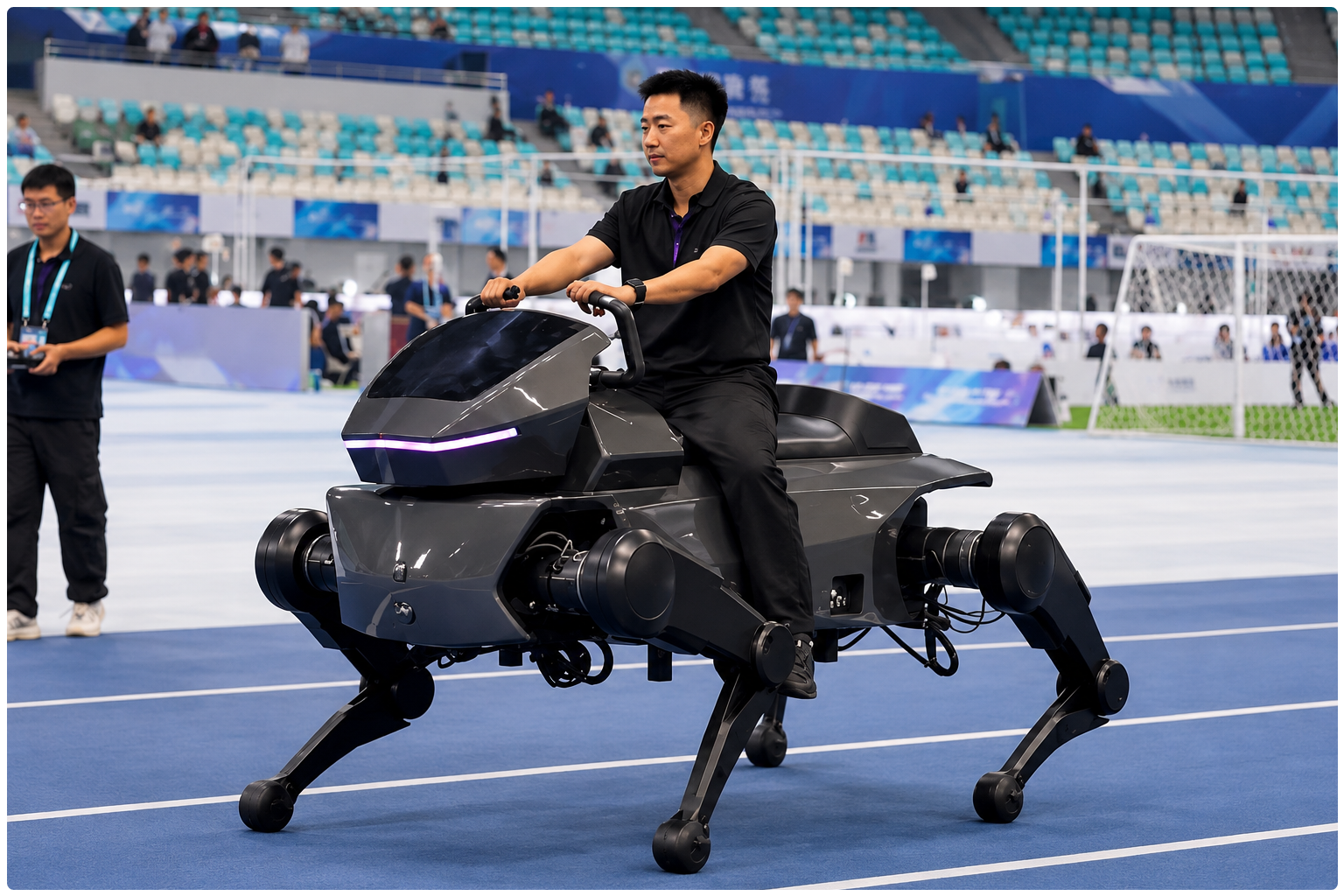
The PLA has publicly demonstrated armed quadrupedal machines known as “robot wolves.” Different versions are designed for reconnaissance, carrying supplies and attacking targets. China's Defence Ministry says newer variants can carry grenade launchers and micro-missile systems, autonomously identify and aim at targets, while leaving the final decision to fire to a human operator.
The PLA has also incorporated robotic dogs, unmanned vehicles, heavy-lift drones and exoskeletons into military exercises for reconnaissance, transportation, medical assistance and casualty evacuation.
Humanoid robots, however, present significantly greater technical challenges.
Current machines consume large amounts of energy, struggle with endurance and can remain unreliable outside controlled environments. Mud, rubble, damaged buildings, electronic warfare and unpredictable human behaviour create conditions vastly more difficult than robot demonstrations.
There are also serious questions surrounding autonomous lethal force. International humanitarian law requires combatants to distinguish civilians from military targets and recognise surrendering or wounded fighters.
China's Defence Ministry said earlier this year that AI-powered weapons should remain under human control.
For now, there is no evidence that an armed humanoid robot has been deployed with an operational PLA unit.
But Chinese military thinking is already looking beyond support roles. A PLA Daily commentary in 2025 argued that humanoids could eventually evolve “from supporting combat toward primary combat,” including situations where a robot could fire after a human verified the target.
China is not alone. The US Army has launched its own programme seeking “militarized humanoid capabilities” for reconnaissance, security, obstacle clearance, hazardous environments and potentially offensive and defensive operations.
What distinguishes China is the scale of the industrial base behind the effort.
The war in Ukraine has already demonstrated how drones and unmanned ground systems can transform reconnaissance, logistics and attacks while reducing the exposure of soldiers. The PLA has closely studied those lessons.
The next step China is preparing for is bringing increasingly sophisticated robots onto the ground alongside human troops and eventually giving some of them a much larger role in combat.