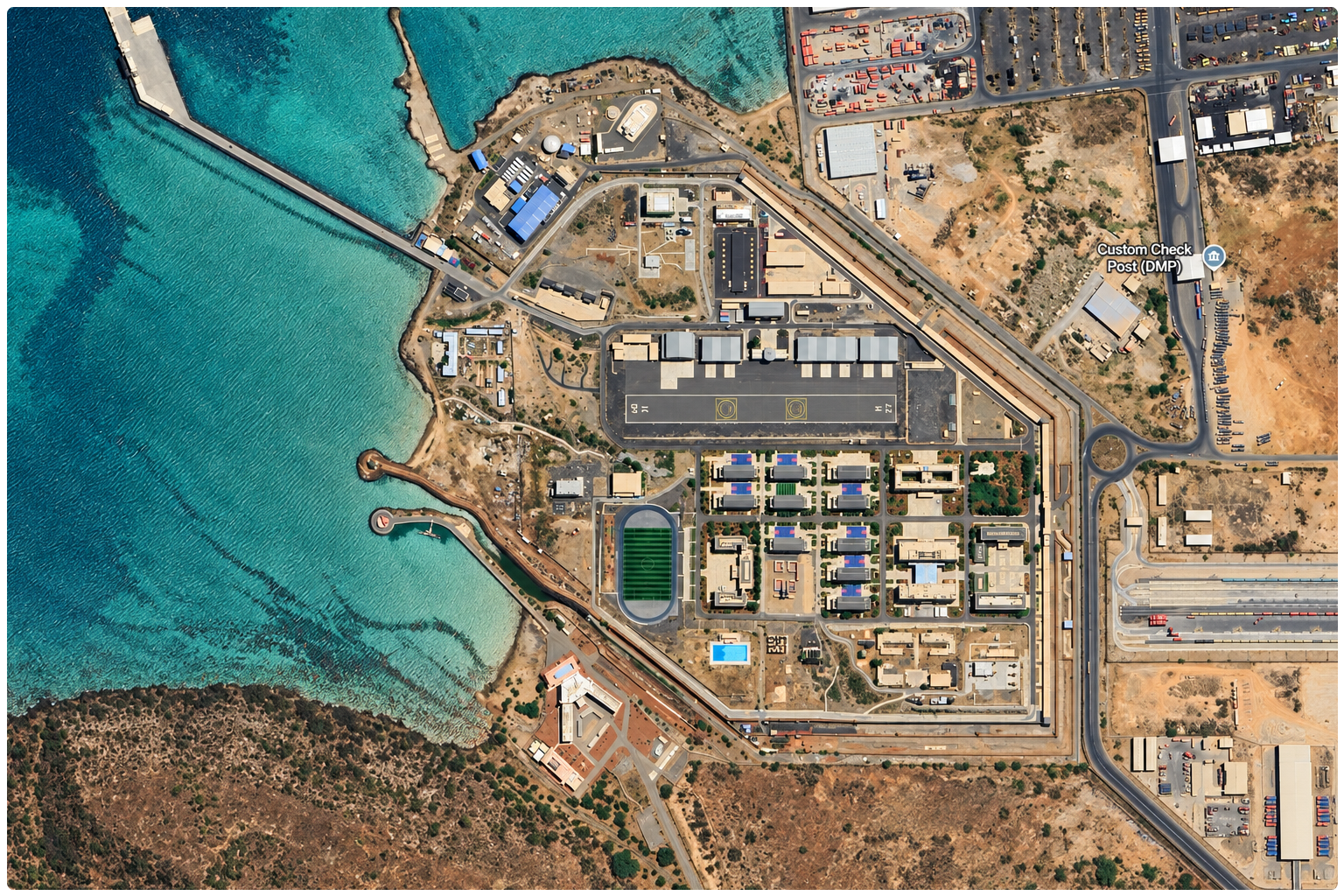
China has significantly upgraded its military base in Djibouti with new communications and surveillance infrastructure that could expand Beijing’s ability to monitor military activity across the Red Sea, Gulf of Aden, Middle East and East Africa.
Commercial satellite imagery analysed by the Center for Strategic and International Studies shows that two new communications compounds have been built at the People’s Liberation Army Support Base since mid-2024. The facilities include high-frequency antennas, very- and ultra-high-frequency equipment, satellite communications dishes, probable 5G towers and radomes housing unidentified systems. CSIS assesses that the equipment is likely part of a broader command, communications, intelligence, surveillance and reconnaissance network.
The upgrades could allow the PLA to maintain more reliable long-range communications with Chinese ships and aircraft operating far from home while also improving its ability to collect signals intelligence. CSIS said the equipment may allow China to detect and analyse military signals across a broad region, although there is no public evidence proving that Beijing is currently intercepting the communications of foreign militaries.
The location makes those capabilities particularly significant. Djibouti sits beside the Bab el-Mandeb Strait, the narrow passage connecting the Red Sea with the Gulf of Aden and one of the world’s most important maritime chokepoints. CSIS estimates that around 16% of global maritime trade passes through the area. The country also hosts military bases operated by the United States, France, Italy and Japan, all within roughly 10 miles of the Chinese facility.
China opened the Djibouti base in 2017, officially describing it as a support facility for anti-piracy missions, peacekeeping, humanitarian operations and naval escorts. It remains China’s only formally acknowledged overseas military base and has become an important logistical hub for People’s Liberation Army Navy operations in the Gulf of Aden and waters off Somalia. Chinese naval task forces continue to use the facility for resupply and mission handovers.
Its strategic value has grown sharply as the Red Sea and surrounding region have become increasingly militarised. Houthi attacks, fighting involving Iran, Saudi Arabia and the United States, and the deployment of large numbers of American warships and aircraft have turned the area into one of the most heavily watched military theatres in the world. CSIS noted that by July more than 20 US Navy vessels, including two carrier strike groups, were operating in the wider region.
The new communications infrastructure also fits China’s broader push to conduct what the PLA calls “far seas” operations, allowing its navy to operate for longer periods far beyond the western Pacific. A stronger Djibouti base gives Beijing not only logistical support but potentially a much clearer picture of military movements around Africa and the Middle East.
The development does not mean China has publicly changed the stated mission of the base. Beijing continues to describe it primarily as a support facility. But the physical changes suggest its role is becoming more sophisticated.
At a time when control of shipping routes, energy corridors and military intelligence around the Red Sea is becoming increasingly important, China’s only acknowledged overseas base is evolving into a much more capable strategic outpost.