In death, as in life, Tukaram Ombale gave Mumbai something to hold onto.

It was a little past midnight on November 27, 2008, when a white Skoda came speeding down the Marine Drive, headlights blazing, its wipers running to make it harder for anyone outside to see in.

Mumbai had already been under attack for nearly two hours.

Ten men had come ashore near Colaba a few hours earlier, split into pairs and headed towards their targets: the railway station, two five-star hotels, a café popular with backpackers, and a Jewish outreach centre few people outside the community even knew existed.

By the time the Skoda reached a police barricade near Girgaum Chowpatty, Mumbai Police were operating on fragmented radio messages, still trying to understand the scale of what was unfolding across the city.

Assistant Sub-Inspector Tukaram Omble was manning that barricade

A former Army signalman who had joined the police as a constable in 1991, Omble watched as the car swerved towards the roadblock and came to a stop. One of the gunmen inside, Abu Ismail, was killed in the exchange that followed. The other, a 21-year-old named Ajmal Kasab, fell out of the vehicle and appeared, briefly, to be surrendering.

He wasn't.
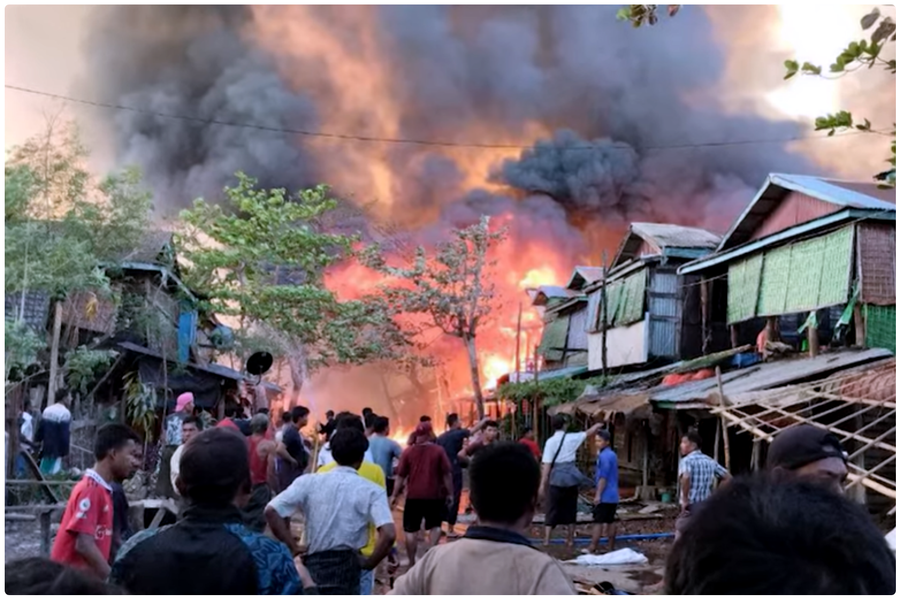
As Omble rushed towards him unarmed, Kasab raised his rifle.

Omble grabbed the barrel of the weapon with both hands and held on as Kasab fired into him at point-blank range. He absorbed the bullets that might otherwise have struck the policemen behind him and refused to let go until his colleagues wrestled Kasab to the ground.

Omble died on the road minutes later.

Kasab survived.

He became the only one of the ten Mumbai attackers to be captured alive, the single thread investigators would eventually follow back through Lashkar-e-Taiba and towards the men coordinating the operation from Pakistan.

Omble was posthumously awarded the Ashoka Chakra, India's highest peacetime gallantry award. His daughter has said that the family still keeps his belongings where he left them, as though waiting for him to return.

What almost nobody in Mumbai knew that night was that the attack Omble died trying to stop had been painstakingly prepared months in advance by an American citizen.

He had walked through the same hotel lobbies carrying a video camera. He had studied entrances and exits, observed security arrangements and recorded the locations that would later become killing grounds. He then sent what he had gathered back to handlers in Pakistan.

And for years before that, this same man had been on the payroll of the United States government.

His name was David Coleman Headley.

The story of how he was able to continue operating despite repeated warnings  and how, after his conviction, the United States ensured that he would not be extradited to the country whose citizens he helped kill remains one of the most troubling unresolved questions surrounding 26/11.

The iconic Taj Hotel Photo credit @ Dipinder Rainu

From Daood Gilani to David Headley  

He wasn't born David Headley. He was born Daood Gilani in Washington, D.C., in 1960, the son of Sayed Salim Gilani, a prominent Pakistani diplomat and broadcaster, and Alice Serrill Headley, an American woman from a socially prominent Philadelphia family.

His childhood was divided between two very different worlds.

After his parents separated, his father retained custody and Gilani remained in Pakistan. He attended the elite Cadet College Hasan Abdal, a military-style boarding school, where he became friends with Tahawwur Rana, the son of an army doctor. Decades later, Rana would become one of his closest associates and eventually a co-conspirator.

His mother returned to Philadelphia, where she reinvented herself as a bar owner and ran a nightspot called the Khyber Pass near Independence Hall.

It took her several attempts and roughly seven years to bring her son to the United States. She finally succeeded when he was seventeen, taking him from a military-school upbringing in Pakistan to an apartment above her Philadelphia bar.

By most accounts, the adjustment was difficult: a teenager raised in a strict and formal Pakistani Muslim household suddenly found himself living above a tavern with a mother whose life had become almost completely unfamiliar to him.

Drugs entered the picture early.

During trips back to Pakistan, he began spending time with heroin users and eventually started using the drug himself. By his mid-twenties, he was trafficking it.

Photo Credit @ cch.edu.pk

At one point, according to Rana's account, Gilani smuggled half a kilogram of heroin out of Pakistan's tribal areas while using Rana, apparently without Rana's knowledge as cover.

Then, in June 1988, customs officers at Frankfurt Airport stopped him while he was travelling back to Philadelphia. Inside a false bottom in his suitcase they found two kilograms of heroin.

Gilani quickly agreed to cooperate.

By the end of the same day, he had offered information on his drug associates in exchange for a reduced sentence. That arrest was what first put him on the radar of the U.S. Drug Enforcement Administration.

And it would not be the last time he made a deal.

After being released early for cooperating and placed on probation, he was arrested again in the late 1990s, this time during a DEA sting involving heroin smuggled from Pakistan into the United States.

The arrangement that followed would shape the rest of his life.

Instead of simply serving a lengthy prison sentence, Gilani became a informant and was sent back into Pakistan to report on narcotics networks he already knew.

For the agency, the logic was straightforward: turn a trafficker, use his contacts and let him earn his freedom by feeding information back.

What made his case extraordinary is that the contacts he was cultivating in Pakistan weren't just narcotics networks. 

They overlapped heavily with the world of narcotics, militants, training camps and Pakistan's security establishment ecosystem. It surrounded Lashkar-e-Taiba, the Pakistan-based jihadist organisation that Indian and international investigators have long accused elements of Pakistan's own intelligence service, the ISI of supporting.

Somewhere along the way, by his own account, Gilani stopped being merely an informant moving around jihadist circles and became a committed jihadist himself.

In 2006, he legally changed his name from Daood Gilani to David Coleman Headley.

The change mattered.

A name and a passport that let him move through Indian immigration without the scrutiny a Pakistani-sounding name would invite.

He opened a front business, an immigration consultancy with a branch office in Mumbai, and used it as cover for five separate scouting trips to the city between 2006 and 2008.

He filmed the Taj, the Oberoi-Trident, the Leopold Café, and Nariman House, timed the tides for the attackers' sea approach, and even rode a jet-ski to test possible landing points. He handed all of it to his Lashkar handlers and, according to his own later court testimony, to a Pakistani military officer he knew only as "Major Iqbal.

The cover-up

Here is the part that turns this from a story about one radicalized man into a story about American institutional failure. Headley wasn't a mystery to American authorities. He was, for years, a known asset sitting inside their own files and they had several opportunities to stop him and simply didn't take.

In 2005, one of Headley's wives went to police in New York following a domestic dispute. Headley had been involved with three women at around the same time, something that only emerged publicly later. She told investigators that her husband had trained extensively with Lashkar-e-Taiba in Pakistan.

She also said that he had boasted about being a paid American informant while doing so.
Two years later, in December 2007, another wife of his, a Moroccan woman, went to the U.S. Embassy in Islamabad and told officials essentially the same thing. Both women were effectively describing a man already immersed in militant networks while still operating freely in the US soil.

A joint investigation by ProPublica's Sebastian Rotella and The Washington Post later documented how the FBI received warnings about Headley but did not take action sufficient to stop him, while Headley spent the next four years running reconnaissance missions around the world, five of them to Mumbai, unbothered.

Despite the allegations raised about him years before 26/11, American authorities did not alert their Indian counterparts that a U.S. citizen with a history as a government informant had been accused of training with Lashkar-e-Taiba.  Whatever the reasoning inside the Bureau, a bureaucratic caution, a reluctance to burn a source, plain negligence, the practical result was that a country he was scouting was never told enough about him to stop him.

There's a genuinely contested question buried in here, and it deserves more than a passing mention: was "DEA informant" ever the whole story? 

The CIA question  

The official record establishes, and the U.S. government itself has confirmed, that Headley was a paid DEA informant during his years of terrorist training in Pakistan, recruited off a heroin bust in the late 1990s. Officially, that's where his relationship with American intelligence begins and ends.

A lot of people in India simply don't believe that's the full picture, and the suspicion isn't fringe conspiracy. A DEA narcotics informant is a fairly low-grade asset, typically handled for one narrow purpose: naming names in a drug network.

What Headley went on to do bears almost no resemblance to that. He moved in and out of Pakistan and India for years with a freedom that surveillance-conscious jihadist networks don't usually extend to outsiders.

He built a cover business solid enough to survive routine immigration scrutiny in a country like India, that was already on alert for exactly this kind of infiltration. And at multiple points, the 2005 tip from his wife, the 2007 tip from another wife directly to a U.S. embassy, the system had him cold and did nothing, not once but twice, over a span of years.

Individually, any of those could be explained by bureaucratic incompetence. Taken together, they're also exactly what it would look like if someone with more institutional pull than a narcotics handler had an interest in keeping him out of a cell.

It's also worth saying plainly: nobody should treat a CIA denial as evidence of anything. Intelligence agencies do not confirm human sources, and an agency running an asset inside a terrorist plot that killed six Americans has every institutional reason in the world to say "no" regardless of the truth. A denial from the one party with the strongest motive to lie isn't proof of innocence, it's just noise, and treating it as an answer is naive. 

The double game   

Headley wasn't just useful to Lashkar. In his own sworn testimony in a Chicago courtroom in 2011  given as the government's star witness against his old friend and co-conspirator Tahawwur Rana  he described reporting up a chain that ran directly through Pakistan's Inter-Services Intelligence agency.

Before reporting to Lashkar, he said, he always reported first to a man he knew as Major Iqbal, who personally participated in target selection, in mapping the sea route for the attack, and in scouting a proposed safe house for the gunmen. "This was being coordinated," Headley told the court, "but the instructions emanated from Major Iqbal."

It was, in other words, a genuinely three-cornered arrangement: an American citizen, trained and equipped by a Pakistan-based terror group, run in part by that country's own intelligence service, while carrying a history as a paid asset of the American government.

Pakistan has always denied any ISI role in the attacks. But Headley's courtroom account intensified longstanding allegations that Pakistan plays a double game in the fight against terrorism. It publicly allied with Washington against jihadist violence while elements of its own security establishment cultivate the very groups carrying it out. Calling him merely a "double agent" almost understates the complexity of the world in which he operated. There were far more than two sides. 

The steal deal  

Headley was not ultimately arrested because of the Mumbai attacks.He was picked up at Chicago's O'Hare International Airport in October 2009, eleven months after 26/11, while preparing to travel to Pakistan.At the time, investigators were pursuing him over a separate plot targeting the Danish newspaper Jyllands-Posten, which had published cartoons depicting the Prophet Muhammad.

It was only after his arrest that the full extent of his role in the Mumbai attacks began to emerge publicly.Headley cooperated extensively with American investigators,  and that cooperation came with enormous benefits.

In March 2010, he pleaded guilty to twelve federal terrorism charges.

Under the plea agreement, Headley agreed to cooperate with U.S. investigators and make himself available for testimony in foreign judicial proceedings.

In return, prosecutors agreed not to seek the death penalty.

More importantly for India, the agreement protected him from extradition to India, Pakistan or Denmark for the offences covered by the deal.

The contrast was difficult to ignore.

Ajmal Kasab, the only surviving member of the ten-man squad that physically carried out the Mumbai attacks, was prosecuted in India and hanged in 2012.

Headley a  man who had spent years scouting the locations Kasab and the others would attack would never see the inside of an Indian court.

Headley was sentenced in January 2013, when Judge Harry Leinenweber handed him a 35-year prison term. He could be eligible for release by 2039, by the time he would be in his late seventies.

India's frustration with the arrangement has never entirely disappeared.

Former Union Home Secretary G.K. Pillai put the asymmetry bluntly after Rana's extradition.

Headley, Pillai argued, was the "main culprit", while Rana had played a comparatively "small role". By protecting Headley from extradition while eventually surrendering Rana, he said, the United States had acted in "bad faith".

Pillai made another uncomfortable point.

Headley returned to India even after the Mumbai attacks.

Had Indian authorities known then what American investigators already knew or suspected about him, India might have had an opportunity to arrest him on Indian soil.

An open wound  

Headley is, today, a federal prisoner somewhere in the American system, he is a cooperating witness and a convicted terrorist, and permanently beyond the reach of the country he helped devastate.

Kasab, the 21-year-old who fired the shots that killed the man who caught him, was hanged within four years of his capture. The mastermind who mapped the killing ground, who did it on an American passport, has spent more than a decade in an American prison.

But barring an extraordinary change in circumstances, he will never stand in a Mumbai courtroom and answer directly to the country where the consequences of his work were felt.

Somewhere in Satara district, Tukaram Omble's family still keeps his belongings exactly where he left them, waiting, as his daughter once said, for a man who isn't coming home. It's hard not to notice the asymmetry: the country whose citizen mapped his death has never once had to answer to the country where he died.