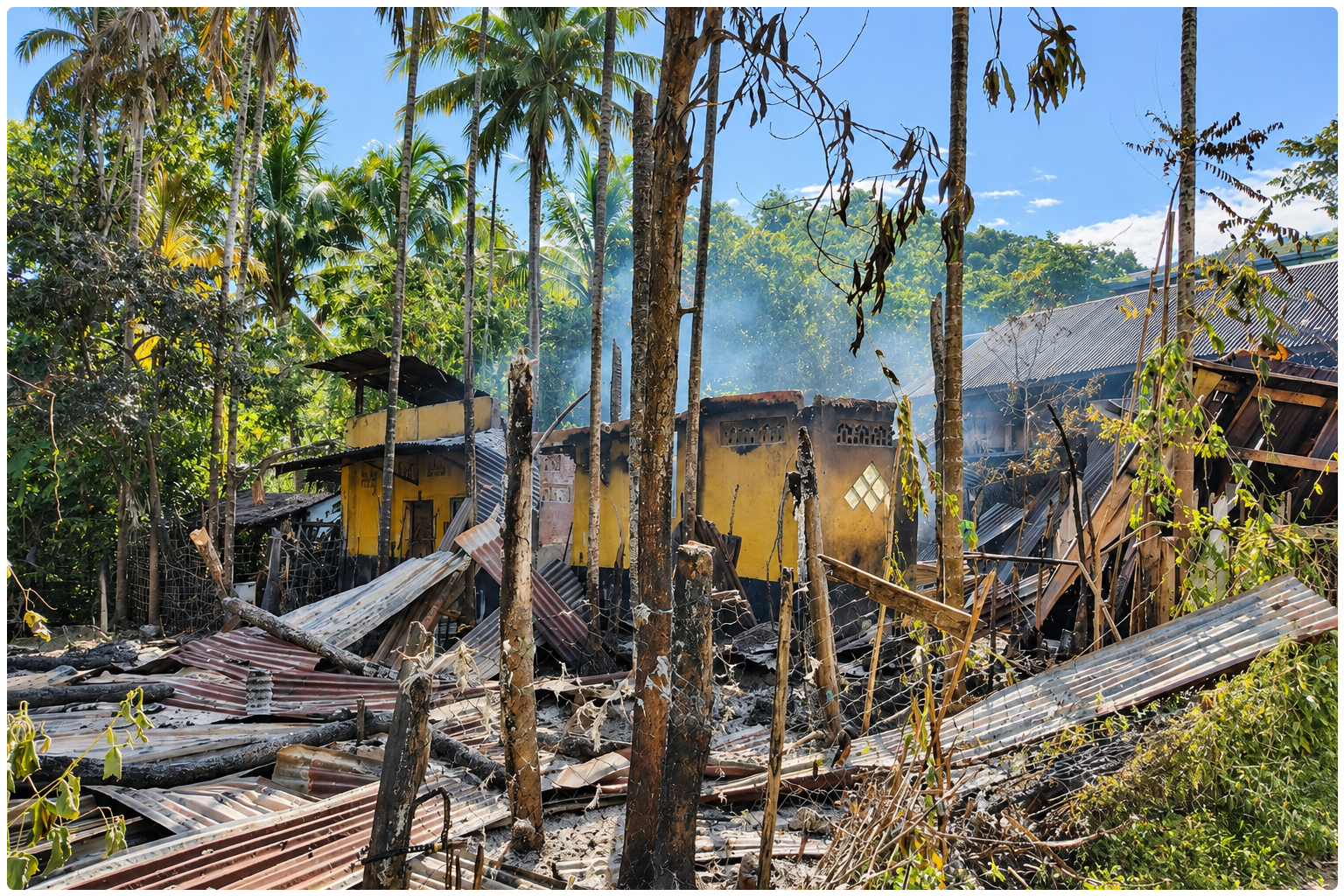
A displacement camp in western Myanmar, where families had sought shelter from years of civil war, has reportedly been bombed for the second time in six weeks. Twelve people, including a five-year-old child, were killed and 18 injured when military aircraft struck the Byar La camp in Rakhine State on Friday evening, November 13, according to local rescue workers and residents.
The attack occurred around 7 p.m. in Ponnagyun township, northeast of the state capital Sittwe. Local accounts indicate that a fighter jet dropped two bombs on the settlement, destroying makeshift homes and leaving families searching through the wreckage. Three of the injured were reportedly in critical condition.
Myanmar Military Junta Continues to Commit War Crimes Through Airstrikes on IDP Camps, Public Roads, Bridges and Civilian Residential Areas News ၊ 15 November 2026 The fascist military junta continues to carry out indiscriminate airstrikes across the Arakan region, deliberately targeting civilian areas and infrastructure unrelated to military operations, including internally displaced persons (IDP) camps, schools, hospitals, clinics, religious buildings, public roads, bridges and residential neighbourhoods. These ongoing attacks constitute serious violations of international humanitarian law and involve acts that may amount to war crimes. At approximately 7:00 PM on 13 November 2026, a fighter jet belonging to the fascist military junta dropped two bombs on the Byala IDP camp, located between Yoe Ngu and Thayet Cho villages in Ponnagyun Township, in an aerial attack. As a result, 12 innocent internally displaced civilians were killed and 18 others were injured. Numerous shelters and personal belongings belonging to displaced families were also destroyed. The same Byala IDP camp had previously been subjected to an aerial bombardment by two fighter jets belonging to the military junta on 4 October 2026. During that attack, six innocent displaced civilians were killed and another 10 were injured. Several shelters, personal belongings, motorcycles and motorcycle sidecars belonging to displaced families were also burned and destroyed. The latest attack on 13 November marks the second aerial attack on this IDP camp. At approximately 2:00 AM on 14 November 2026, the military junta launched an aerial bombardment targeting the bridge in Son Ye Village, Anjanapura Township, causing damage to parts of the bridge. Similarly, at approximately 1:32 AM on 14 November 2026, the military junta carried out mine explosions, destroying the Thazin Tan Pauk Bridge and Thant Tha Ma Chay Bridge in Ramree Township. The two bridges were subsequently subjected to further aerial bombardments at approximately 1:40 AM and 10:12 AM on the same day. Furthermore, at approximately 9:30 AM on 14 November 2026, naval forces of the military junta fired heavy artillery from a military vessel at Taung Ngu Su Ward in Sane Town, Kyaukphyu Township. The shelling caused fires that destroyed seven civilian homes. These repeated attacks on displaced civilian populations, residential areas and public infrastructure demonstrate the continuing threat faced by innocent civilians throughout the Arakan region. Source@AAInfoDesk
— Maung Khin Zaw (@MaungKhinZaw4) November 15, 2026
Among those who lost relatives was 27-year-old shopkeeper Chit Su Wai, whose daughter, mother and aunt were killed. Other residents described finding relatives dead among collapsed bamboo shelters. Khine Hein Htet, chairman of the Phyusin Yin Khwin Foundation, a local rescue organisation, confirmed the reported death toll and said most victims had been sheltering together when the bombs struck.
Byar La had already suffered an airstrike on October 4 that reportedly killed six displaced civilians. Families who remained there were living in a camp that residents said was away from active fighting. The latest attack has left the survivors facing another search for safety in a region where opportunities to escape the violence are increasingly limited.
Much of Rakhine is controlled by the Arakan Army, an ethnic armed organisation that has captured extensive territory from Myanmar’s military. Government forces retain positions around strategic centres, including Sittwe, and have increasingly relied on aircraft to attack areas beyond their ground control. The fighting has damaged transport networks, restricted humanitarian access and left communities struggling to obtain food and medical supplies.
The scale of displacement illustrates how few secure alternatives remain. According to UNHCR’s latest displacement figures, more than four million people were internally displaced across Myanmar as of October 26, including approximately 508,200 in Rakhine State.
The danger to civilians in Rakhine has been documented repeatedly. In September, UN Human Rights Chief Volker Türk condemned airstrikes on a crowded market in Kyauktaw, where at least 50 people were reportedly killed. The UN warned that attacks affecting civilian populations raised serious concerns under international humanitarian law.
The November bombing also follows fresh allegations of military strikes against civilian facilities elsewhere in Rakhine, including a school area in Mrauk-U on November 12. These incidents have intensified scrutiny of the military’s use of air power, sustained in part by aviation fuel imports that have continued despite sanctions. An earlier investigation into Myanmar’s disguised jet-fuel shipments examined how fuel allegedly reached the country through misleading commercial documentation.
Regional diplomatic efforts have made little progress in curbing the violence. ASEAN’s Five-Point Consensus, which calls for an end to hostilities and humanitarian access, remains largely unimplemented. Myanmar’s military authorities have not publicly responded to the latest allegations concerning Byar La.
For families who have spent years moving between temporary shelters, the repeated bombing of the same camp has made even displacement sites unsafe. Survivors now face the immediate problems of treating the wounded, burying relatives and finding somewhere else to live, with little assurance that another location will offer better protection.