On Thursday, guards walked Chinmoy Krishna Das out of Chattogram Central Jail. He had just five hours to perform the last rites of his mother, Sandhya Rani Dhar.

A video of the visit is now circulating online. Das is on his knees in front of a Radha-Krishna idol at Pundarik Dham temple, crying. He had asked to see his mother while she was still alive. The government turned a deaf ear to his request, and she died before she could ever see her son again. Only after she was gone did the prison gates open for five hours.

By then, there was no mother left to embrace and no final goodbye to whisper. So he went to the temple and fell at the lotus feet of Radha Krishna, crying and wailing before the deity, because that is how he could make sense of what was happening to him.

This is what Bangladesh's persecution of Chinmoy Krishna Das looks like: a man who has endured unimaginable suffering and yet remains filled with divine grace and when he was faced with unbearable loss, he chose Krishna over hatred.
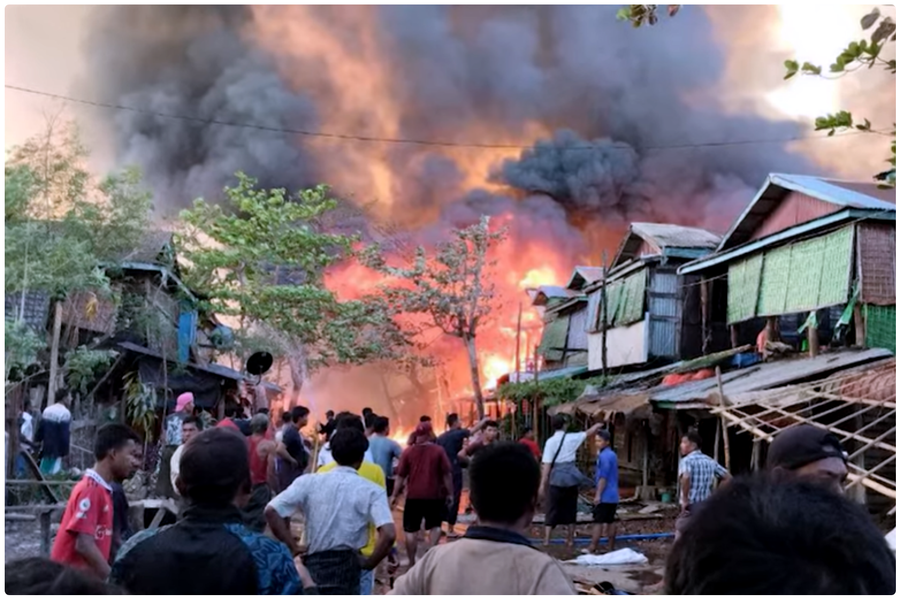

After Sheikh Hasina fled the country in August 2024, Bangladesh's Hindu minority came under sustained attack. The UN recorded assaults on Hindu homes and properties across 27 districts in the weeks after the government fell, along with the burning of an ISKCON temple. Human Rights Watch has since documented a continuing wave of mob violence against religious minorities, with hardliners gaining ground while the new authorities have shown no real interest in checking them.

Islamist organisations that Hasina's government kept in check are now operating in the open. Jamaat-e-Islami, banned for years, is back as a serious political force. They have gone after Hindu and Sufi shrines, cultural events, and even women's football matches. Nearly 20,000 supporters of Hefazat-e-Islam marched through Dhaka this year to oppose expanding women's rights. USCIRF has documented attacks on Hindu temples, homes and religious statues so severe that Hindu women have reportedly stopped wearing bangles and bindis in public to avoid being identified as targets.

Perhaps nothing captures the horror of that climate more brutally than what happened to Dipu Chandra Das. In December 2025, the Hindu garment worker was accused of blasphemy, dragged into the hands of a mob in Mymensingh, beaten to death, his body tied to a tree and set on fire. Investigators later found out that they could not find direct evidence that he had made the remarks for which he was killed. By then, the truth was useless to him.

In spite of all this, the world has said almost nothing about the plight of Hindus in Bangladesh. Washington built an entire foreign-policy vocabulary around religious freedom. That vocabulary goes quiet the moment the victim is a Hindu monk and the entire pogrom is of their making. There has been no sustained diplomatic pressure, no serious public campaign, nothing close to what similar cases generate when the persecuted minority fits a more familiar narrative.

Chinmoy Krishna Das stood in the middle of that violence and called for peace and an end to the bloodshed. He organised large rallies demanding protection for Hindus, justice for the perpetrators, and equal treatment under the law. Then, on November 25, 2024, he was arrested on sedition charges over a flag displayed at one of those rallies.

The next day, court in Chattogram denied him bail. Thousands of his supporters gathered outside. In the violence that followed, a lawyer named Saiful Islam Alif was killed. Das was already in a police custody when it happened. He could not have been anywhere near the killing. Months later, the state charged him with abetting Alif's murder anyway.

A man has been prosecuted for a killing that took place while he was locked in police custody. How is that for Justice?

This month, the High Court finally granted him bail in several of these cases, including vandalism and obstruction of police duties. And yet, he is still not free. Bangladesh’s Supreme Court has stayed the bail order in the sedition case, while the murder charge remains active. Every time one door appears to open, another is slammed shut. At this point, it is difficult to escape the impression that the system is hell-bent on ensuring that he does not see the light of day.

There is an almost painful irony in that. In the story of Krishna, Devaki and Vasudeva endured fear, imprisonment, and the repeated loss of their children before Krishna himself was born in the darkness of a prison cell. His birth did not come after the darkness had passed; it came through the darkness itself. For Chinmoy Krishna Das, still waiting behind prison walls, that image carries an unsettling resonance: darkness may surround him now, but in the tradition he has devoted his life to, darkness has never had the final word.