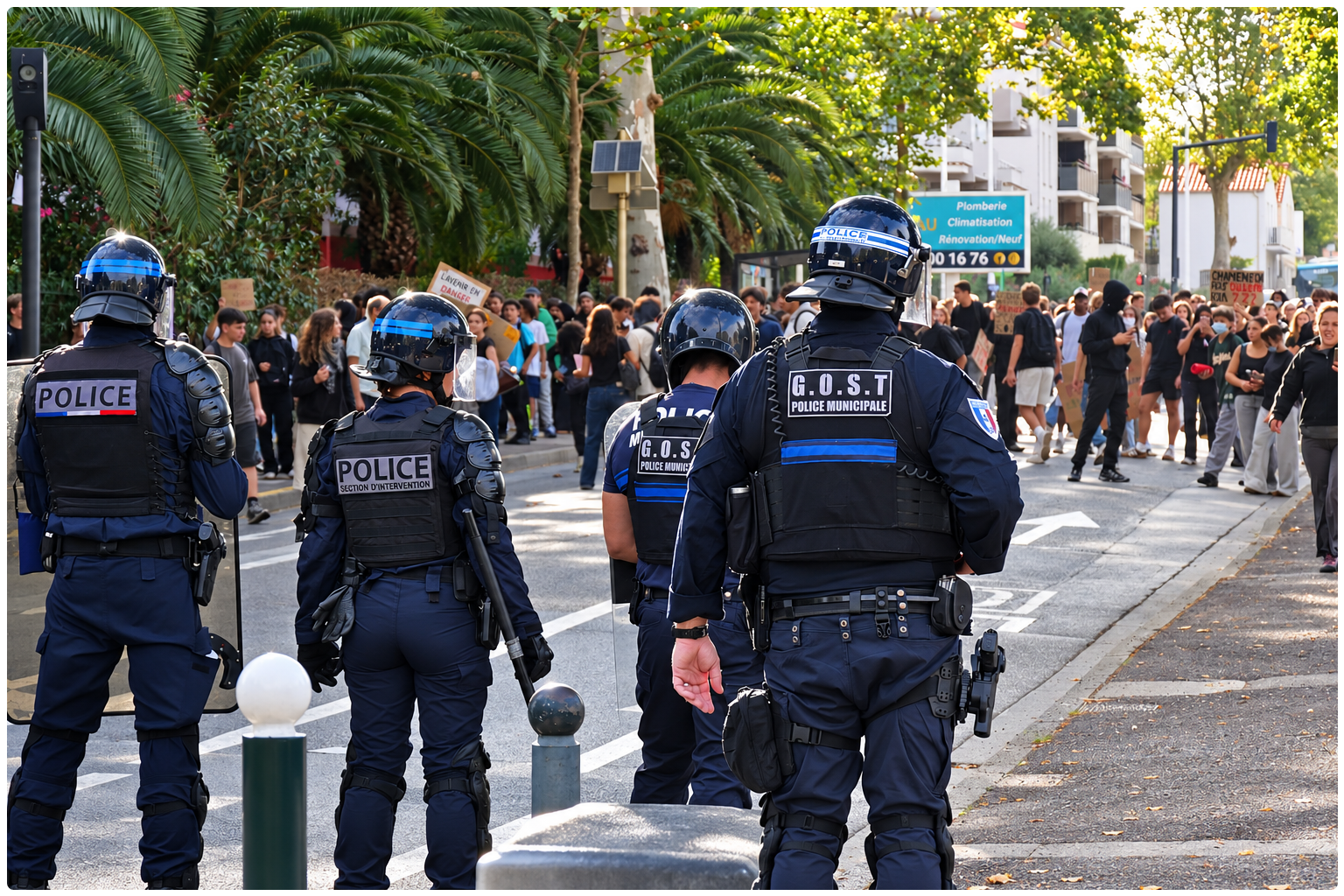
French police fired tear gas at demonstrators in Paris on Saturday as a widening protest movement over living costs, public services and police conduct brought thousands onto the streets across the country. In Marseille, protesters briefly entered City Hall, while fires, barricades and clashes with officers were reported in several other cities.
The demonstrations on October 17 were among the most confrontational since the unrest began in September. At least 166 people were arrested, and the Interior Ministry recorded around 140 protest actions involving 32,800 participants outside Paris by midday. Violence was reported in Rennes, Toulouse and Angers, with police deployed in large numbers to prevent further damage.
In the capital, officers confronted masked demonstrators around Place de la République, where tear gas was used to disperse crowds. Police also restricted access to the Champs-Élysées and Arc de Triomphe, while several central Métro stations were closed. Many people marched peacefully, although confrontations involving smaller groups repeatedly interrupted the demonstrations.
🇨🇵🔸France is seeing one of its largest nationwide protests against the high cost of living, with school pupils, university students, and trade unions taking part. In Paris, the police are taking a firm stance against attempts to hold unauthorized "spontaneous marches. https://t.co/LVU1w9pG10
— Argonaut (@FapeFop90614) October 17, 2026
The movement has travelled a considerable distance from its beginnings in the classrooms of suburban Paris. Students first organised protests over missing teachers, overcrowded classrooms and deteriorating school buildings. By early October, hundreds of French schools had closed or suspended lessons, and confrontations with police had resulted in injuries, arrests and damaged property.
The treatment of young protesters has since become a grievance in its own right. A 15-year-old boy lost a hand during clashes in northern France, prompting an investigation into the circumstances of his injury. Interior Minister Laurent Nuñez subsequently suspended the use of a particular stun grenade. Authorities maintain that officers have faced repeated attacks, while student organisations and civil liberties groups have accused police of excessive force.
By the second week of October, trade unions had joined the student-led demonstrations, broadening the demands beyond education funding. The CGT union has called for higher wages and pensions, stronger public services and measures to ease household expenses. Veterans of the Yellow Vest movement have also returned to the streets, reviving memories of the protests that challenged Emmanuel Macron's government in 2018.
Economic conditions have given the movement another source of momentum. Official figures published by France's statistics agency, INSEE, show annual inflation accelerating to 3.1 per cent in September from 2.4 per cent in August. Energy prices rose 21.3 per cent over the year, with diesel and petrol becoming substantially more expensive.
For households already struggling with transport, heating and everyday expenses, the increase has renewed arguments over wages and the cost of maintaining France's public services. Those demands arrive at an inconvenient moment for Prime Minister Sébastien Lecornu, whose government faces difficult budget negotiations in a parliament without a stable majority.
France's public finances leave limited room for concessions. The government is attempting to reduce its deficit while unions and students demand greater spending on education, wages and social protection. Opposition parties have seized on the unrest, although the demonstrations themselves remain politically diverse and lack a single leadership.
The approaching 2027 presidential election adds another complication. Macron cannot seek a third consecutive term, and the contest to succeed him is already taking shape amid widespread dissatisfaction with the country's economic direction.
For now, the students who began demanding functioning classrooms find themselves part of a much larger confrontation over how France distributes public money and manages social discontent. Saturday's violence has placed renewed pressure on the authorities to restore order, but the complaints that first brought protesters into the streets remain unresolved.