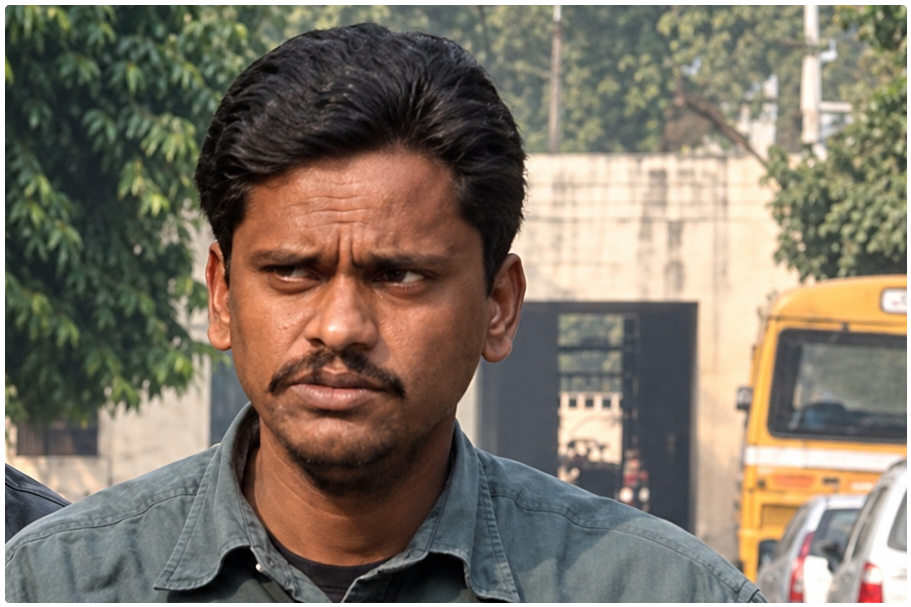
Surendra Koli, who spent nearly two decades in prison before ultimately being acquitted in all cases arising from the Nithari killings, has been found dead at the small tea stall he was running in Haridwar, less than a year after the Supreme Court ordered his release.
Koli, 53, was found hanging inside the stall in the Sapt Sarovar area of Bhupatwala on September 18, according to police. An acquaintance, Dharmender Kaushik, discovered the body and alerted authorities. Police said the preliminary circumstances suggested suicide, but no suicide note was recovered and a post-mortem examination was ordered to establish the cause of death. His family was informed.
Koli had reportedly been living in Haridwar for more than a month and trying to rebuild his life by running the tea stall. He had walked out of Greater Noida’s Kasna jail in November 2025 after the Supreme Court acquitted him in the final criminal case still pending against him.
His death brings renewed attention to one of India’s most disturbing and controversial criminal investigations.
The Nithari case emerged in December 2006 after human remains belonging to children and young women were discovered in and around a drain behind businessman Moninder Singh Pandher’s house in Noida. Koli worked as Pandher’s domestic help. Police eventually registered 19 FIRs, while the CBI filed charge sheets in 16 cases. Koli was convicted in multiple cases and received several death sentences.
But over time, the prosecution case began to collapse.
In October 2023, the Allahabad High Court acquitted Koli in 12 cases, finding serious problems with the evidence relied upon by investigators. The court questioned whether his confession had been voluntary, noting that he had spent around 60 days in police custody without access to a lawyer and that allegations of tutoring and torture had been raised. It also found problems with the recovery of bones and other material from the area behind Pandher’s house, which was an open location already known to police and the public.
The Supreme Court rejected appeals against those acquittals in July 2025. Koli, however, remained imprisoned because an earlier conviction in one case involving the rape and murder of a teenage girl was still standing.
That changed in November 2025.
A three-judge Supreme Court bench allowed Koli’s curative petition and acquitted him in the last case, saying the same evidence that had been found unreliable in 12 prosecutions could not logically sustain a conviction in the thirteenth. The court said the confession, alleged recoveries and forensic evidence suffered from “structural infirmities” and observed that the actual perpetrator had not been established to the required legal standard.
The ruling effectively cleared Koli in all 13 cases against him and ended a legal battle in which he had once come close to execution. His death less than a year later has therefore drawn considerable attention.
Jhabbu Lal, whose 15-year-old daughter was among the victims identified in the Nithari investigation, has disputed the preliminary suggestion of suicide and alleged that Koli was murdered. He has claimed Koli may have been preparing to reveal information about the case. No evidence establishing that allegation has publicly emerged, and police have not announced any finding of foul play.
The Haridwar investigation will now focus on Koli’s final movements, the circumstances inside the tea stall and the post-mortem findings.
His death does not resolve the larger questions left by the Nithari case. The discovery of human remains in 2006 was never in dispute, but after years of convictions, death sentences and appeals, the courts ultimately found that investigators had failed to prove Koli’s responsibility beyond reasonable doubt.
Nearly two decades after the killings first horrified the country, the man once presented as their principal perpetrator is dead acquitted by the courts, while the question of exactly who committed the crimes remains legally unresolved.