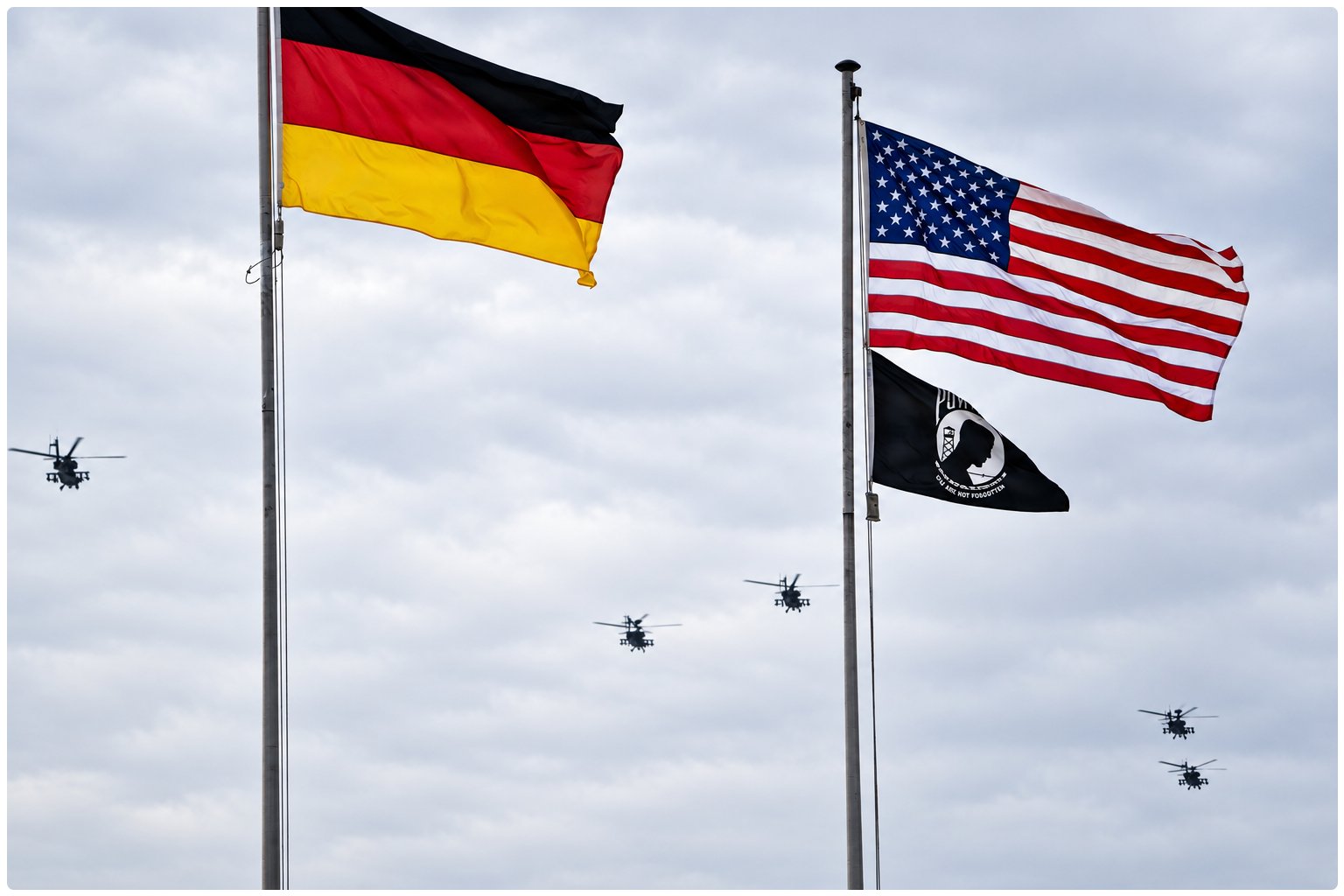
Germany and the United States have signed a new defence-industry cooperation agreement aimed at making it easier for companies in both countries to work together on military production, procurement and supply chains.
The pact was signed in Berlin by senior German and US defence officials and is intended to deepen industrial cooperation at a time when NATO countries are trying to rebuild weapons stockpiles, expand ammunition production and reduce the delays that have exposed weaknesses across Western defence manufacturing.
The agreement focuses on closer collaboration between German and American defence companies, with an emphasis on speeding procurement, improving industrial coordination and identifying obstacles that slow joint production. It also seeks to strengthen transatlantic supply chains for critical defence components and create more predictable conditions for companies working across both markets.
That matters because the biggest constraint on Western military power is increasingly not simply how much governments are willing to spend.
It is how quickly industry can actually produce.
The war in Ukraine exposed serious shortages in ammunition, air-defence interceptors, artillery shells and spare parts across Europe and the United States. Germany has responded with a major defence expansion, including large procurement programmes and efforts to grow domestic production capacity. Washington, meanwhile, has been pushing allies to increase spending while also expanding the US defence-industrial base.
Germany is central to that effort.
It is Europe’s largest economy, one of NATO’s biggest military spenders and home to major defence companies including Rheinmetall, Hensoldt, Diehl Defence and TKMS. Several of those firms already work closely with US manufacturers on ammunition, air defence, armoured vehicles, electronics and missile systems.
The new agreement is designed to make that cooperation more systematic rather than leaving it dependent on individual contracts.
It also fits a broader German strategy of building a more resilient European defence industry without cutting itself off from American technology and production. Berlin has argued that Europe needs far greater manufacturing capacity of its own, but German officials have also resisted calls for a purely European procurement system that would exclude US suppliers.
That balancing act is becoming increasingly important.
European governments want greater strategic autonomy, but many of the systems they urgently need from Patriot air defence to fighter aircraft, missiles and advanced electronics remain heavily dependent on US companies. Germany, in particular, has chosen a deeply transatlantic procurement path, including its purchase of F-35 fighters and US-made air-defence systems.
The new pact therefore reflects a practical reality: Europe may want more industrial independence, but in the short term, faster rearmament still requires tighter integration with the United States.
For Washington, the agreement offers another benefit. Greater German production capacity can reduce pressure on US factories and help distribute NATO’s industrial burden more evenly.
For Berlin, it offers access to American technology, markets and supply chains at a moment when defence spending is rising sharply.
The agreement will not solve NATO’s production bottlenecks overnight.
But it marks another step in turning transatlantic defence cooperation from a military alliance into a more integrated industrial system.