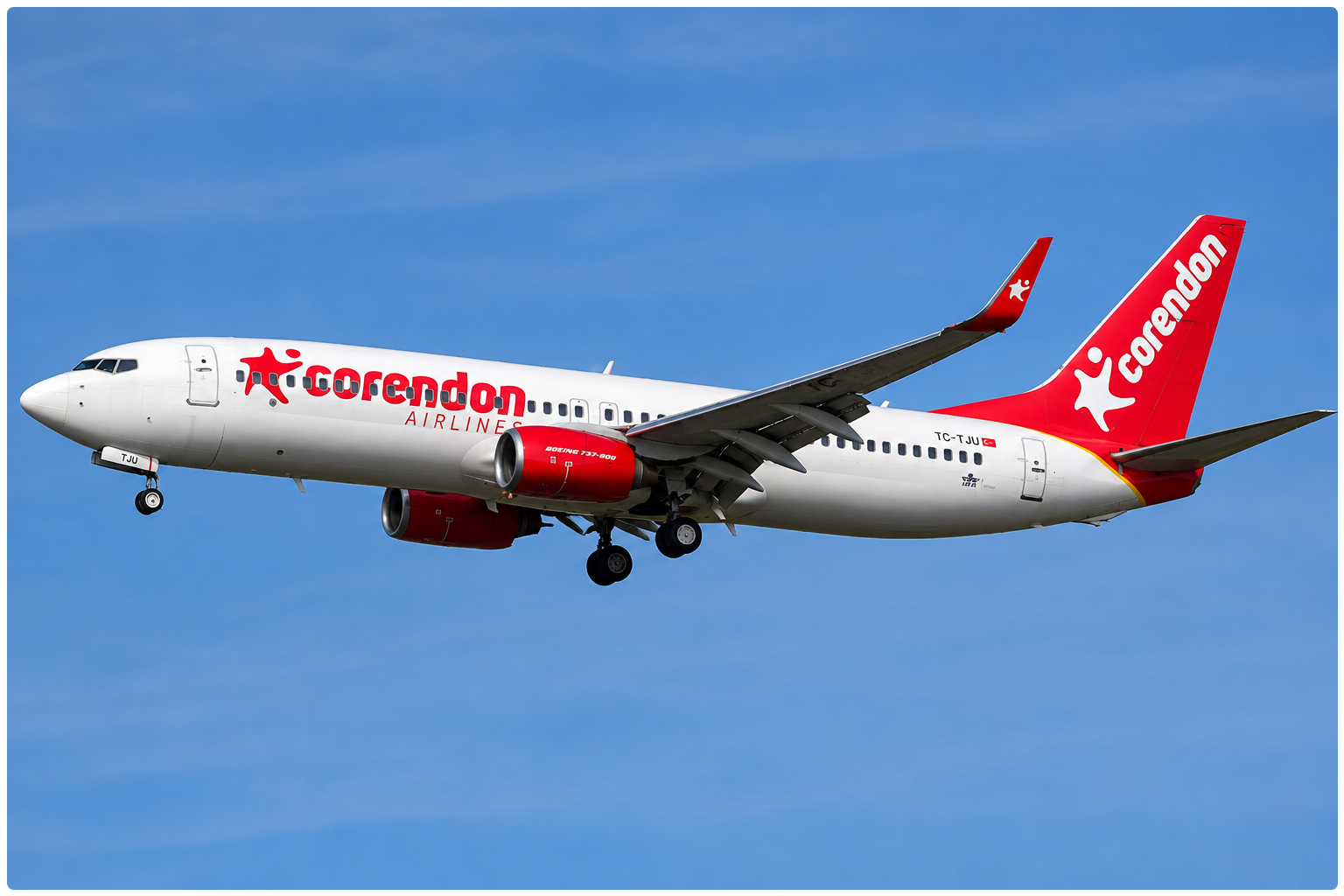
A passenger aircraft carrying holidaymakers from the Greek island of Corfu prompted a military response across European airspace on Tuesday after transmitting a signal indicating a possible hijacking. By the time the Boeing 737 approached Nuremberg, two German fighter jets were escorting it, police had secured the airport and civilian flights had been temporarily suspended.
The emergency turned out to be a false alarm. Corendon Airlines, which operated flight XR456, attributed the incident to a malfunction in the aircraft's radio communication system. The plane landed safely on October 13, with all 178 passengers unharmed.
The trouble began as the aircraft passed through Croatian airspace, where its transponder transmitted code 7500, the internationally recognised signal for unlawful interference or hijacking. Air traffic controllers were also unable to establish radio contact with the cockpit, leaving authorities without immediate confirmation of what was happening aboard.
Germany's air force dispatched two Eurofighter jets from Neuburg Air Base in Bavaria. They accompanied the passenger aircraft towards Nuremberg, where police and emergency personnel had assembled in anticipation of a possible security incident. Croatian military aircraft were also reportedly mobilised as the alert developed.
The Boeing landed shortly after noon, but the airport remained under heightened security while officers established contact with the crew and assessed the situation. Authorities gave the all-clear at approximately 1.20pm, allowing flight operations to resume shortly afterwards. Six departures were delayed and two incoming aircraft were diverted during the disruption.
Corendon subsequently explained that a temporary communications malfunction had caused the mistaken hijacking signal. The precise technical circumstances remain unclear, including how the fault led to the transmission of code 7500.
Germany maintains fighter aircraft on permanent readiness to respond to unidentified or unresponsive aircraft. Under the Bundeswehr's air-policing procedures, military pilots can be ordered to intercept civilian aircraft when communications fail or their behaviour raises security concerns. Their initial responsibility is to identify the aircraft, establish visual contact and determine whether intervention is necessary.
The response also reflects the wider European system of airspace protection, in which national air forces coordinate with civilian controllers and neighbouring countries. A potential hijacking involving an international passenger flight can therefore prompt military preparations before the circumstances are fully understood.
Nuremberg had experienced a separate aviation security alert earlier that morning, when three pilots reported sighting a possible drone near the airport. Police searched the surrounding area but found no aircraft. Authorities have established no connection between the suspected drone and the later hijacking scare.
The two incidents nevertheless occurred against growing concern over aviation security in Germany, where suspected drone activity has repeatedly interrupted airport operations and prompted debate over the country's ability to protect sensitive infrastructure.
Tuesday's alert was different in origin. The emergency signal came from the passenger aircraft itself, accompanied by a breakdown in communication that prevented controllers from immediately dismissing the possibility of a hijacking.
Normal operations had resumed at Nuremberg by the afternoon. Investigators must now establish how a routine flight developed into an international air-security emergency and whether additional safeguards could prevent a similar malfunction from triggering another military response.