India spent nearly 100 hours trying to solve one of the most difficult problems facing this year's BRICS summit: how to get Iran and the United Arab Emirates, two members divided by the war in West Asia, to agree on the same declaration.
Iran and the UAE joined the other BRICS members in adopting the New Delhi Declaration, which called for “maximum restraint” in West Asia, protection of civilians, respect for sovereignty and territorial integrity, and the safeguarding of global trade, energy flows and maritime security. On paper, it was another carefully worded diplomatic statement. But getting Tehran and Abu Dhabi to agree to it was anything but routine.
The disagreement had been building for months. Iran and the UAE are both members of the expanded BRICS grouping, but the West Asia war had placed them in increasingly hostile positions. Iran has repeatedly attacked the UAE during the conflict, including an August strike targeting Al Minhad Air Base, which housed American forces and helicopters. At the BRICS foreign ministers' meeting in New Delhi in May, disagreements over the conflict were among the issues that prevented the grouping from producing a fully consensual joint statement.
That left India, as BRICS chair, with an uncomfortable problem. A summit designed to demonstrate the growing influence of the Global South risked instead exposing how deeply divided its members had become.
Indian diplomats began working on the problem months before the summit. According to sources, negotiations intensified during a narrow ceasefire window and eventually involved nearly 100 hours of discussions, drafts and diplomatic exchanges. India played the central coordinating role, while China and Russia helped nudge the two sides towards compromise and Egypt and Brazil also supported the effort.
The eventual solution was classic diplomatic ambiguity. Instead of producing language that explicitly blamed Iran, Israel, the United States or any other country, BRICS concentrated on principles that all sides could accept: restraint, sovereignty, protection of civilians, diplomacy and opposition to further escalation. It did not resolve the war or erase the differences between Tehran and Abu Dhabi. It created enough common ground for both governments to sign.
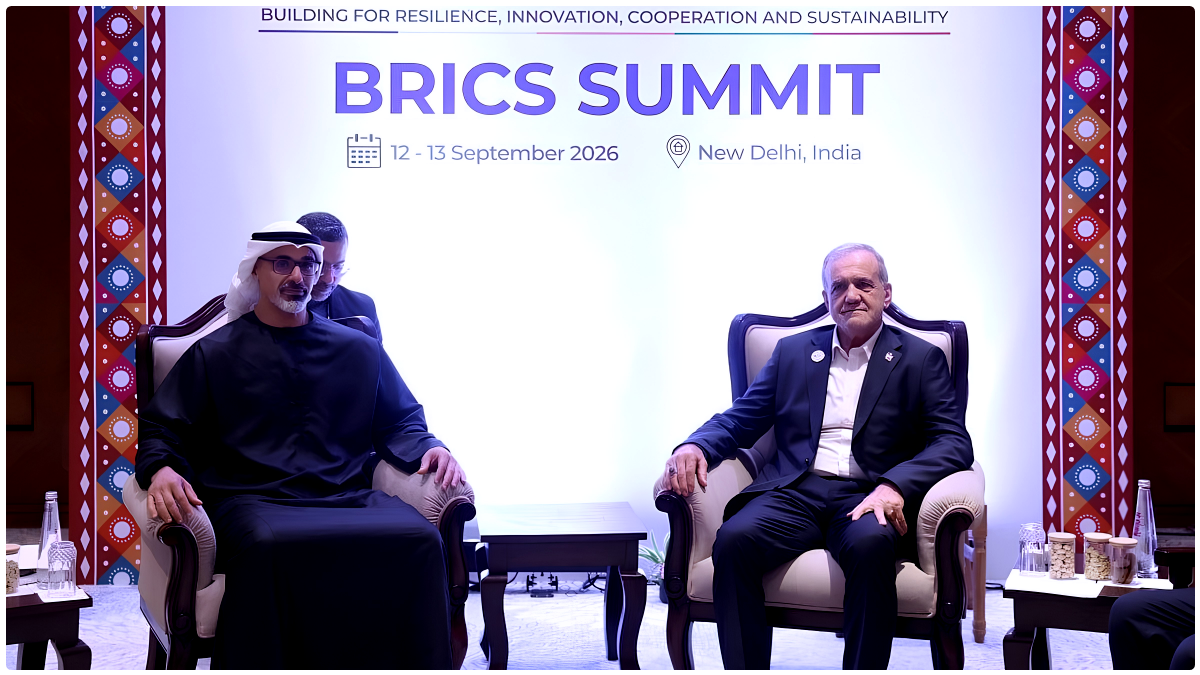
A more visible breakthrough was that Iranian President Masoud Pezeshkian met Abu Dhabi Crown Prince Sheikh Khaled bin Mohamed bin Zayed Al Nahyan on the sidelines of the summit, the highest-level engagement between Iran and the UAE since the conflict began. The two discussed de-escalation, regional stability and efforts towards peace and development. No major bilateral agreement emerged, but after months of confrontation, the fact that the two sides were talking at that level was itself significant.
India was unusually well placed to make that conversation possible. New Delhi maintains substantial relations with both Tehran and Abu Dhabi. Iran remains strategically important to India because of geography, energy security, Afghanistan and connectivity through Chabahar, while the UAE has become one of India's closest partners in the Gulf, with deep ties spanning trade, investment, energy, defence and the Indian diaspora. India therefore had little interest in choosing between the two.
That balancing act may ultimately be more important than the language of the declaration itself.
BRICS has expanded rapidly, bringing together countries with very different strategic interests. Iran and the UAE sitting inside the same organisation demonstrates both its potential and its biggest weakness: the bloc can claim to represent a broader section of the world, but every new member makes consensus more difficult.
There was no reconciliation between Iran and the UAE, nor did the BRICS declaration end the war.
But what India acheived was still significant.