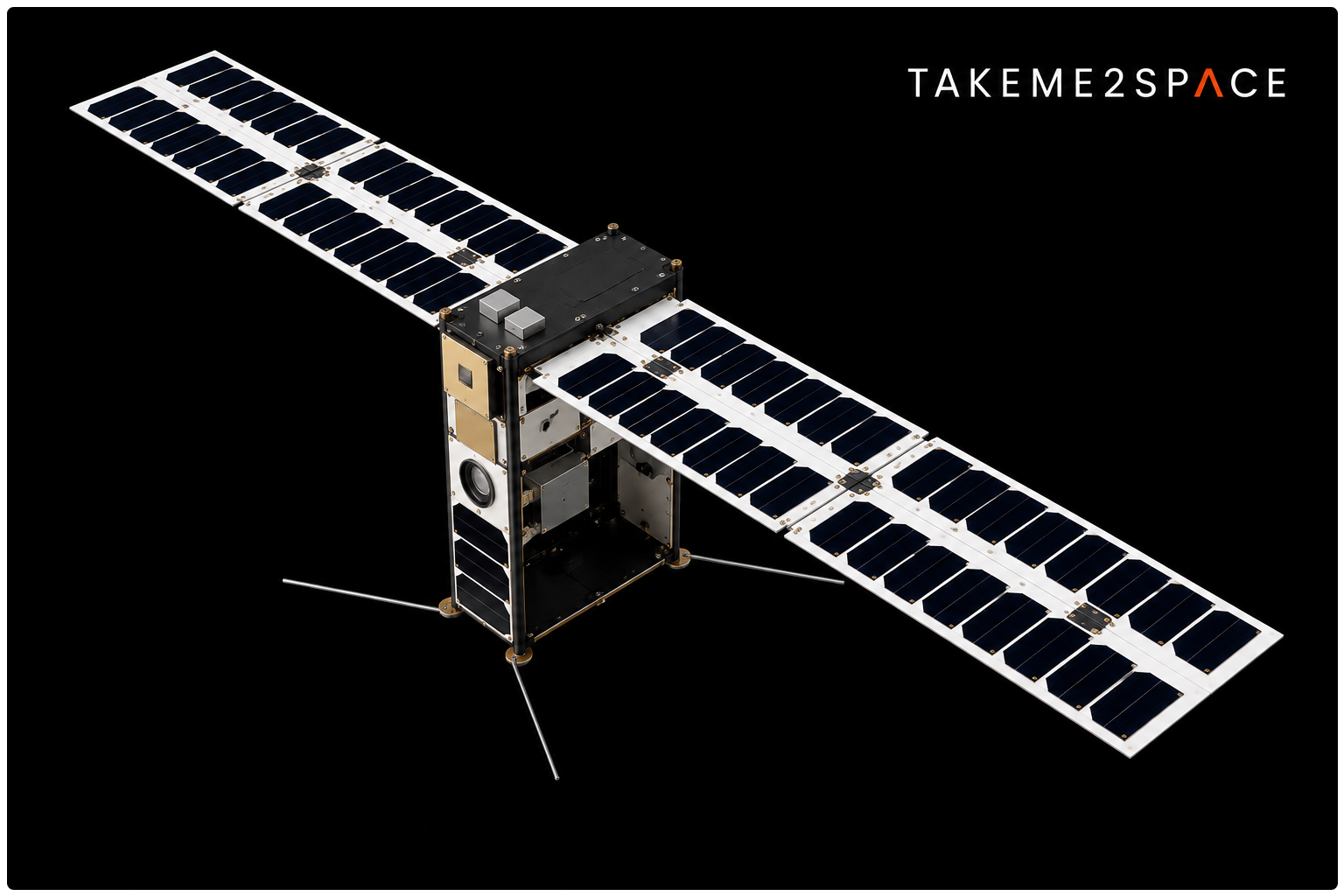
Indian space-technology startup TakeMe2Space is preparing to launch what it describes as the country’s first commercial orbital-computing satellite aboard a SpaceX Falcon 9 rocket on October 1.
The Hyderabad-based company’s MOI-1A spacecraft will travel on SpaceX’s Transporter-18 rideshare mission. Its purpose is to process Earth-observation data directly in orbit instead of transmitting large volumes of raw imagery to ground stations for analysis.
Conventional observation satellites collect images and send the underlying data to Earth, where computers process it. That approach requires substantial communications capacity and can delay the delivery of useful information. MOI-1A is designed to carry out part of that work aboard the satellite and send only the resulting analysis.
Customers will be able to upload containerised artificial-intelligence models to the spacecraft. As the satellite passes over a selected region, those models can examine images, identify relevant features and transmit the findings to Earth.
The company says this could reduce the cost and time required to obtain information for agriculture, mining, insurance, geographic-information services and supply-chain management. A farming company, for example, could receive an assessment of crop conditions without paying to download and process every image captured over an agricultural area.
TakeMe2Space says it has signed 23 customers for the mission, including businesses, geographic-information companies and educational institutions. The American space-data company Little Place Labs is among the commercial customers.
The satellite also carries a nine-band multispectral imager, which can observe portions of the electromagnetic spectrum beyond visible light. Such imagery can help identify vegetation stress, changes in water bodies, mineral characteristics and other features that may not be visible in an ordinary photograph.
Its peak power capacity is approximately 120 watts. That makes MOI-1A an edge-computing satellite rather than a full-scale data centre in space. Its role is to test whether useful AI workloads can be performed reliably aboard a small, power-constrained spacecraft.
The launch represents a second attempt to place the company’s operational platform in orbit. TakeMe2Space’s MOI-1 satellite was lost in January after the third stage of its launch vehicle suffered a failure. The spacecraft itself was reportedly functioning normally until contact was lost.
The company had previously flown a smaller technology demonstration aboard ISRO’s PSLV-C60 mission in December 2024. That experiment completed hundreds of orbits and demonstrated the ability to upload applications, conduct AI inference in space and return the results to Earth.
Most of MOI-1A’s satellite subsystems are designed and manufactured in India, although its processor, solar cells and propulsion equipment are sourced externally.
TakeMe2Space plans to begin deploying larger satellites from 2027. It is also developing a networked orbital data-centre mission for 2028 involving two 100-kilogram satellites with substantially greater computing power, storage and optical links to divide workloads between spacecraft.
The company eventually intends to offer orbital storage for financial, defence and other organisations seeking backups beyond terrestrial data centres. Whether that model can compete with ground infrastructure will depend on launch costs, satellite lifetimes, power generation and the difficulty of cooling computing equipment in space.
MOI-1A is therefore less a data centre than the first operational test of the business behind one. If successful, it could demonstrate that satellites need not merely collect data and send it home. They can begin deciding what information is worth sending.