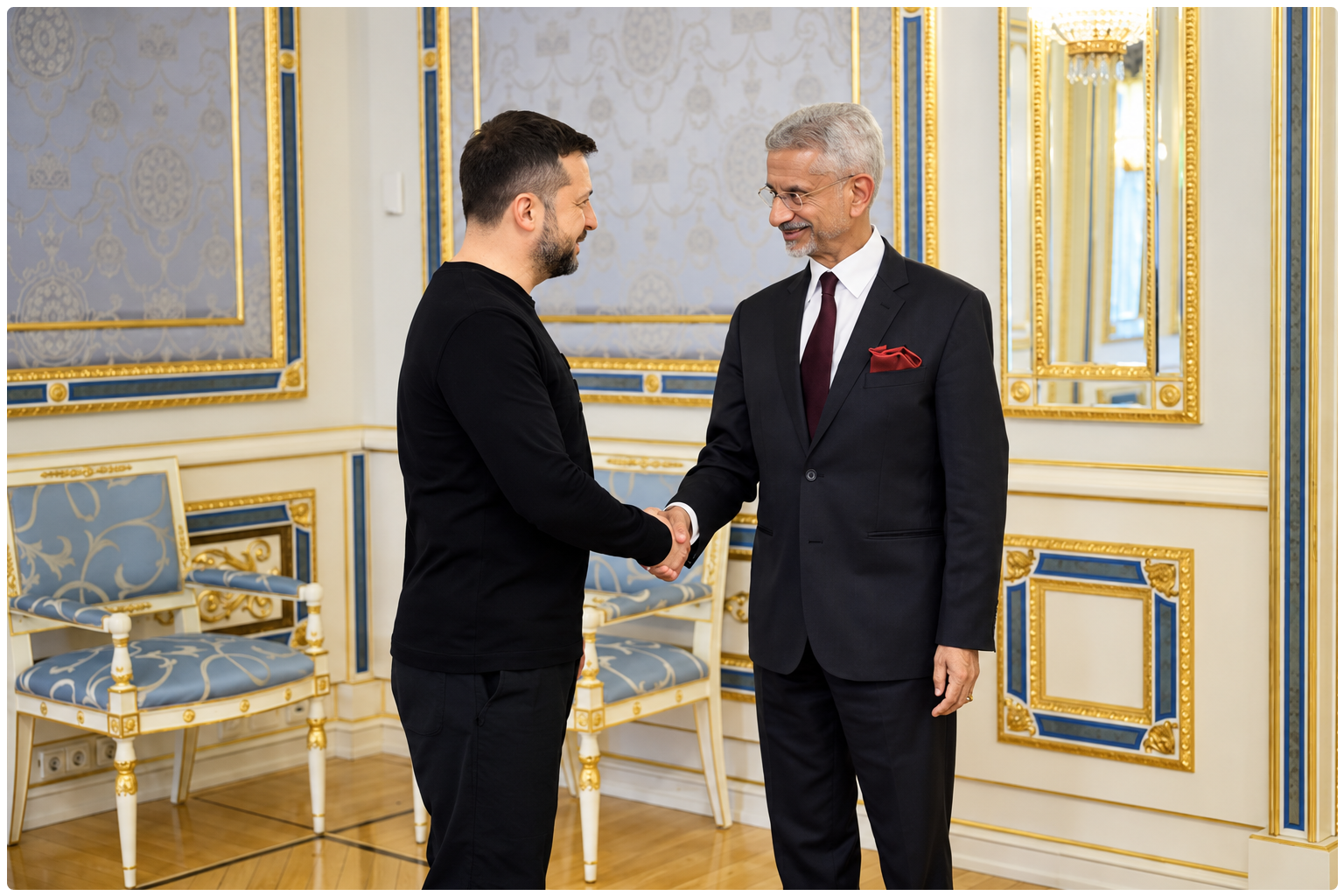
External Affairs Minister S. Jaishankar has defended India's continued purchases of Russian oil during a visit to Kyiv, telling Ukraine that New Delhi's responsibility to secure energy for 1.4 billion people must also be respected.
Speaking after meetings with Ukrainian President Volodymyr Zelenskyy and Foreign Minister Andrii Sybiha on Thursday, Jaishankar acknowledged Kyiv's objections to countries continuing to buy Russian energy but made clear that India viewed the issue differently.
“Clearly the Ukraine side has its perspective, which we respect, and we have ours, which I would expect others to also respect,” Jaishankar said.
He argued that stopping purchases of Russian commodities would not by itself bring the war to an end.
“This conflict... will not dissolve because somebody is buying or not buying oil or alumina or minerals or metals,” he said. “This conflict will be solved by dialogue, by diplomacy, by negotiations.”
The remarks underline India's continued resistance to pressure over its economic relationship with Moscow. Russia emerged as one of India's largest crude suppliers after its invasion of Ukraine in 2022, as Western sanctions and restrictions allowed Indian refiners to purchase Russian barrels at discounted prices.
India's dependence on Russian crude has risen further in recent months as conflict in the Middle East disrupted traditional supply routes. Russian oil accounted for more than half of India's crude imports in June and July, with volumes exceeding 2.6 million barrels per day.
The Gulf conflict has complicated India's energy calculations. Disruption around the Strait of Hormuz, through which a significant share of global oil and gas supplies normally passes, has pushed India to seek alternative supplies. As a result, refiners have increased purchases from Russia, including crude originating in the Russian Far East.
The issue has also become increasingly important in India's relationship with Washington. The US Senate recently passed legislation that would give President Donald Trump authority to impose tariffs of up to 100% on goods from countries that remain among the largest purchasers of Russian oil or natural gas. India and China are among the major buyers that could be affected if such measures are imposed.
Jaishankar nevertheless stressed that India's energy policy must take into account the scale of domestic demand and an increasingly difficult global energy environment.
His visit also addressed the broader consequences of the war. Jaishankar raised attacks on commercial shipping, noting that Indian sailors working aboard vessels under different flags have been among the casualties. He said disruption to shipping was contributing to fuel, food and fertiliser shortages across countries in the Global South.
Despite the disagreement over Russian oil, India reiterated its support for a negotiated end to the conflict. Jaishankar said New Delhi was willing to assist peace efforts “in any manner,” while Zelenskyy thanked India for its commitment to ending the war.
India's position therefore remains largely unchanged: it continues to call for dialogue between Moscow and Kyiv while maintaining that its trade and energy decisions will be determined primarily by its own economic and energy-security requirements.