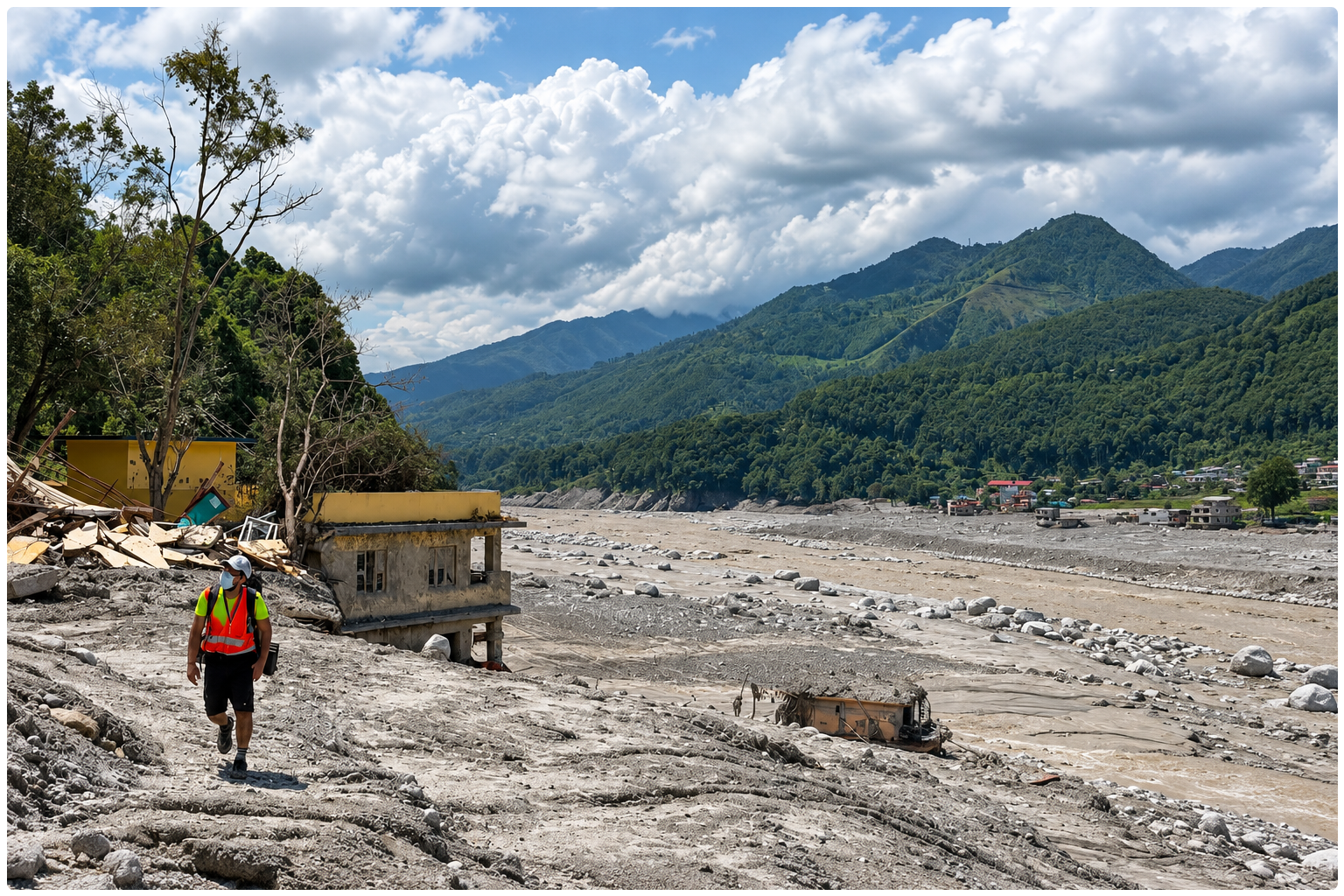
Nearly three weeks after a collapsing Himalayan glacier unleashed one of the deadliest floods in Nepal’s modern history, thousands of families still do not know whether their relatives are alive or dead.
More than 5,130 people remain missing in Nepal, while another 519 are unaccounted for in Tibet. At least 1,386 people have been confirmed dead in Nepal and 43 in Tibet. But behind those numbers are families trying to reconstruct the final minutes before someone they loved simply disappeared.
For the family of 67-year-old Anil Goel, those final minutes have been preserved in a photograph. Goel, a retired World Bank employee from Virginia, was travelling towards Mount Kailash when he reached the Rasuwagadhi immigration checkpoint on the Nepal-Tibet border on August 26. Roughly 35 to 45 minutes before the flood devastated the area, he sent his family a photograph showing members of his group at the crossing. His son Anurag later said passport records and WhatsApp messages indicated the group was still around the border when communications stopped.
His children have tried to determine whether he crossed into Tibet before the flood hit, while appealing for greater information about both the missing and the unidentified dead. But two extraordinary rescues have made it almost impossible for families like theirs to abandon hope.
Sanjay Sah, a 30-year-old mechanical foreman at the Upper Trishuli 3A Hydropower Station, was trapped underground when floodwater and debris tore through the project. For nine days he remained inside the darkness of the tunnel with no food, surviving on floodwater and seepage from the mountain.
When rescuers finally reached him on September 4, Sah had lost track of time. He later said he had spent long periods with his eyes closed in the darkness and recited the Maha Mantra to keep himself going. His survival, alongside fellow worker Kabir Maharjan, has become the only glimmer of hope in a disaster where thousands remain missing
New videos of the flash flooding in Nepal
— Paul Robertson 🇺🇸 (@ShadeSalvo) September 9, 2026
This is incredibly sad…
Cars, buildings, bridges, lives…all taken out in an instant 😬 pic.twitter.com/4CIq80fxX5
64-year-old Chandika Kumari Shrestha disappeared when the floods struck Betrawati. Her family believed she was dead and had already begun Nepal's traditional mourning rites. Ten days after the disaster, rescuers inspecting the remains of a four-storey building heard a voice. Shrestha was alive and she had survived inside a small pocket within the collapsed structure, surrounded by water and mud. A police team spent about 45 minutes extracting her before she was taken for treatment.
Stories like these are both a blessing and a torment for families still waiting.
They prove that people can survive for days in places rescuers initially believed unsurvivable. But they also make it harder to accept that a missing relative may never return.
The physical search remains enormous. Around 2.2 million tonnes of debris are believed to cover parts of the disaster zone. Roads have vanished, slopes remain unstable and entire structures lie buried beneath mud and rock. Families have turned to hospitals, DNA testing, embassies and online missing-person networks as official searches continue.
Nepal is already discussing reconstruction and billions of dollars in international assistance.
For the families still studying photographs, checking hospital lists and waiting for DNA results, that conversation feels premature.
After what happened to Sanjay Sah and Chandika Shrestha, hope has become very difficult to surrender.