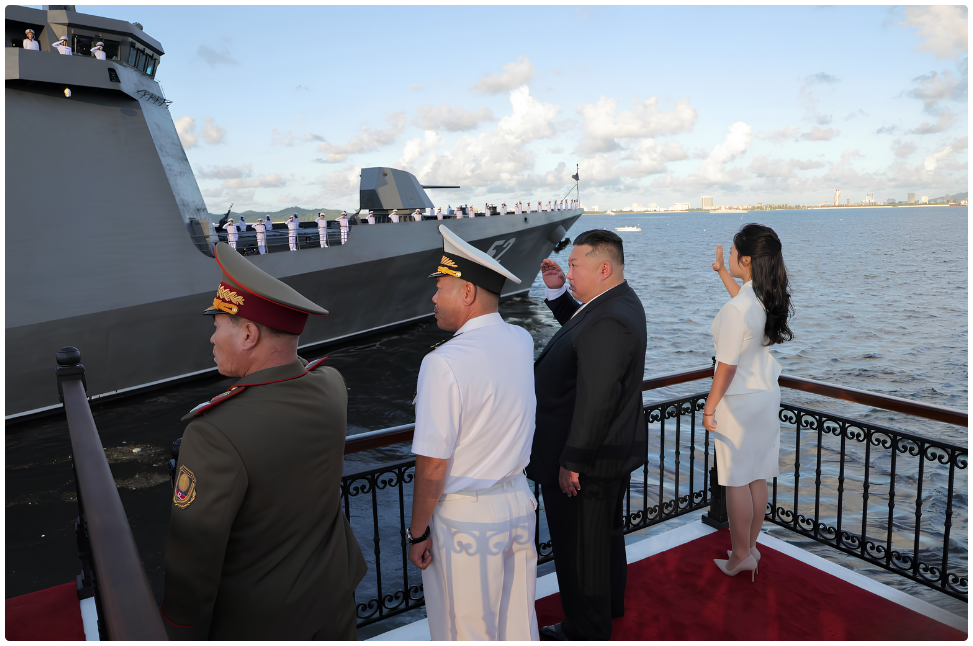
North Korea has commissioned a new 5,000-ton destroyer that leader Kim Jong Un says will form part of the country's nuclear response system, marking another major step in Pyongyang's effort to transform its ageing navy into a force capable of delivering strategic weapons from the sea.
The Kang Kon was formally commissioned on Sunday at Wonsan on North Korea's eastern coast, with Kim attending the ceremony alongside his wife Ri Sol Ju and daughter Kim Ju Ae.
Kim described the vessel as “essentially an offensive destroyer” and said it should be capable of delivering a “deadly retaliatory blow” against North Korea's enemies. He said the ship would operate as part of the country's “state nuclear counteraction system” and called for the navy to develop into a nuclear-armed force.
The Kang Kon has been assigned to the Korean People's Navy's East Sea Fleet. It is the second of North Korea's new Choe Hyon-class destroyers to enter service, following the commissioning of the Choe Hyon in June.
The two ships represent a significant technological leap for a North Korean navy historically dominated by smaller and ageing vessels.
The class is heavily armed for its size. Defence analysts examining imagery of the Choe Hyon have identified dozens of vertical launch system cells capable of accommodating different types of missiles, alongside anti-aircraft, anti-ship and anti-submarine weapons.
The US Naval Institute reported that the Choe Hyon entered service with 88 vertical launch cells following modifications, some of which are believed capable of carrying land-attack weapons. Among the weapons potentially available to the class is the nuclear-capable Hwasal-2 land-attack cruise missile, which has an estimated range of about 1,000 nautical miles.
The vessels also carry a large-calibre naval gun, torpedoes and close-in defence systems, while their rear flight decks can accommodate a helicopter or unmanned aircraft.
However, describing the Kang Kon as “nuclear-capable” requires an important distinction.
North Korean state media did not say that nuclear weapons had actually been placed aboard the destroyer. Instead, Kim's comments indicate that the vessel is intended to become part of the country's broader nuclear strike and retaliation architecture.
That distinction does little to reduce the strategic significance of the programme.
North Korea has traditionally relied overwhelmingly on land-based ballistic and cruise missiles for its nuclear deterrent. Deploying nuclear-capable cruise missiles aboard surface warships would give Pyongyang another potential launch platform and make its arsenal more difficult to track and neutralise during a conflict.
Analysis by 38 North suggests North Korea has been steadily diversifying its nuclear delivery systems beyond land-based missiles. Pyongyang has equipped surface vessels with dual-capable land-attack cruise missiles, pursued ballistic-missile submarines and assigned a nuclear mission to parts of its air force.
The Kang Kon itself has had an unusual path into service. The ship suffered a highly publicised accident during its original launch ceremony in May 2025, partially capsizing at the Chongjin shipyard. Kim publicly condemned the incident, and the vessel was subsequently salvaged, repaired and relaunched before undergoing weapons and sea trials.
Its commissioning comes as the United States, South Korea and Japan conduct their latest Freedom Edge trilateral military exercise. North Korea has repeatedly condemned such exercises as rehearsals for war, while Washington, Seoul and Tokyo describe them as defensive training intended to improve their ability to respond to regional threats.
Kim has made clear that the two destroyers are not intended to be the end of North Korea's naval expansion .
Pyongyang has outlined plans for additional large surface combatants and is also pursuing a nuclear-powered submarine. At Sunday's ceremony, Kim promised further powerful strategic assets and said the world would see evidence of another important naval development within eight months.
For decades, North Korea's nuclear threat has primarily been associated with missiles launched from concealed positions on land. The arrival of heavily armed destroyers such as the Kang Kon suggests Pyongyang now wants to extend that deterrent to sea adding another dimension to the military challenge facing South Korea, Japan and US forces in the region.