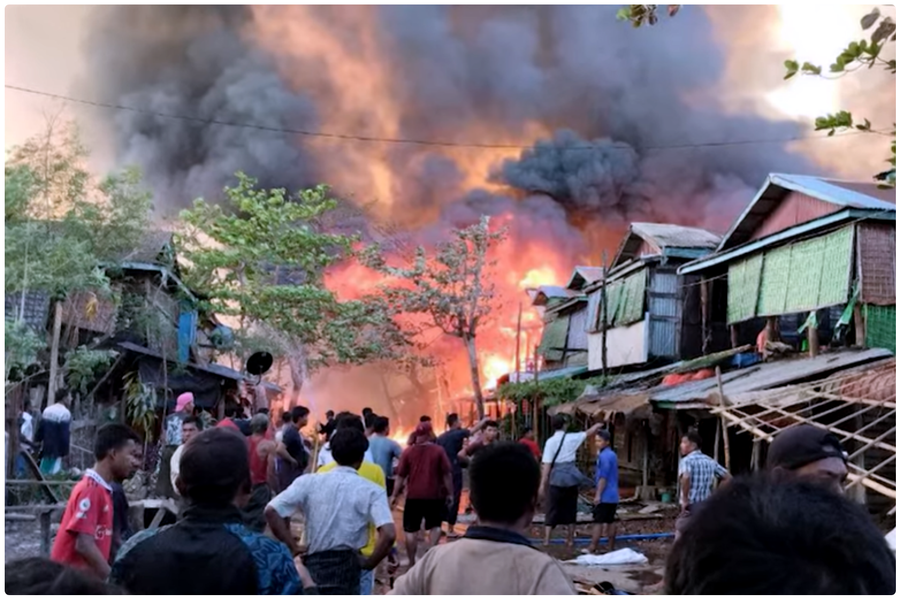
Oil prices are racing towards $110 a barrel as the Middle East's supply crisis spreads from the Strait of Hormuz to the Red Sea, raising fears that disruption could hit several of the world's most important energy routes at the same time.
Brent crude climbed as high as $109.97 a barrel on Friday, its highest level in nearly four months, after jumping more than 6% in the previous session. West Texas Intermediate has also moved above $100. Brent is now on course to finish the week above $100 for the first time since May, having gained nearly 13% this week alone. What began as a risk premium over the US-Iran conflict is increasingly becoming a much broader supply problem.
The biggest pressure remains the Strait of Hormuz. Roughly a fifth of the world's oil and liquefied natural gas normally passes through the narrow waterway between Iran and Oman, but tanker traffic has fallen sharply during the conflict. Iran said it attacked 10 ships near the strait this week after the United States struck five Iranian oil tankers, marking the largest declared exchange of attacks against shipping since the war began. Some tankers have continued crossing with their tracking systems switched off, but reports estimate that Gulf oil exports are still running at only around two-thirds of pre-war levels.
The danger is that the crisis is no longer confined to Hormuz. Iran-aligned Houthis have seized Mocha on Yemen's western coast and are pushing towards positions overlooking Bab el-Mandeb, the narrow passage connecting the Red Sea with the Gulf of Aden. The group has also attacked Saudi cities and energy infrastructure. For Saudi Arabia, this creates a particularly difficult problem. Its east-west pipeline allows crude to bypass Hormuz and reach the Red Sea port of Yanbu, but oil heading from there towards Asian markets must eventually sail through Bab el-Mandeb. A serious disruption there would put pressure on the alternative route designed to reduce Saudi dependence on Hormuz.
⚡️WATCH: Mass Surrender of Pro-Saudi Forces to Yemen's Houthis in Khalid Bin Walid Military Camp pic.twitter.com/VKlqzSf3Ar
— Iran Observer (@IranObserver0) September 10, 2026
There are problems elsewhere too. OPEC production fell by around 640,000 barrels per day in August, while Ukrainian attacks on Russian refineries continue to affect another major energy producer. US crude inventories also declined last week. The result is a market with fewer comfortable buffers just as geopolitical risk is spreading across several producing regions.
And the consequences are moving well beyond petrol stations. Surging energy prices are feeding fears that inflation could remain stubbornly high, forcing central banks to keep interest rates elevated or raise them again. Global bond markets have already sold off sharply, with the US 10-year Treasury yield approaching 5%. Asian stock markets have fallen, but India, one of the world's largest crude importers, has so far shown notable resilience. The Nifty 50 and Sensex have come under pressure as Brent moved above $108, yet India's diversified energy sourcing, substantial foreign-exchange reserves and policy measures have helped cushion the impact, keeping the country's financial system stable and its economy better positioned than many peers to absorb a temporary oil shock.
There is still no certainty that oil will stay near $110. A diplomatic breakthrough that restores reliable passage through Hormuz could send prices lower quickly. Demand is also not particularly strong: OPEC has repeatedly reduced its forecast for global oil-demand growth this year. But traders are increasingly assuming that the Middle East conflict will last longer than previously expected, and that means every tanker attack, Houthi advance or strike on energy infrastructure can produce another jump in prices.
The greater danger now is not simply that one oil route could be disrupted. It is that several could come under pressure together. Hormuz is already operating far below normal levels. The Houthis are advancing towards Bab el-Mandeb. Saudi energy infrastructure is again being targeted.