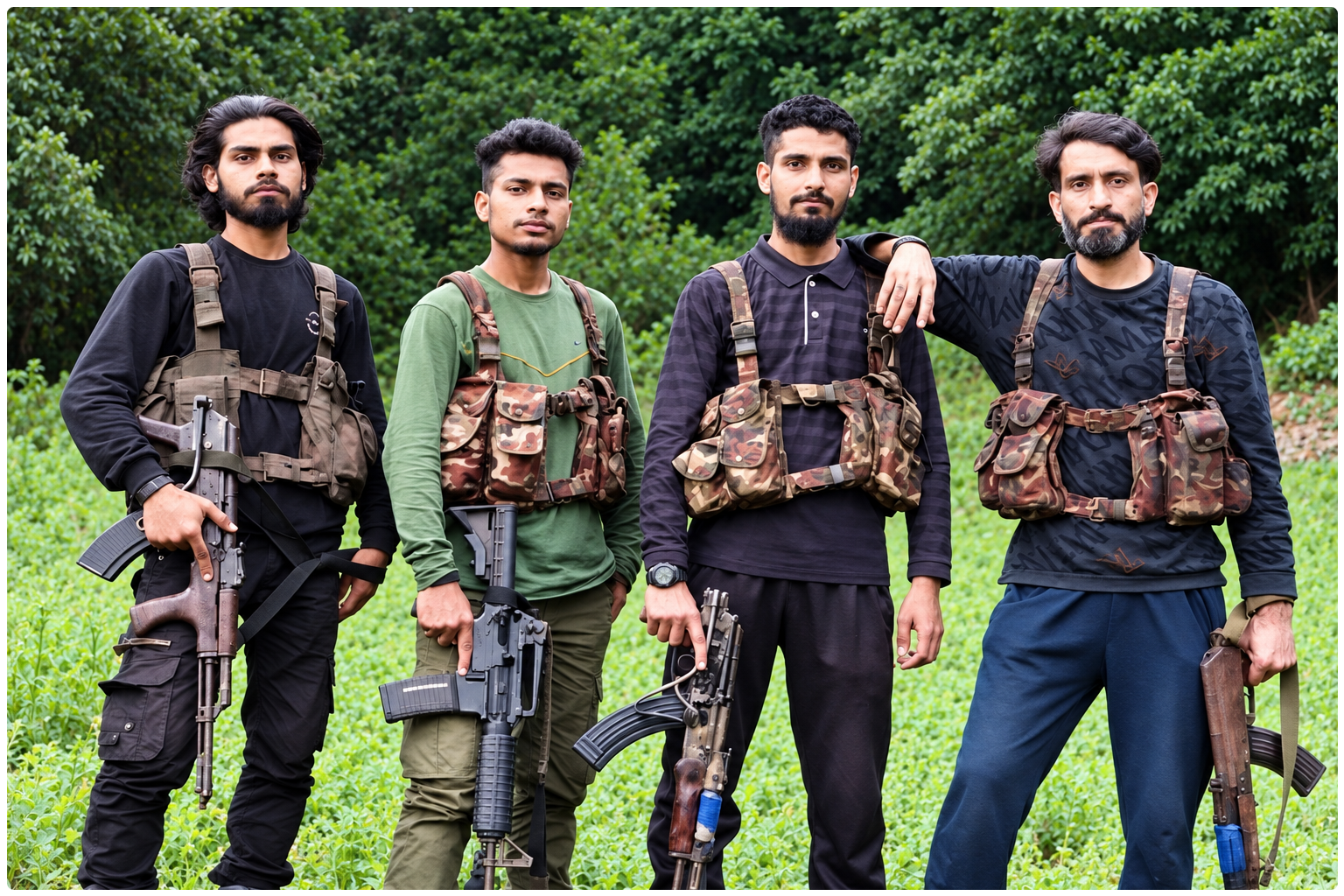
Security forces have recovered the body of a Pakistani Lashkar-e-Taiba militant identified as Mohammad Asif alias Hashim Moosa following an overnight encounter in Jammu and Kashmir’s Budgam district.
The Army said the body was found early Wednesday in the Palmaidan area, along with what it described as “war-like stores”. The recovery followed a gunfight near Korag in the upper reaches of Yousmarg, where a joint team had launched a search operation based on specific intelligence.
The operation involved the Indian Army, Jammu and Kashmir Police and the Central Reserve Police Force. According to the Army’s account, troops detected suspicious movement on Tuesday and challenged the individuals. The militants allegedly opened fire, leading to an exchange in which one was killed.
Update: OP KORAG
— Chinar Corps🍁 - Indian Army (@ChinarcorpsIA) September 30, 2026
Further to the ongoing operation, during the search early morning in General Area Palmaidan, body of Pak based Lashkar-e-Taiba ( LeT) terrorist, identified as Mohammad Asif alias Hashim Moosa recovered along with war like stores.
Operation under progress.…
Searches continued after the firing stopped, and the body was recovered the following morning. The security operation remained in progress as forces searched the surrounding forest for possible associates, weapons and supplies.
Initial reports described Mohammad Asif as a suspect in the April 2025 Pahalgam attack, in which 26 civilians were killed at Baisaran Valley. All of those killed were Hindu tourists, this shooting triggered a major security operation across Kashmir as well as a sharp military confrontation between India and Pakistan.
However, the connection requires clarification because the alias Hashim Moosa was previously associated with a different militant whom the Indian government said had been killed in July 2025.
Following Operation Mahadev near Dachigam, Union Home Minister Amit Shah told Parliament that three Pakistani Lashkar-e-Taiba militants named Suleman, Hamza Afghani and Jibran had carried out the Pahalgam attack and had been killed by security forces. Suleman had widely been identified at the time as Hashim Moosa or Hashim Musa.
The government said witnesses who had sheltered the attackers identified the three bodies. It also said forensic testing matched weapons recovered from the militants with cartridges collected from the Pahalgam attack site. Shah told Parliament that all three gunmen responsible for the killings had been eliminated.
The Army’s public statement confirmed the dead militant’s name, alias and alleged affiliation with Lashkar-e-Taiba but did not describe him as a Pahalgam attacker. No detailed statement linking Mohammad Asif to the massacre had been issued by the National Investigation Agency at the time of publication.
Lashkar-e-Taiba is based in Pakistan and has carried out numerous attacks in India. Indian authorities also identify The Resistance Front, which initially claimed responsibility for the Pahalgam killings before withdrawing the claim, as a Lashkar proxy.
The National Investigation Agency has chargesheeted Lashkar-e-Taiba, The Resistance Front and several individuals in the Pahalgam case. A supplementary chargesheet filed in July 2026 also named Lashkar chief Hafiz Saeed as an accused in the wider conspiracy.
The Budgam encounter is therefore a confirmed security operation in which a Pakistani Lashkar militant was killed. His reported involvement in the Pahalgam attack remains less certain and will require an official explanation reconciling the latest identification with the government’s earlier statement that all three attackers died during Operation Mahadev.