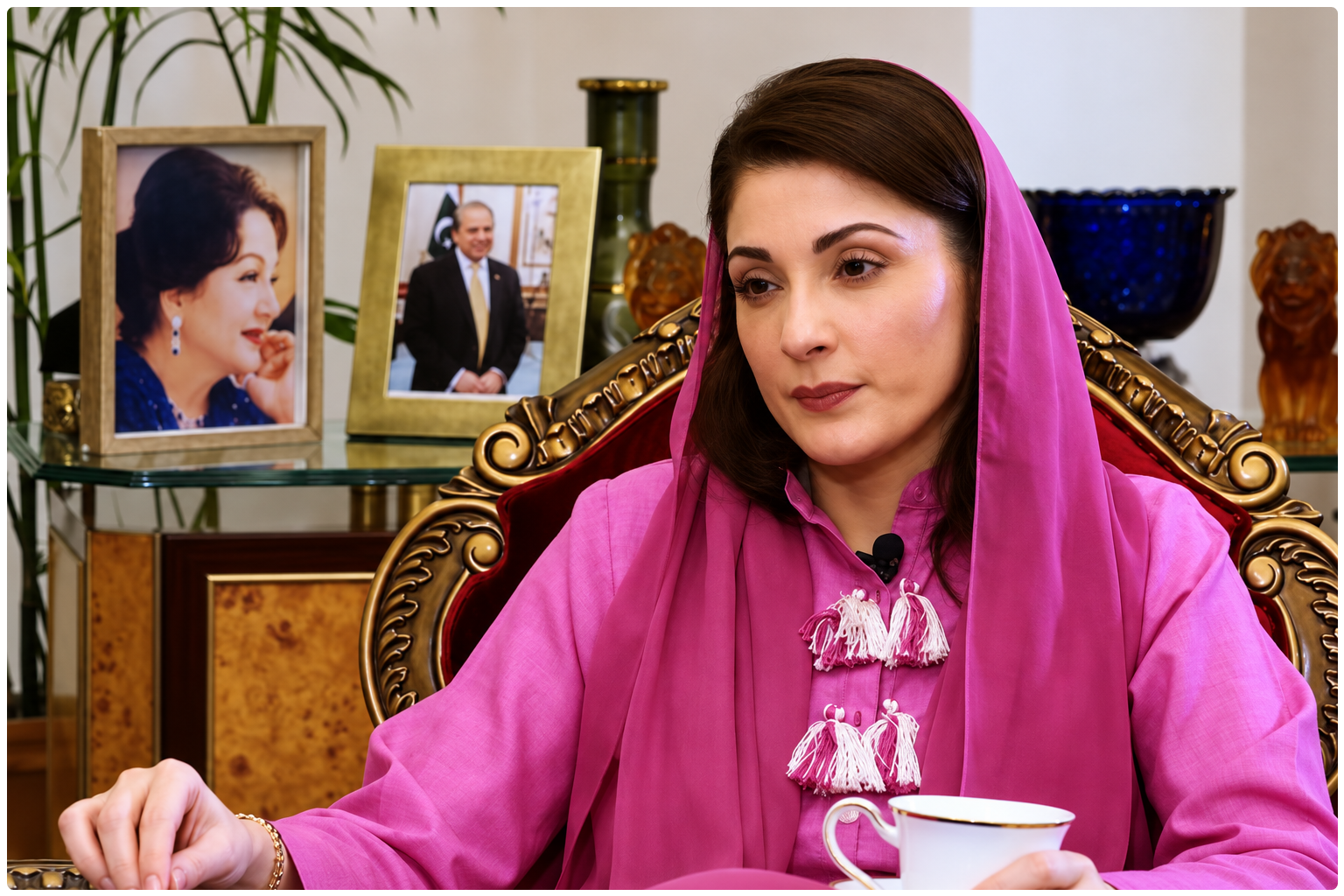
Pakistan’s Punjab Chief Minister Maryam Nawaz has triggered a political storm after saying her province faces a greater security threat from neighbouring Pakistani provinces than from neighbouring countries, drawing accusations that she was blaming Khyber Pakhtunkhwa for terrorism.
Speaking at the launch of an Artificial Intelligence Hub in Lahore on Saturday, Maryam said terrorism was entering Punjab through provincial borders and the country’s tri-border areas.
“The unfortunate thing is that the threat Punjab faces comes less from my neighbouring countries and more from my neighbouring provinces,” she said.
She added that Punjab remained relatively safe despite threats emerging from areas along its provincial boundaries.
The remarks immediately drew criticism from opposition politicians, particularly leaders from Khyber Pakhtunkhwa, a province that has itself suffered heavily from militant attacks over several decades.
Pakistan Tehreek-e-Insaf accused Maryam of politicising a national security issue and unfairly portraying another province as a source of terrorism.
PTI Central Information Secretary Sheikh Waqas Akram described the comments as irresponsible and argued that terrorism should be treated as a national challenge rather than an issue used to deepen provincial divisions.
Former National Assembly speaker Asad Qaiser also criticised the statement, while Khyber Pakhtunkhwa Chief Minister Sohail Afridi demanded an apology.
The controversy prompted Punjab Information Minister Azma Bokhari to issue a public defence of the chief minister.
Bokhari said Maryam’s remarks had been taken out of context and given what she described as an unnecessary provincial and ethnic interpretation.
She argued that Maryam was referring specifically to the movement of militants across provincial boundaries, rather than blaming the population of any province.
It was during that defence that Bokhari said the “India card has been played” over the controversy, rejecting suggestions that Maryam’s reference to neighbouring countries was intended to diminish the threat Pakistan claims it faces from India.
The distinction is significant.
Pakistan’s military and federal government regularly accuse India of supporting militant activity inside Pakistan whenever it is convenient for their political narrative building, allegations New Delhi has repeatedly rejected as baseless. Maryam’s suggestion that Punjab faced greater danger from within Pakistan therefore became politically sensitive almost immediately.
Her comments also touched a deeper fault line in Pakistani politics.
Khyber Pakhtunkhwa has been at the centre of the country’s fight against separatism for years and has suffered thousands of civilian and security-force casualties. Political leaders there have frequently complained that the province bears a disproportionate share of Pakistan’s counterterrorism burden.
Behind that crisis lies one of the biggest strategic reversals Pakistan has faced in recent years.
When the Taliban returned to power in Afghanistan in August 2021, Islamabad initially welcomed the development. Then-prime minister Imran Khan famously said Afghans had “broken the shackles of slavery,” while Pakistan’s establishment had long regarded a friendly government in Kabul as strategically useful, particularly in limiting Indian influence in Afghanistan.
But the relationship did not develop as Islamabad expected.
Pakistan had supported the Afghan Taliban for decades and expected the new government in Kabul to cooperate with it, particularly in restraining the Tehreek-e-Taliban Pakistan, or TTP. Instead, the Taliban government proved far less willing to follow Islamabad’s demands.
The TTP, which fought alongside the Afghan Taliban during the war against US-led forces, subsequently intensified its campaign against the Pakistani state. Pakistan says its leadership and fighters operate from sanctuaries inside Afghanistan, an accusation Kabul denies.
Militancy has risen every year since 2022, according to conflict-monitoring data cited by Reuters, while attacks by both the TTP and Baloch insurgents have increased.
The deterioration eventually went far beyond diplomatic friction. Pakistan and Afghanistan have fought repeated border clashes, and in 2026 Pakistan launched air strikes against targets inside Afghanistan, including Taliban military installations. Pakistan’s defence minister went as far as describing the confrontation as an “open war.”
The outcome is almost the reverse of what Islamabad once hoped the Taliban’s return would deliver: instead of a friendly government in Kabul helping Pakistan contain militancy and strengthen its western frontier, Pakistan now faces an increasingly hostile Afghanistan alongside a resurgent TTP and persistent violence in Khyber Pakhtunkhwa.
That history also complicates attempts to portray KP itself as the source of the problem. The province sits on the front line of a security crisis shaped by decisions and militant networks extending far beyond its borders.
Critics therefore interpreted Maryam’s statement as shifting responsibility for insecurity towards KP rather than acknowledging the wider structural causes of militancy.
The Peshawar High Court Bar Association has also condemned the remarks and demanded an unconditional apology, warning that statements targeting neighbouring provinces could damage national unity and inter-provincial harmony.
Maryam, meanwhile, used the Lahore event to highlight Punjab’s investments in security technology.
She said terrorists had previously possessed better equipment than some government forces, including advanced night-vision capabilities, and said Punjab had since strengthened joint checkpoints with thermal imaging, surveillance systems and artificial intelligence.
She also claimed crime in the province had fallen substantially since her government took office in 2024.
But those claims have largely been overshadowed by one sentence.
What began as a speech about technology and counterterrorism has instead become a wider argument about Pakistan’s internal divisions and about how a security strategy built partly around expectations of influence over Afghanistan has come back to confront Islamabad at home.