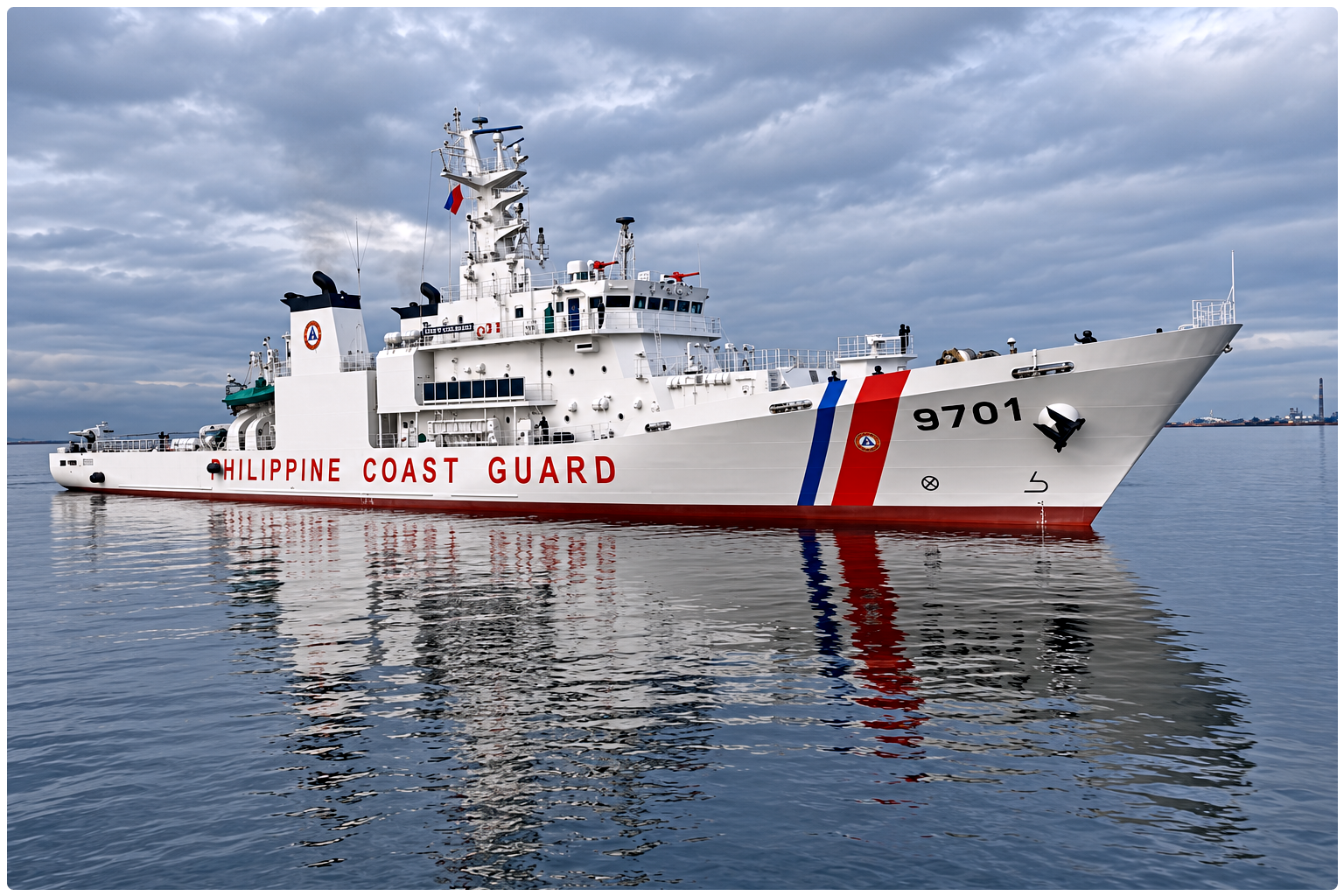
The Philippines has deployed its largest coastguard vessel and an aircraft to confront a Chinese research ship operating near its northernmost islands, opening another point of friction between Manila and Beijing close to Taiwan and the strategically important Luzon Strait.
The Philippine Coast Guard sent the 97-metre BRP Teresa Magbanua after the Chinese-flagged JIA HAI KE 7 was detected about 37 nautical miles northwest of Itbayat Island in Batanes province. The vessel had reportedly remained in the area since September 28, despite Manila’s objections to what it described as unauthorised marine scientific research.
The location placed the Chinese ship outside the Philippines’ 12-nautical-mile territorial sea but within its 200-nautical-mile exclusive economic zone. Foreign ships retain navigation rights within an exclusive economic zone, but the United Nations Convention on the Law of the Sea allows coastal states to regulate and authorise marine scientific research there.
PCG DISRUPTS AND DRIVES AWAY CHINESE RESEARCH VESSEL JIA HAI KE 7 FROM ITS LOITERING POSITION OFF BATANES DESPITE CHINA COAST GUARD SHIELDING
— Jay Tarriela (@jaytaryela) October 1, 2026
The Philippine Coast Guard (PCG) successfully disrupted the unauthorized marine scientific research (MSR) of the Chinese research vessel… pic.twitter.com/jSxBUbtSkb
The Teresa Magbanua approached to within approximately 100 yards of the research vessel. Its crew also deployed a rigid-hull inflatable boat that circled the JIA HAI KE 7 while issuing radio challenges and ordering it to explain its activities.
Philippine authorities said the Chinese vessel repeatedly changed course to evade the smaller boat. The operation eventually forced it to leave the position where it had been loitering, although the coastguard continued monitoring the vessel to ensure that it exited the Philippine exclusive economic zone.
The confrontation widened when a China Coast Guard vessel arrived and positioned itself near the research ship. It issued its own radio challenges and attempted to shield the JIA HAI KE 7 from the Philippine operation. No collision, weapons fire or injuries were reported.
China said the vessel was conducting normal operations in waters under Chinese jurisdiction and accused the Philippines of harassment. Beijing called on Manila to stop interfering with the ship, highlighting the conflicting positions held by the two countries over maritime rights in the region.
The Philippine Coast Guard had previously accused the JIA HAI KE 7 of transmitting misleading location information while operating near Batanes. It also questioned why a privately owned research vessel received direct support from the China Coast Guard, arguing that the intervention raised questions about the ship’s relationship with the Chinese state.
The waters surrounding Batanes are especially sensitive. The islands sit in the Luzon Strait between the Philippines and Taiwan, near important shipping routes and submarine communications cables. Scientific surveys can collect information about currents, marine ecosystems and seabed geology, but detailed seabed data may also have strategic value for submarine operations and mapping underwater infrastructure.
The confrontation comes as the Philippines strengthens its strategic relationship with India. The two countries elevated their ties to a Strategic Partnership in August 2025, with maritime security and defence cooperation becoming important pillars of the relationship.
Manila has acquired the Indian-made BrahMos shore-based anti-ship missile system under a $375 million agreement, giving the Philippines a powerful coastal-defence capability. Their growing cooperation was visible again this week as the second ASEAN-India Maritime Exercise began in Subic Bay.
India and the Philippines have repeatedly emphasised freedom of navigation, adherence to international law and the peaceful settlement of maritime disputes. Their expanding defence relationship gives Manila another important Asian security partner at a time when confrontations with China are becoming more frequent.
The encounter occurred away from the reefs and shoals where most recent Philippine-Chinese confrontations have taken place. Manila and Beijing have repeatedly clashed around Scarborough Shoal and the Second Thomas Shoal, where Chinese vessels have used water cannon, blocking manoeuvres and close approaches against Philippine ships.
An international tribunal ruled in 2016 that China had no legal basis for claiming historic rights across most of the South China Sea. Beijing rejected the decision. The latest operation suggests that the confrontation is extending northwards, bringing Chinese and Philippine government vessels into close contact near one of East Asia’s most strategically important waterways.