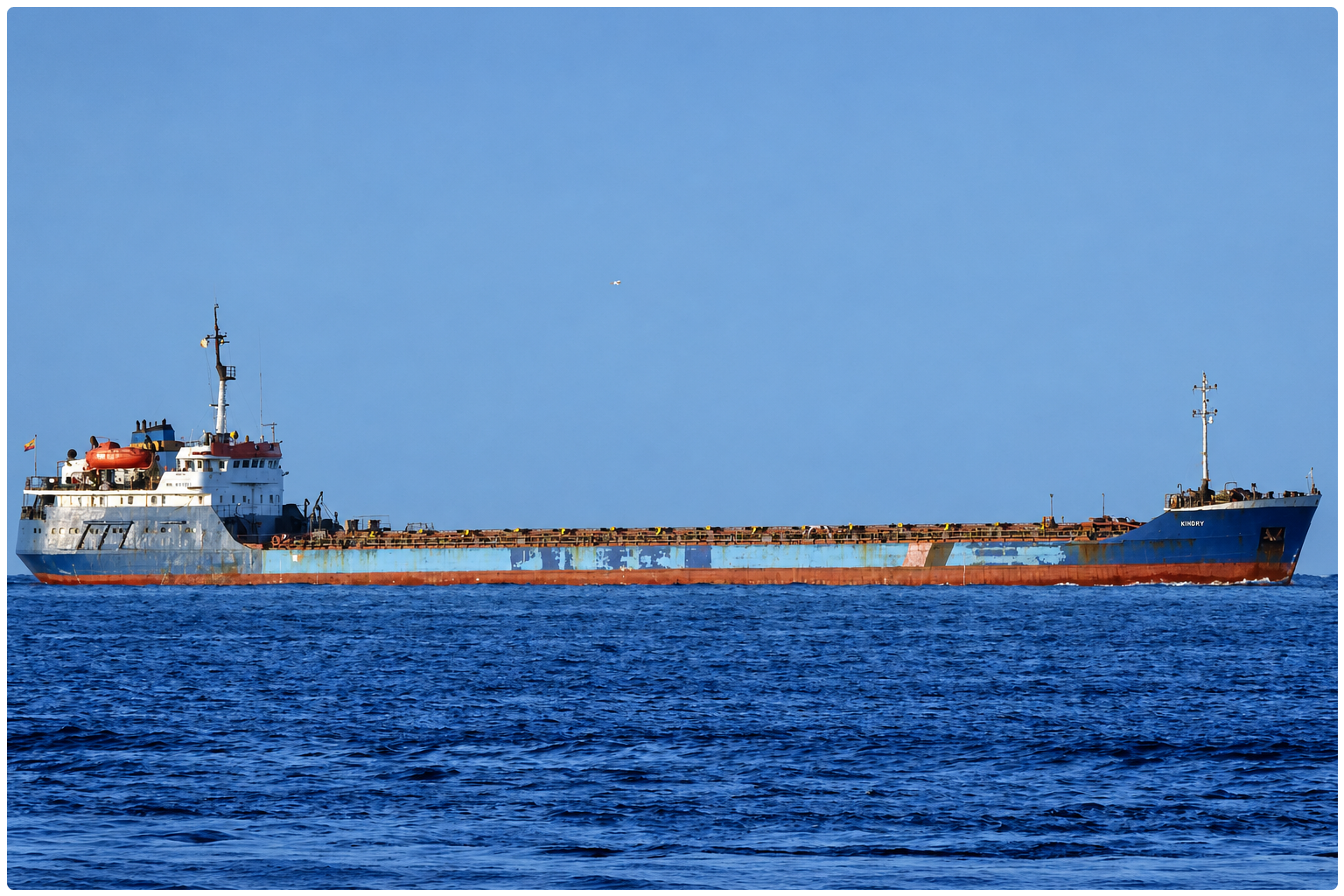
The Khoryv was approaching Romania's Black Sea coast when a fire broke out aboard the vessel on Friday morning. Within hours, the Comoros-flagged cargo ship had capsized, leaving one sailor dead and three others missing. Romania's president blamed Russia, drawing the latest commercial shipping disaster into a widening confrontation over security in the Black Sea.
The vessel issued a distress call at approximately 10 am local time, around 13 nautical miles east of Constanța, just beyond Romania's territorial waters. According to statements issued by the Romanian Naval Authority and the Ministry of Internal Affairs, the ship carried 13 crew members, comprising ten Ukrainian and three Azerbaijani nationals. Nine survived, while rescue teams recovered one body and continued searching for three missing sailors.
Seventh bulk carrier sank off the cost of Romania after being attacked for ferrying military goods to/from Ukraine: https://t.co/cwL2QPquks
— Bashkarma🇺🇸🌏🇷🇺 (@Karmabash) October 23, 2026
The first rescue came from another commercial vessel operating nearby. Its crew recovered ten sailors, including the one who had died, before the survivors were transferred to a Romanian Coast Guard vessel. Emergency teams were subsequently deployed from the Romanian Agency for Saving Human Life at Sea, while strong winds and poor visibility prevented an immediate helicopter operation.
President Nicușor Dan identified a drone strike as the cause of the sinking and accused Russia of escalating the war's consequences beyond Ukraine. In his public remarks on October 23, Dan described the incident as part of the continuing escalation associated with Moscow's military campaign and called for an end to the fighting.
The Romanian authorities have not publicly released forensic findings identifying the drone used against the Khoryv. Its precise origin, operator and intended target therefore remain unverified, even as Bucharest attributes responsibility to Russia.
The attack occurred against an increasingly troubled maritime security environment. Romanian authorities have documented repeated drone incursions, explosions and unidentified aerial objects around the country's eastern frontier. On October 17, two Romanian F-16 fighters intercepted and destroyed drones over Romanian territorial waters, with the Defence Ministry identifying them as jet-powered attack drones belonging to the Geran family.
That incident was unrelated to the Khoryv sinking, but it demonstrated how frequently Romania's military is being called upon to respond to threats crossing from the conflict zone.
The scale of the problem is reflected in the Defence Ministry's published incident figures. As of October 21, Romanian authorities had recorded 54 unauthorised drone incursions since the beginning of Russia's full-scale invasion of Ukraine, along with six drones shot down and nine drifting naval mines neutralised by Romanian forces.
Romania had already sought NATO assistance with these threats. During a North Atlantic Council meeting in June, Bucharest raised concerns about maritime drones and requested faster access to allied counter-drone capabilities. The discussions extended to protecting the Danube Delta and maintaining security around the Black Sea.
More recently, at an October 22 meeting with the chairman of the European Union Military Committee, Romanian defence officials called for stronger maritime surveillance, early warning systems and regional coordination.
The sinking also exposes a practical limitation in protecting civilian shipping. Military aircraft can intercept drones entering national airspace, but commercial vessels beyond territorial waters remain vulnerable to attacks that may unfold faster than coastal forces can respond.
For the families of the missing sailors, the immediate concern remains the search at sea. For Romania and its NATO partners, the sinking raises a harder question: how to protect commercial shipping along a coastline increasingly exposed to weapons from the war in Ukraine.