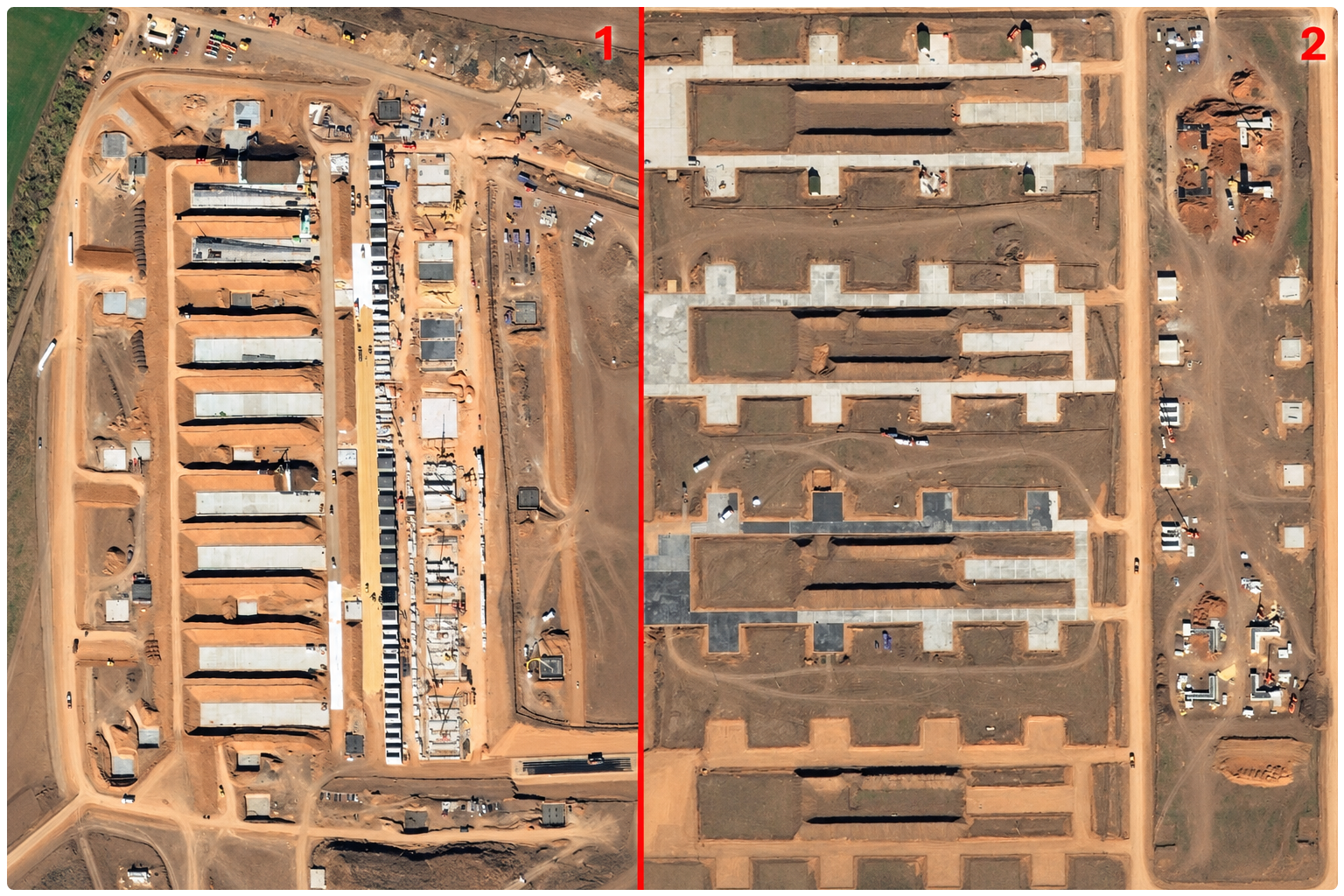
Russia has transformed a field near its Millerovo military airfield into a large drone-launch installation in just six weeks, adding eight launch platforms to a region already used for attacks on Ukraine. Satellite imagery shows construction approaching completion, with the facility apparently intended to accommodate a newer generation of jet-powered drones that Ukrainian forces are struggling to intercept.
The installation lies in Russia's Rostov region, approximately 3.5 kilometres from the existing airbase. Covering nearly 0.9 square kilometres, or roughly 126 football pitches, it has taken shape at remarkable speed. Commercial satellite photographs from August 31 showed an undeveloped field with a few vehicles. By October 14, eight launch platforms and 32 drone-preparation positions were visible, alongside additional infrastructure.
🇷🇺🇺🇦 Satellite imagery shows that Russia managed to build an entire drone port within the last 30 days. More of these are popping up every month. https://t.co/bckRdrtRNa
— Heyman_101 (@SU_57R) October 13, 2026
Ukrainian open-source intelligence researchers first identified the construction on October 13. Subsequent examination of Planet Labs and Airbus imagery established that two launch platforms already had rails installed, with work progressing on at least two others. Images from October 12 also appeared to show drones being unloaded at the site.
Defence specialists believe the facility is being prepared for Russia's Geran-4 and Geran-5 attack drones. Unlike the slower, propeller-driven Shahed models used extensively since the early stages of the war, these newer aircraft use jet propulsion and can reportedly reach speeds of 600 kilometres per hour.
Ukraine has invested heavily in developing inexpensive interceptor drones to destroy incoming Russian aircraft without exhausting its stocks of costly air-defence missiles. The emergence of faster Russian models has complicated that approach. Aircraft designed to pursue conventional Shahed drones cannot necessarily catch their jet-powered successors, particularly during high-speed attacks.
Millerovo was already part of Russia's aerial campaign before the latest construction began. In an October 5 operational report, Ukraine's Air Force identified the area among the launch origins of 205 Russian drones, including 49 jet-powered aircraft.
The surrounding military infrastructure offers Moscow another potential advantage. The nearby airbase operates within an established military installation, and analysts believe its defensive systems could provide some protection for the new launch facility.
Ukrainian forces have already attempted to weaken those defences. In September, the 429th Achilles Brigade reported destroying a Russian Nebo-M radar near Millerovo, part of Kyiv's wider campaign against radar installations and military infrastructure supporting Russian operations.
Ukraine has also expanded its long-range attacks against Russian energy and defence facilities, seeking to disrupt production and logistics well beyond the front line. The emergence of another fixed drone installation near Millerovo could eventually offer Kyiv an additional target, although its proximity to existing Russian defences may complicate such operations.
Mike Monnik, founder of the security intelligence company DroneSec, estimates that the facility could eventually support more than 100 jet-powered drone launches in a single day, depending on weapons availability and operational requirements. That remains a projection rather than an established operating capacity.
Russia has not publicly detailed the facility's intended role, and there is no independently verified evidence that regular launches have begun there. The construction itself, however, is unmistakable in successive satellite photographs. What stood largely empty at the beginning of September now contains the infrastructure for a substantial expansion of Russia's drone campaign.