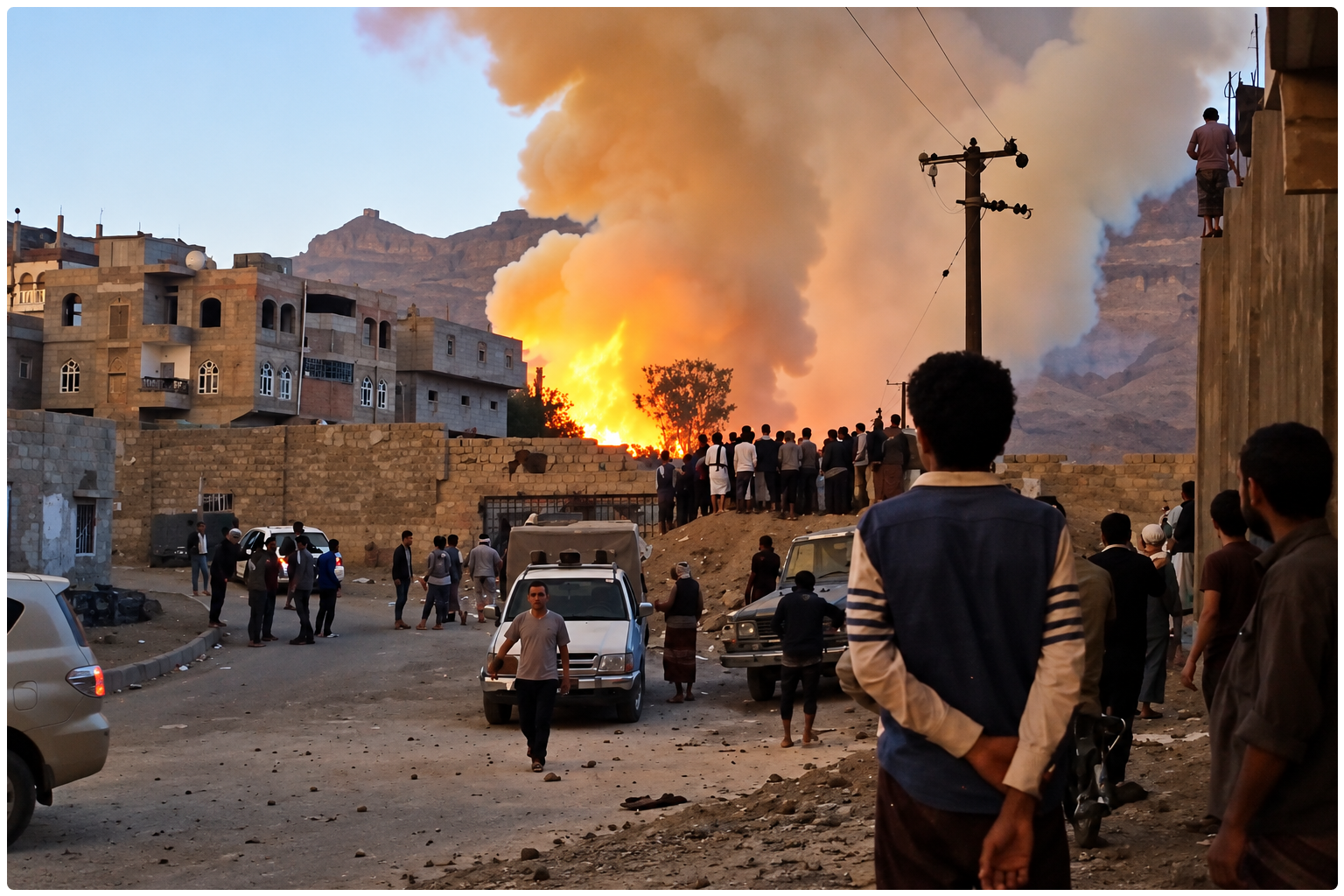
The Saudi-led coalition carried out airstrikes on Yemen’s capital, Sanaa, on Tuesday after warning civilians to evacuate a fuel storage facility on the city’s western outskirts. The attack prompted an immediate response from the Houthis, who threatened Saudi Arabia’s airports and oil installations, raising the prospect of further strikes against critical infrastructure in both countries.
The coalition had identified the Yemen Petroleum Company’s Al-Sabaha Central Station as the intended target, publishing a map of the facility and instructing civilians to leave before the operation. Explosions were subsequently reported in the area, while Houthi-controlled media said coalition aircraft had struck the petroleum installation.
Houthis name Aramco HQ, Riyadh Airport & Refinery as targets after Saudi hits Sanaa oil depot It’s clear, factual, high signal, and works well as a standalone headline or the first line of the post. You can drop the Persian summary underneath it. https://t.co/bIwG5qhtRQ
— Martin (@Martin_Sedi) October 13, 2026
The Houthi authorities maintained that the facility was empty and had no military significance. Independent assessments of the damage were not immediately available, and there was no verified casualty figure from the attack.
The strike comes after several days of Houthi missile and drone attacks on Saudi Arabia, including a deadly assault on King Khalid International Airport in Riyadh. At least 13 people were killed and more than 300 injured in Saturday’s attack, while another strike on the airport the following day caused further casualties and damage.
The repeated attacks have placed Saudi civilian aviation infrastructure under considerable pressure. Riyadh has responded with renewed military operations in Yemen, targeting Houthi positions while supporting government forces attempting to recover territory lost to the group.
Houthi military spokesman Yahya Saree responded to the Sanaa operation by warning civilians and employees to leave several Saudi installations, including Aramco facilities and King Khalid International Airport. He threatened further attacks on Riyadh if the coalition continued striking the Yemeni capital.
The threats extend the confrontation into infrastructure central to Saudi Arabia’s economy, particularly its oil industry and international aviation network. Although the Houthis have previously demonstrated an ability to strike Saudi energy installations, the latest warnings do not establish that further attacks have been launched.
The renewed fighting also follows a government offensive inside Yemen. On October 5, President Rashad al-Alimi announced the launch of Operation Dawn of Yemen, declaring that government forces intended to recover state institutions and ultimately the capital from Houthi control.
Fighting has since intensified around the strategically important Bab el-Mandeb Strait, where control of coastal territory has consequences for both Yemen’s internal conflict and shipping through the southern entrance to the Red Sea.
The United Nations has warned that the deterioration is already reversing years of diplomatic efforts to contain the war. During an October 9 briefing to the Security Council, UN Special Envoy Hans Grundberg said Yemen had returned to full-scale conflict, with fighting spreading across several fronts and attacks on Saudi civilian and energy infrastructure causing casualties.
For Saudi Arabia, the immediate challenge is to suppress Houthi missile and drone attacks without exposing more of its civilian and energy infrastructure to retaliation. For Yemen, the renewed bombardment comes as government forces seek to recover territory and the prospect of a negotiated settlement becomes increasingly remote.
Neither side has indicated that the latest exchange will bring military operations to an end.