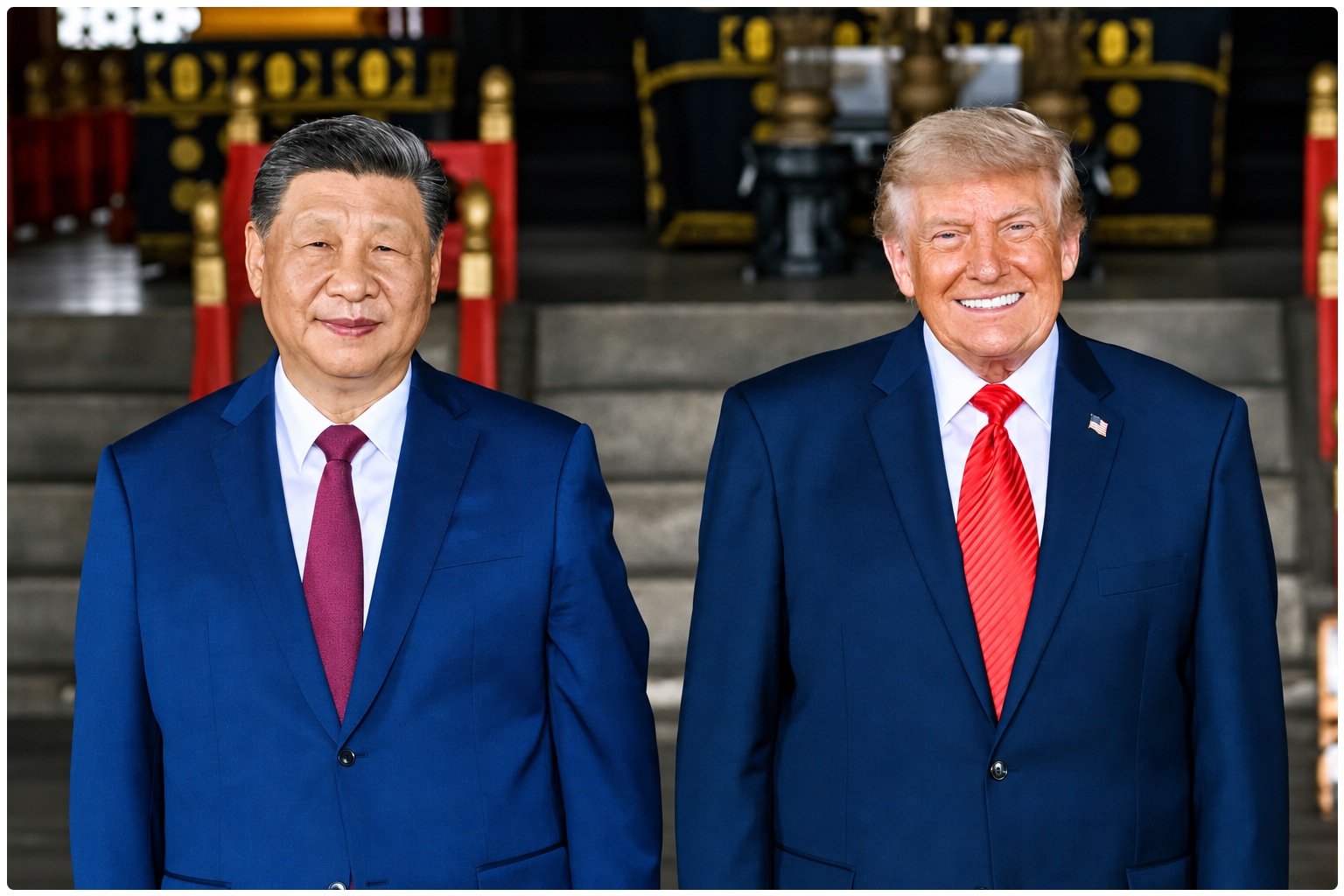
US President Donald Trump is preparing to host Chinese President Xi Jinping for a high-stakes summit in Washington as the leaders of the world’s two largest economies attempt to preserve a fragile period of stability in their relationship.
Xi arrived in the United States on Wednesday for a state visit lasting until September 25. Trump took the unusual step of personally receiving him and his wife, Peng Liyuan, at Joint Base Andrews outside Washington.
The formal summit programme is scheduled to begin on Thursday morning with a state arrival ceremony at the White House. Trump and First Lady Melania Trump will welcome Xi and Peng before a military review and public remarks by the two presidents. Trump and Xi will then hold closed-door talks, followed later by a state dinner.
The meeting is their second summit of 2026, following Trump’s visit to Beijing in May. Both governments have presented the reciprocal visits as an attempt to prevent economic and strategic competition from developing into direct confrontation.
Trade will dominate the discussions. Ahead of the summit, US Treasury Secretary Scott Bessent said the two countries had agreed to extend their existing tariff truce from November 10 until January 10, giving negotiators additional time to pursue a broader agreement.
The original truce halted an escalating trade confrontation in which threatened tariffs exceeded 100% and raised fears of severe disruption to global supply chains. Washington and Beijing have since discussed reducing tariffs on selected non-strategic goods, removing non-tariff barriers and improving access to each other’s markets.
Trump is expected to press Xi for clearer progress on Chinese purchases of American agricultural products and commercial aircraft. China previously committed to increasing imports of US farm goods and purchasing at least 200 Boeing aircraft, but several elements of those arrangements remain incomplete. Expectations of a major aircraft announcement have weakened as negotiations continue.
Rare-earth minerals will form another central part of the summit. China dominates the processing of several critical minerals used in automobiles, electronics and defence equipment. Washington argues that Beijing has not fully restored supplies promised under earlier agreements, while China objects to American restrictions on advanced semiconductors and investment in sensitive industries.
Artificial intelligence has also emerged as an important area of both competition and possible cooperation. Officials have explored guardrails intended to prevent advanced models from assisting cyberattacks or reaching hostile non-state groups. However, the two governments remain divided over access to computing chips, Chinese open-weight models and US attempts to restrict China’s technological development.
Strategic issues are likely to prove more difficult. Xi is expected to oppose American military and political support for Taiwan, which Beijing claims as part of China. Trump will also face pressure to raise China’s relationship with Iran and its role in efforts to secure maritime traffic through the Strait of Hormuz.
The summit comes four months after the two leaders endorsed a framework described as constructive strategic stability. Since then, communication has improved, but disagreements over trade, technology and regional security remain largely unresolved.
The visit itself therefore carries much of the diplomatic significance. Neither side appears ready for a comprehensive settlement, but both have an interest in preventing renewed tariffs, supply-chain restrictions or military tensions from overwhelming the relationship.
The immediate test will be whether Trump and Xi can turn the existing truce into enforceable commitments. Without progress on purchases, rare-earth supplies and communication over security disputes, the summit may preserve calm without resolving the competition beneath it.