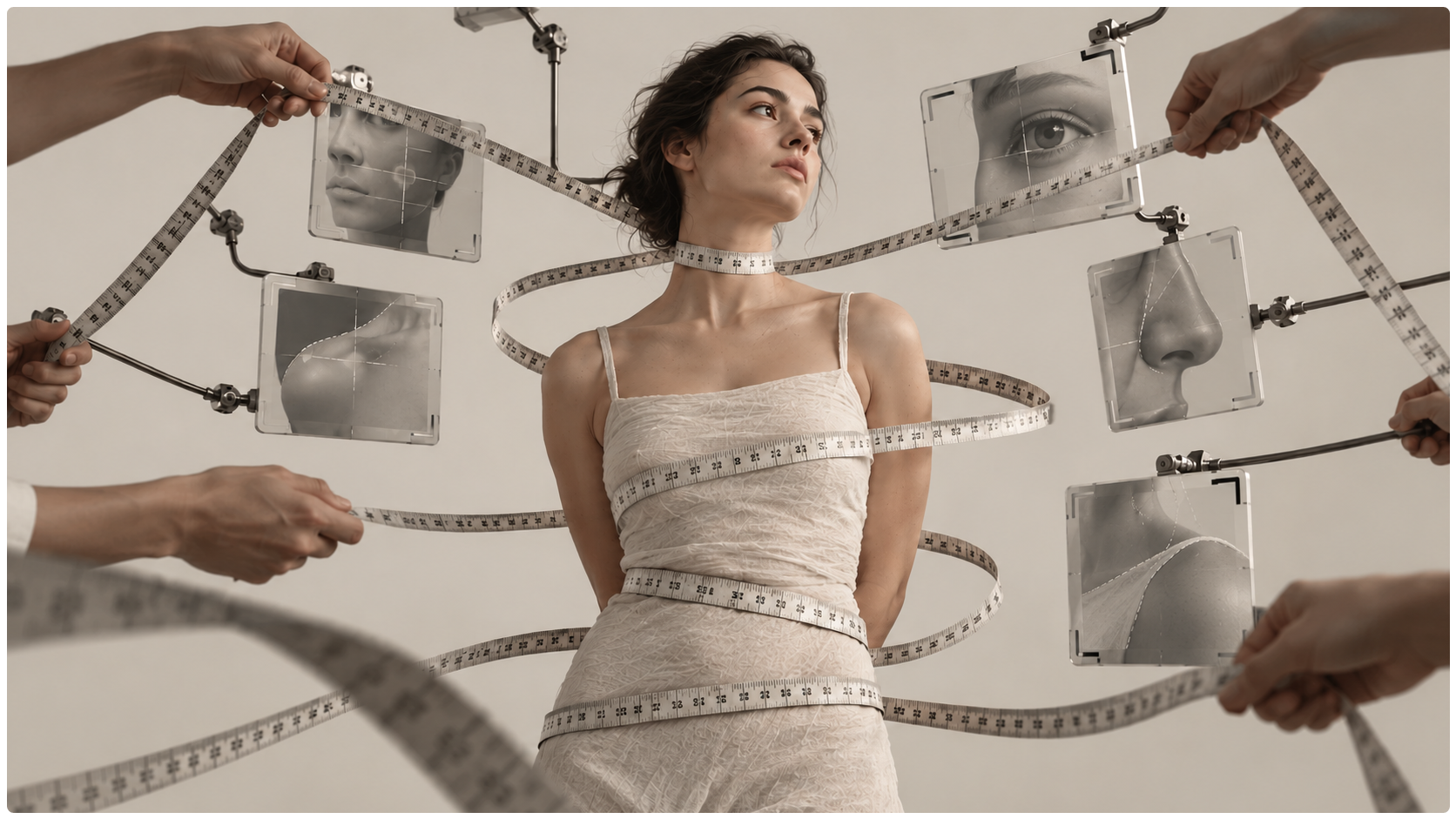
I have been trying to work out what the correct female body looks like. There must be one, because society seems remarkably confident when telling women what is wrong with theirs.
She cannot be too large, because someone will tell her to lose weight. She cannot become too thin, because then people start saying she looks “weak”, “unhealthy” or “like she needs to eat”. She should be strong, but not so muscular that people start questioning her femininity. Curves are welcome, although apparently only in approved places. She should look young, but naturally young, because trying too visibly to stay young is another offence altogether.
So help me out here. What exactly are we aiming for?
Are women clay, expected to be moulded and remoulded until we resemble whichever version of femininity happens to be fashionable that decade? Because if we are not, it is difficult to explain when a woman’s body changes by a few kilograms, a pregnancy, an illness or simply the passing of time and suddenly becomes a matter of public discussion.
And the sad truth is, most of us have probably participated in this culture in some way. Our comments can seem harmless when taken one by one, but together they reveal the larger social problem - women are expected to live inside their bodies while everyone else feels entitled to review them.
I bring life into this world
One of the most beautiful gifts God has given women is the ability to bring another life into the world. Motherhood can be joyful, intimate and almost impossible to describe, but pregnancy itself cannot be reduced to a sentimental word.
It asks the body to stretch, carry, nourish, endure and recover in ways that are difficult to fully understand unless you have lived through it yourself.
After all of that, the body deserves tenderness, celebration and time. Instead, the applause for motherhood often gives way to inspection. How much weight has she gained? How quickly will she lose it? Has she “bounced back”? Does she look like she did before?
That is why the recent conversation around Katrina Kaif felt so familiar. Months after becoming a mother, she appeared publicly and the discussion quickly shifted to her weight and changing appearance, as though pregnancy and childbirth should somehow leave no visible trace behind.
these gawars trolling katrina kaif without knowing shit about postpartum body changes are so annoying, how do you expect a woman in her 40s who just had a baby to look like a twenty year old? She’s still a total beauty https://t.co/uS7dIFmYfM
— Bebos Shenanigans (@yearnerduck) September 17, 2026
And she is hardly the first. Aishwarya Rai Bachchan faced relentless scrutiny over her post-pregnancy weight after the birth of her daughter. Deepika Padukone encountered the opposite kind of scrutiny during her pregnancy, when some online commenters questioned whether her pregnancy was even real because her body and baby bump did not look the way they expected.
That contradiction says almost everything.
Gain too much weight and people talk. Do not gain enough and they still talk. Apparently, even pregnancy now comes with a visual standard women are expected to meet.
Even Success Does Not End the Inspection
Perhaps we could dismiss all of this as the price of working in an image-driven industry. But that explanation falls apart the moment the same pattern appears in sport, where a woman’s body should be judged for what it can do, not how pleasing it is to look at.
At the 2026 IPF World Sub-Junior and Junior Classic Powerlifting Championships, Keyaa Banerji deadlifted 140 kg and won silver in the junior women’s 47 kg category. The lift went viral almost instantly, her social-media following surged, and mainstream interviews followed. But much of the attention was not focused on her strength or achievement. It was her looks that drew people in, with countless posts expressing surprise that someone they found so attractive could also be a powerlifter. Her face was soon everywhere online, while the years of discipline behind her performance received far less attention.
At the same championship, 17-year-old Madhura Kar delivered an even stronger result, winning four gold medals in the 52 kg sub-junior category. Yet she received only a fraction of the attention Banerji did a disparity that even mainstream media later began to acknowledge.
I am really happy that Keya Banerji won silver medal. She has made India proud.
— 𝘼𝙮𝙪𝙨𝙝 (@abasu4ever) September 4, 2026
But, people should focus on her achievements, not appearance.
Also, Madhura Kar won gold medal in the same competition. When do we praise her?
Let's be better than this. pic.twitter.com/2EO4wrq78h
The contrast was hard to miss. Banerji’s achievement was something that deserved recognition, but much of the frenzy around her quickly became about how she looked. Madhura, meanwhile, had four world golds and nowhere near the same level of public obsession.
And that is precisely the problem. In a sport defined by numbers on the bar, looks still managed to enter the conversation. This pattern is not anecdotal.
A study examining Olympic athletes featured on Sports Illustrated covers across six decades found that female athletes were more likely than male athletes to be portrayed in sexually objectifying ways. Even in sport, where the body should logically be discussed in terms of performance, women have historically been presented through the lens of attractiveness as well.
Serena Williams has experienced versions of this throughout her career, with commentary about her muscularity and femininity often sitting beside discussions of her tennis.
Women can win medals, break records and dominate their disciplines, yet the conversation somehow finds its way back to the same old question “yes, but how does she look?”
When beauty becomes a shortcut to visibility
There is another side to this that is worth admitting.
Sometimes beauty does bring women attention, opportunity and visibility, and pretending otherwise would make the argument less honest.
In 2019, an RCB fan named Deepika Ghose appeared on television for only a few moments while cheering during an IPL match. By the next day, she had become the internet’s “RCB girl”, and her Instagram following had jumped into the hundreds of thousands. She had not performed, won anything or set out to become famous. A camera found her in the stands, the internet found her attractive, and that was enough.
Remember the rcb girl
— トレースシーカー 🔍 (@Mix_contents_) February 28, 2026
Over night she went viral on social media
Deepika Ghose, who became an overnight sensation after being spotted cheering for Virat Kohli's men in one of Royal Challengers Bangalore's games in the just-concluded Indian Premier League (IPL) has said that life… pic.twitter.com/KiH1Neaswu
A year earlier, Malayalam actor Priya Prakash Varrier became an overnight sensation after a brief clip from Oru Adaar Love showed her raising her eyebrows and winking at a boy. The clip spread across India, generated endless memes and pushed her social-media following into the millions before the film had even released.
So yes, appearance can confer a kind of privilege. It can make someone visible faster, open doors and turn an ordinary moment into a viral one. But that privilege comes with an uncomfortable bargain. The same gaze that elevates a woman because it finds her attractive can just as quickly dissect her or turn against her when she no longer fits the image that made her desirable in the first place.
Is this just an “Indian mentality” problem?
It would be comforting to blame this on one culture.
India certainly has its own vocabulary for policing women. Weight, complexion, hair, height and marriageability can all become family discussion. Sometimes the judgement arrives so casually that nobody even registers it as judgement.
But this is not an Indian monopoly.
Hollywood has spent decades dissecting women's bodies. Kate Winslet has spoken repeatedly about the attention given to her weight when she was young. Selena Gomez has had to explain changes in her body in relation to medication. Adele was scrutinised for her weight before her transformation, and then scrutinised all over again after she lost it.
Kate Winslet SLAMS body shaming, pushing women to OWN their TRUE & UNSTOPPABLE selves! 🔥💥 pic.twitter.com/wiiEUOf1Xi
— Fem Mindset (@fem_mindset) April 3, 2025
Calling it an “Indian mentality” problem, lets the rest of the world off far too easily.
One woman is judged, many women learn to judge themselves
Social media did not invent the pressure to compare. It made that pressure constant.
A 2025 systematic review and meta-analysis covering 83 studies and 55,440 participants found that greater social-media comparison was linked to greater body-image concerns and eating-disorder symptoms, as well as a less positive view of one’s own body.
Another study of 138 women found that attractive images of both celebrities and peers increased negative moods and body dissatisfaction. This matters because social media has changed whom women compare themselves with. The comparison is no longer limited to a distant movie star whose appearance may feel impossible to attain. It can now be with a complete stranger who happens to appear in your feed. And because she seems ordinary, her appearance can feel close enough to be achievable, making the comparison even more personal.
But the effect does not end with the woman in the photograph. When a postpartum actress is mocked for gaining weight, other mothers hear it. When an older actress is criticised for her wrinkles, women with the same lines around their eyes hear it too. And when a female athlete is called too masculine, young girls begin to wonder whether becoming strong will make them less feminine.
That is why public body shaming is more consequential than ordinary celebrity gossip. One woman may be the target, but countless others absorb the message. Slowly, almost without noticing, they begin to inspect and criticise their own bodies before anyone else gets the chance.
What If Beauty Was Never the Point?
For years, we have tried to solve narrow beauty standards by widening the frame.
But perhaps the question should be: Why must a woman’s worth keep circling back to beauty at all?
Why do we say “beauty with brains”, as though intelligence needs decoration? Why does strength become “beauty with power”? Why do we reassure an older woman that she is “still beautiful”, as though beauty were something she has managed to preserve against the threat of time? That word, still, gives the whole thing away.
A woman should not have to be beautiful to be respected, admired, heard or remembered. She can be brilliant, funny, ambitious, difficult, tender, strong, ordinary, extraordinary, or all of these things at once without first passing an aesthetic test.
Perhaps women were never failing to meet the standard. The standard was failing to see women for all that they are.