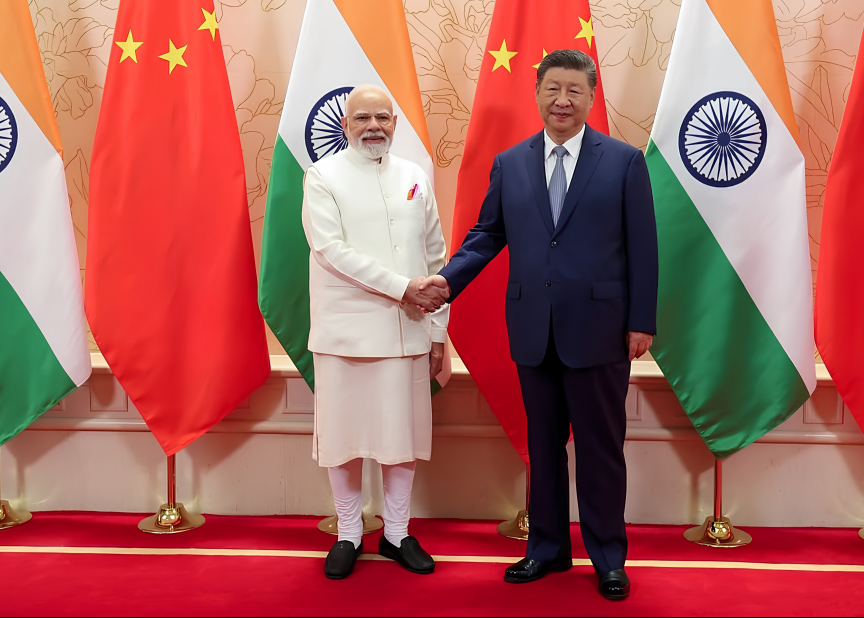
Chinese President Xi Jinping is expected to arrive in New Delhi this weekend for the BRICS summit, in what would be his first visit to India in seven years and perhaps the clearest sign yet that Asia's two giants are trying to move beyond the hostility that followed the deadly Galwan Valley clash of 2020.
India will host the 18th BRICS summit on September 12 and 13 at Bharat Mandapam in New Delhi, bringing together leaders from the expanded bloc and its partner countries. Xi is widely expected to arrive on September 12, although Beijing has yet to formally confirm his attendance. Thousands of police and paramilitary personnel are being deployed across the capital, with special arrangements around the airport, summit venue and hotels accommodating foreign leaders. Xi is reportedly expected to travel with a delegation of around 400 officials.
The symbolism of the visit is difficult to miss. Xi last came to India in October 2019, when Prime Minister Narendra Modi hosted him for an informal summit in Mamallapuram. Eight months later, Indian and Chinese troops fought in the Galwan Valley, leaving 20 Indian soldiers and at least four Chinese troops dead and sending bilateral relations into their deepest crisis in decades. Tens of thousands of troops were deployed along the Line of Actual Control as India tightened restrictions on Chinese investment and banned hundreds of Chinese apps, while political engagement largely froze.
Six years later, the relationship is slowly moving again. Modi and Xi met at the 2024 BRICS summit in Russia, helping begin a cautious diplomatic reset, and Modi visited China last year. Direct flights have resumed, visa procedures have eased and India has relaxed some restrictions on Chinese investment in sectors including electronics, capital goods and solar manufacturing. Bilateral trade reached a record $155 billion last year and has continued growing in 2026.
But calling this a reconciliation would be premature. The border dispute remains unresolved and the trust destroyed in 2020 has not returned. India continues to scrutinise Chinese companies on national-security grounds, while major Chinese firms including BYD and Great Wall Motor abandoned planned Indian investments after facing regulatory hurdles. New Delhi recently rejected a proposal involving Alipay and India's UPI. Indian businesses, meanwhile, have complained of delays involving Chinese visas and crucial industrial equipment. China remains an indispensable supplier to important Indian industries, but that dependence is itself increasingly viewed in New Delhi as a strategic vulnerability.

That is what makes a possible Modi-Xi meeting on the sidelines more important than the summit photograph. Both countries have reasons to prevent another confrontation. India does not want a permanently hostile China on its northern frontier while simultaneously dealing with Pakistan and navigating an increasingly unpredictable relationship with Washington. Beijing, facing its own rivalry with the United States, has little incentive to push India deeper into strategic alignment with America. Yet neither side appears willing to sacrifice its fundamental interests simply for warmer relations.
BRICS provides useful neutral ground for that balancing act. India wants the expanded grouping to remain focused on development, economic cooperation and greater representation for the Global South rather than becoming an explicitly anti-Western bloc. China sees BRICS as an important instrument in building a more multipolar international order. Those visions overlap, but they are not identical.
Xi’s expected return to India does not mean the two countries are becoming friends. India and China are still competitors, neighbours and rivals. But after six years of border tensions, trade restrictions and political distrust, a meeting between their leaders in New Delhi would still be significant. The real test is whether they can build a lasting improvement in relations while addressing the problems that caused their dispute.