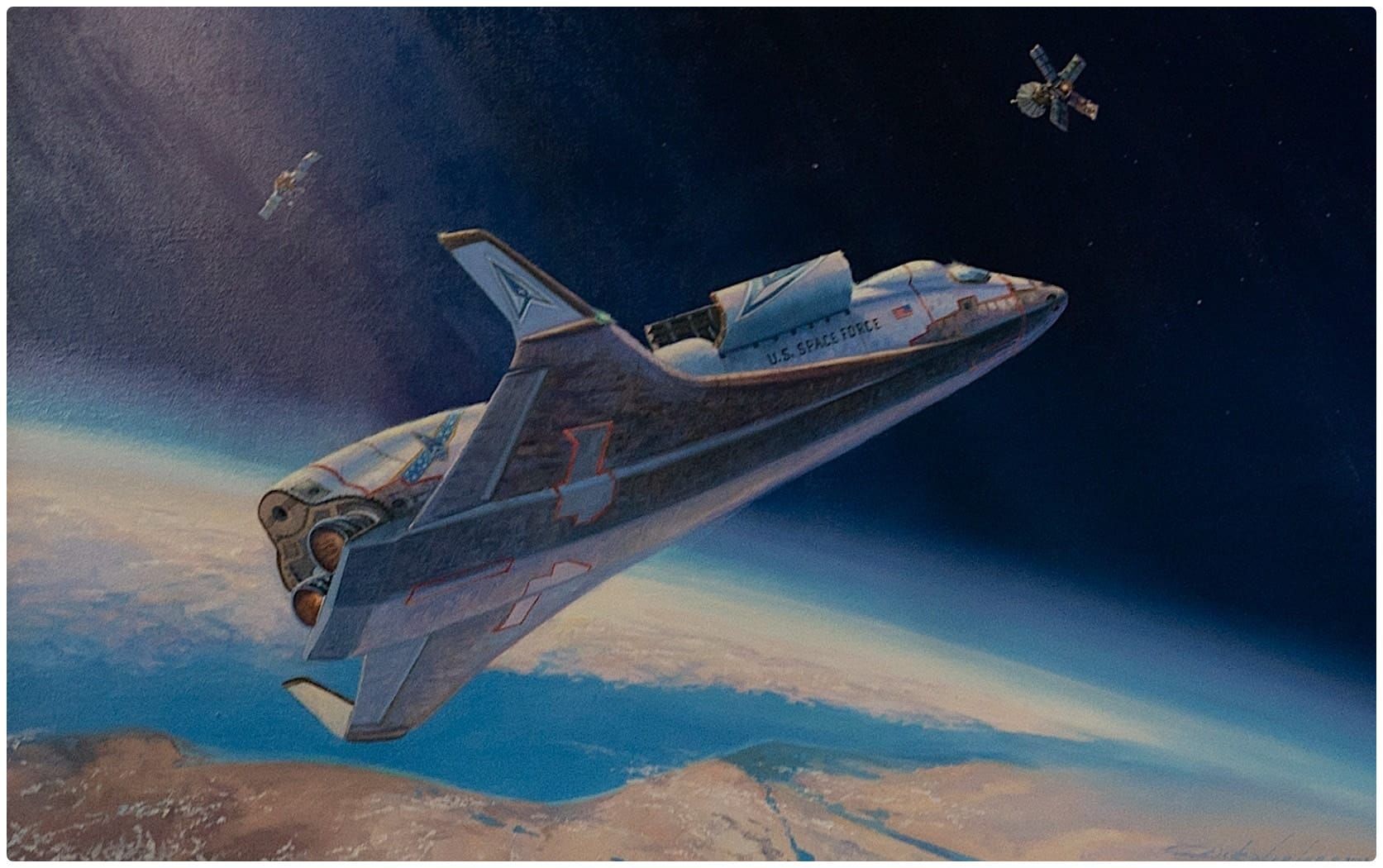
For decades, the United States spoke openly about satellites that could see, communicate, navigate and warn of missile launches. It was much less willing to talk about weapons already circling the Earth.
That changed on Monday.
US Air Force Secretary Troy Meink publicly confirmed for the first time that the Space Force has deployed what he called “on-orbit space control weapons” capable of protecting American forces against hostile action. He disclosed their existence during the Air, Space & Cyber Conference in Maryland but refused to explain what the systems are, how many have been deployed or when they entered orbit.
The announcement is deliberately vague, but its meaning is significant. These are not simply military satellites used for communication or surveillance. “Space control” is a military term broad enough to include capabilities designed to disrupt, disable or potentially destroy an adversary’s ability to operate in space.
A US official told The Washington Post that such a capability could, for example, be used against an enemy satellite helping target American forces. Meink described the public disclosure itself as part of deterrence, while refusing to reveal enough detail to expose how the weapons actually function.
That leaves a crucial question unanswered: what exactly has America placed in orbit?
📌U.S. Deploys First Space Weapon, Air Force Secretary Says
— Context 360 (@NewsContext360) September 15, 2026
Air Force Secretary Troy Meink said the weapon is already in orbit and will be used to support U.S. forces and help maintain “control of space.” He did not disclose what type of weapon is involved.
A U.S. official told… pic.twitter.com/MfvXRZ89yV
Experts say several possibilities exist. An orbital weapon could interfere with another satellite’s communications, jam radio frequencies, dazzle optical sensors with a laser or physically attack another spacecraft. A kinetic weapon capable of smashing a satellite would create dangerous debris, making non-destructive systems such as orbital jammers or laser dazzlers more plausible possibilities. There is currently no public evidence establishing which category the US systems belong to.
The revelation comes after years of increasing concern about China and Russia.
CSIS has documented increasingly sophisticated manoeuvres by Chinese and Russian spacecraft, including satellites approaching or shadowing other spacecraft, alongside widespread development of jamming, cyber, laser and anti-satellite capabilities. US officials have also accused Russia of developing a nuclear anti-satellite system, although no such weapon is known to have been placed in orbit.
Washington has been moving in the same direction more openly. In June, the Space Force operationally accepted Meadowlands, a ground-based mobile system designed to disrupt satellite communications. Separately, the US is developing a constellation of space-based missile interceptors under President Donald Trump’s Golden Dome programme, with an initial demonstration planned by 2028.
The new orbital weapons do not automatically violate international law. The 1967 Outer Space Treaty prohibits placing nuclear weapons or other weapons of mass destruction in orbit, but it does not impose a blanket ban on conventional weapons operating in space.
That legal gap is becoming increasingly important.
Until now, much of the military competition in orbit existed behind euphemisms such as “counterspace,” “space control” and “proximity operations.” Meink’s announcement strips away some of that ambiguity.
The United States is no longer merely preparing for a future war in space.
It has acknowledged that some of the weapons for that war are already there.