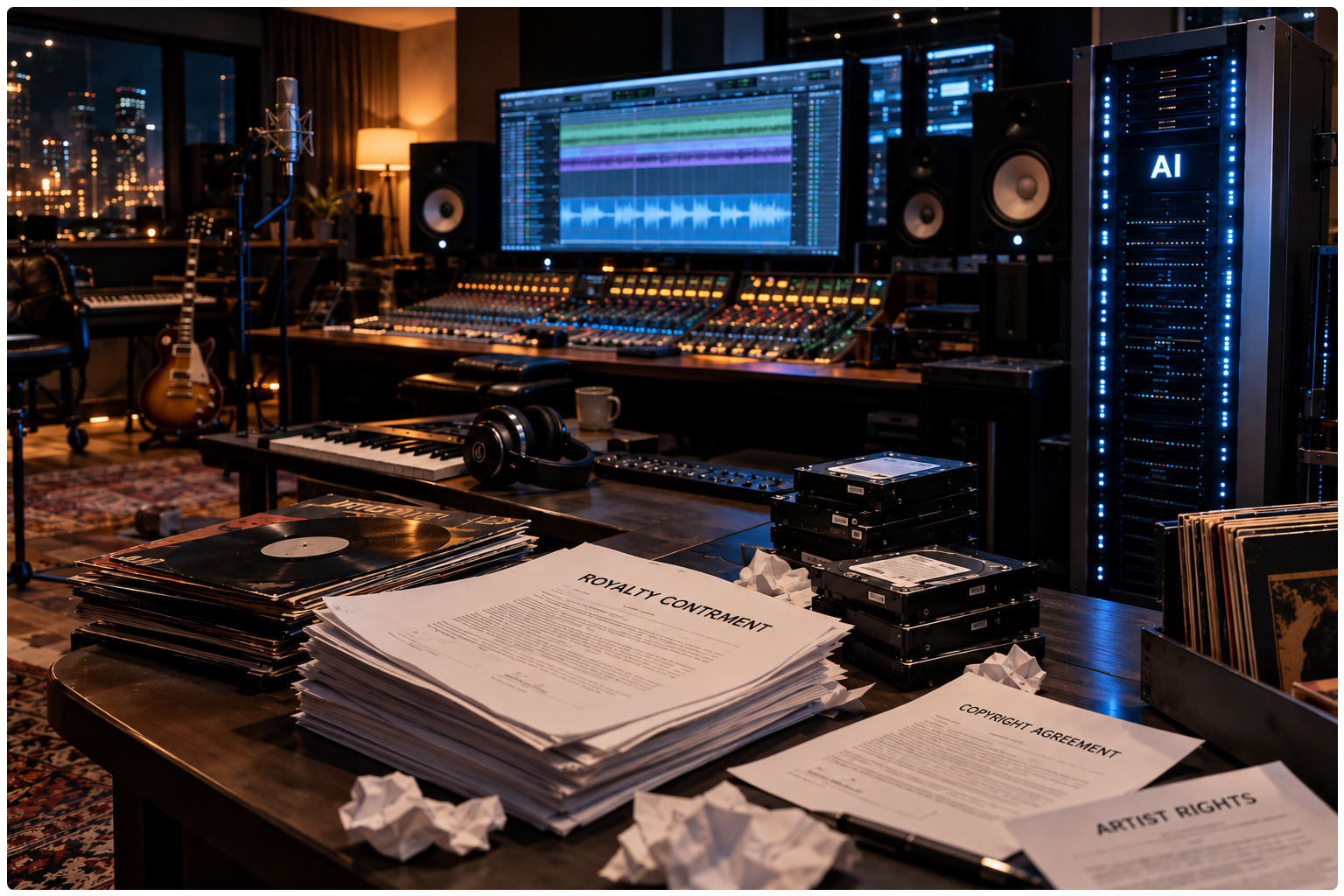
More than 150 Australian musicians have come together to challenge proposed changes to the country's copyright rules, amid growing concerns over how artificial intelligence companies use creative work to train their models.
The newly formed Australia is led by electronic artist KLP, whose real name is Kristy Lee Peters, and singer-songwriter Holly Rankin, better known as Jack River. Its founding membership brings together prominent names including Bernard Fanning, Kate Ceberano, Paul Dempsey, G Flip, Matt Corby, Katie Noonan, Ben Lee, Lime Cordiale, Peking Duk, Troy Cassar-Daley and Sneaky Sound System.
The alliance has emerged at an unusually sensitive moment for Australian copyright policy. Canberra is considering how AI developers might legally train models using copyrighted material while trying to preserve payment and control for creators.
For musicians, the argument is increasingly about where consent sits in that system.
W H A T ? It’s like inviting the burglar into your house, handing him your keys saying “take what you want”. Australia’s #AI copyright plans throw creators to the tech bros instead of protecting them. 👇👇👇
— Claudia Wittmann (@Mrs_Wittmann) October 27, 2026
Prime Minister Anthony Albanese drew a firm line in a July speech on Australia's AI policy, saying Australian musicians, writers, artists and journalists should retain ownership and control of their work, including control over its price. The government had already ruled out a broad text-and-data-mining exception that would permit AI developers to use protected works without permission.
What followed has been less straightforward.
Attorney-General Michelle Rowland confirmed in a September interview that the government was examining a broad range of licensing options. Asked specifically whether an opt-out system remained possible, she stopped short of ruling it out, while maintaining that voluntary licensing was the government's preferred approach and that creators should retain ownership and control.
An opt-out model would reverse the practical burden faced by musicians. Instead of an AI company securing permission before copying material for training, creators could have to indicate that their work must not be used. For artists with recordings scattered across labels, publishers, distributors and online platforms, that difference is hardly administrative trivia.
The Artists Alliance of Australia is intended to give individual performers a more direct role in that debate. Its arrival also reflects frustration that copyright negotiations can become dominated by companies and representative organisations while the people whose voices, performances and compositions give those rights their value remain several steps removed from the policy table.
Australia's established music bodies are already pushing in the same direction. ARIA told the parliamentary AI inquiry that existing licensing structures can accommodate AI companies without removing the permission requirement. Its October polling, conducted by RedBridge Group among 1,524 Australians, found 78 per cent wanted AI companies to continue obtaining permission before using Australian creative work.
The parliamentary argument is still moving. Australia's Joint Select Committee on Artificial Intelligence is examining copyright alongside AI investment and sovereign capability, with its final report due by November 30.
The alliance's next test will be whether its growing membership can translate into influence over Canberra's copyright negotiations. With the parliamentary AI inquiry due to report on November 30, musicians are organising while the rules governing how their recordings and compositions can be used to train AI remain unsettled.