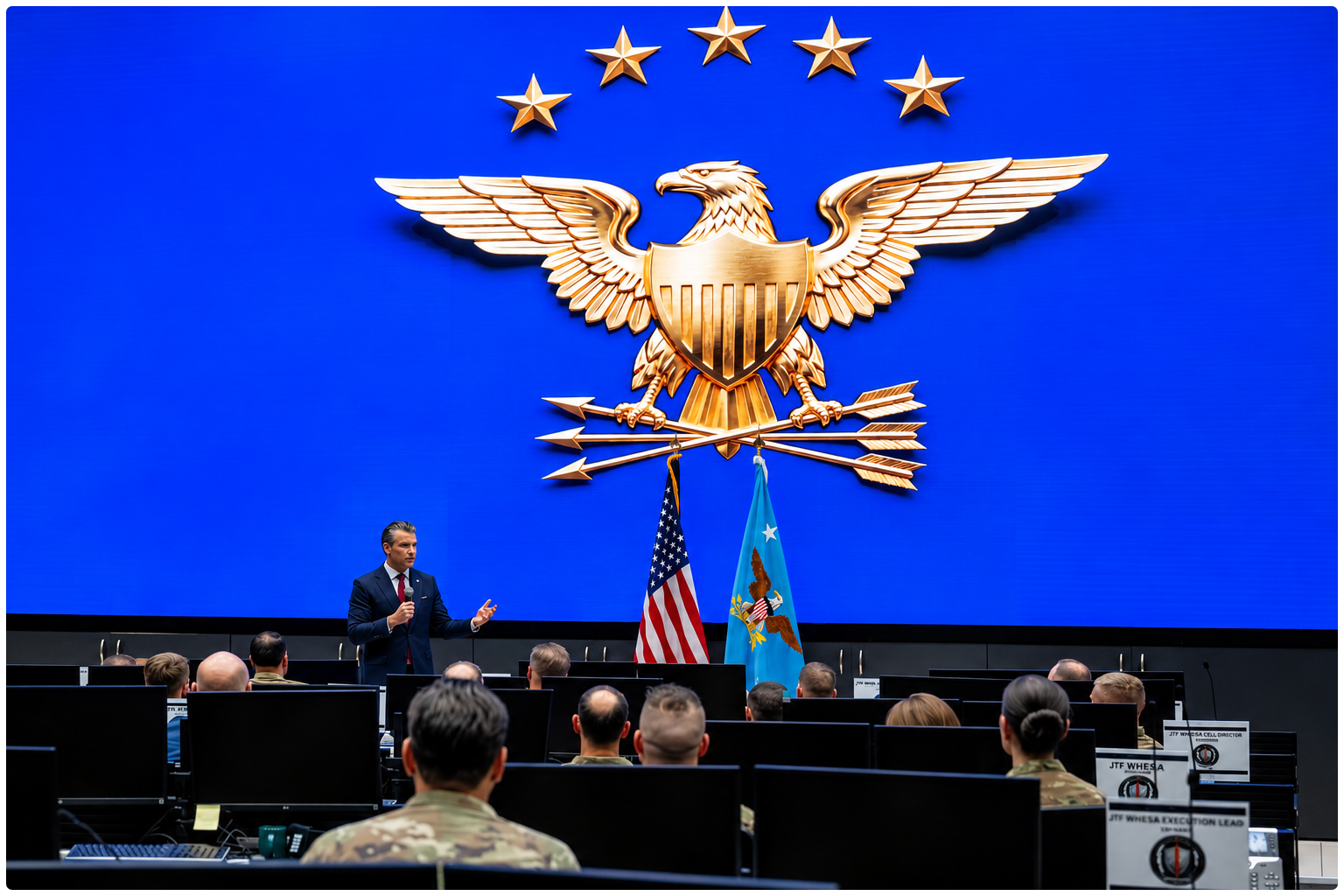
US Defence Secretary Pete Hegseth has reportedly issued a classified directive restricting aspects of military cooperation with Canada, adding to tensions between Washington and Ottawa.
Pentagon spokesperson Sean Parnell acknowledged that the department was reviewing its defence engagements with Canada to ensure they aligned with American strategic objectives. However, he maintained that cooperation through NATO and the North American Aerospace Defense Command (NORAD), along with defence intelligence sharing, would remain unaffected.
The directive has not been publicly released, leaving its precise scope unclear. Neither government has identified which bilateral military programmes would face restrictions, although the Pentagon's assurances suggest that the two countries' central continental defence arrangements will continue operating.
Those assurances protect the most deeply integrated parts of a military relationship developed over decades. Under the NORAD arrangement, American and Canadian forces jointly monitor and defend North American airspace, coordinating aircraft identification, threat assessments and responses across a continent neither country can secure independently.
Other forms of cooperation are less insulated from political decisions. Bilateral military exchanges, joint planning and defence consultations operate through several arrangements outside NORAD, including the Military Cooperation Committee and the Permanent Joint Board on Defence.
Washington had already stepped away from participation in the latter body earlier this year. Hegseth's reported directive therefore follows a deterioration in military relations that began before the latest restrictions.
The dispute has unfolded alongside President Donald Trump's increasingly confrontational treatment of Canada over tariffs, defence spending and sovereignty. His repeated suggestions that Canada should become America's 51st state have further strained relations with Prime Minister Mark Carney's government.
Ottawa has responded by pursuing greater economic and security cooperation with other partners. Canada has been strengthening its relationship with the European Union, including cooperation on defence manufacturing and procurement, while seeking to reduce its dependence on American markets.
Yet the two governments remain closely connected by geography and shared security threats. In a May statement on defence cooperation, Canada's Department of National Defence described the United States as central to continental security and reaffirmed plans for joint exercises, operations and NORAD modernisation.
The relationship extends into the Arctic, where Russian military activity and China's growing strategic interest have increased the importance of surveillance and early warning. Canada and the United States joined other Arctic allies in May in committing to stronger regional security cooperation.
Hegseth's directive arrives against that background of shared military responsibilities and widening political disagreement. Canadian officials have reportedly said they were unaware of the new restrictions, while the Pentagon has not identified which bilateral activities will be curtailed.
The uncertainty is particularly awkward for military officials accustomed to working directly with counterparts across the border. Operational cooperation may continue through NORAD, but planning exercises, personnel exchanges and other bilateral programmes still depend on decisions made in Washington and Ottawa.
For Canada, those arrangements were once among the least contentious elements of its relationship with the United States. They are now being subjected to the same political scrutiny that has unsettled trade and diplomacy between the two neighbours.