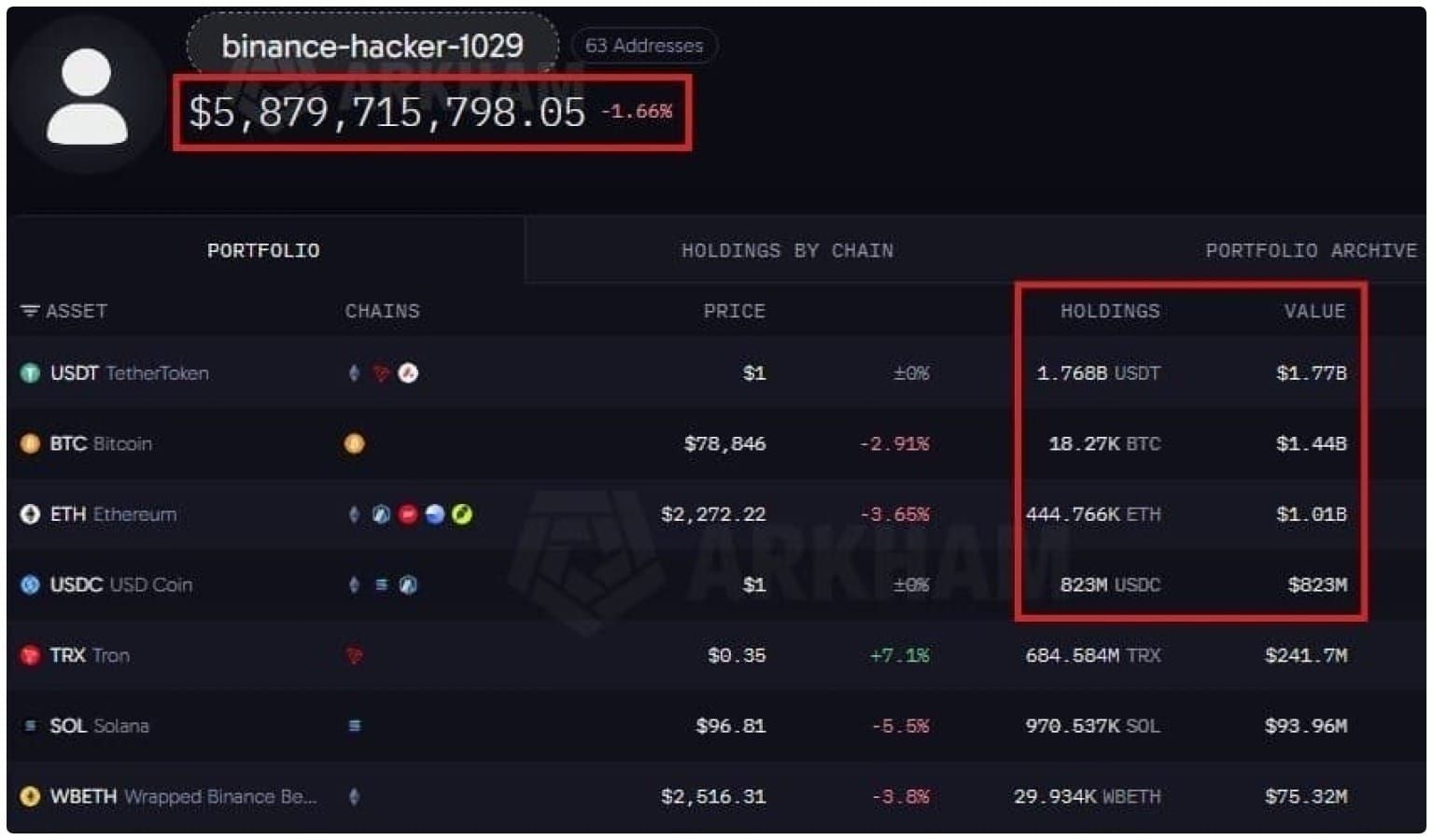
Binance has confirmed a security breach affecting approximately $6.3 billion in cryptocurrency, with about $3 billion in assets already frozen as investigators trace one of the largest thefts ever recorded in the digital-asset industry.
The exchange disclosed the estimated financial impact on Friday, October 30, after suspicious transactions involving its cryptocurrency wallets prompted an emergency suspension of deposits and withdrawals. Binance has pledged to cover customer losses using its own resources and emergency reserves.
The company's official security update identifies a compromised laptop belonging to a DevOps engineer as a possible entry point. According to its preliminary investigation, an attacker may have used that access to enter a service container and initiate unauthorised withdrawal transactions.
🚨 BREAKING: $2.7 BILLION JUST MOVED OUT OF BINANCE IN 24 SECONDS. Everyone is screaming HACK. But the onchain evidence tells a VERY different story. And this could be the biggest misunderstanding in crypto right now. Here's what happened. At 20:24:23 UTC, Binance 14 transferred $2.53 BILLION across 64 tokens. Just 24 seconds later, another Binance hot wallet sent $174.4 MILLION to the exact same destination. TOTAL: $2,701,600,000. The transfers reportedly included: • $1.67B USDT • $454.1M ETH • $88.5M RLUSD • $77.1M wBETH • $50.5M XAUt • $50.4M UNI • $43.9M ENA • $38.1M PEPE • $29.7M LINK • $27.7M USD1 NOW HERE'S WHERE THINGS GET INTERESTING. The receiving wallet was created TODAY. No previous transaction history. And suddenly, it received $2.7 BILLION. Sounds terrifying, right? But there's a detail almost everyone is ignoring. At the time of the analysis, the receiving wallet hadn't sent those funds to mixers, exchanges or unrelated addresses. Another Binance-labeled hot wallet also transferred funds to that same destination. And the original wallet reportedly continued operating 16 minutes later. That looks more consistent with a coordinated internal wallet migration than a typical theft. BUT THERE'S ONE RED FLAG. At 20:41 UTC, the same relayer reportedly attempted another transfer involving 780 MILLION USDC. That transaction failed. And it deserves further investigation. Meanwhile, the market is already reacting. $BNB: -8.6% $ETH: -4.0% $BTC: -2.7% Billions moving. Traders panicking. Rumors spreading everywhere. But suspicious transfers alone DO NOT prove a hack. HERE'S THE WALLET I'M WATCHING: 0x5227f603c1ee34ce3c06efe6477003bdfccb2f8c If those funds start moving toward mixers or unrelated destinations, the situation becomes much more concerning. Until then, I'm treating this as an unconfirmed security incident, not a confirmed $2.7 BILLION theft. SAVE THIS ADDRESS. The next transactions could tell us far more than the headlines.
— Simba (@Simba_crpt) October 29, 2026
Binance said investigators had found no evidence that wallet private keys were exposed. It has revoked the affected authorisation and is working with law enforcement and blockchain intelligence companies to recover assets.
Independent investigators have traced a much wider movement of funds across multiple blockchain networks.
In an analysis published on October 29, blockchain intelligence company TRM Labs identified approximately $6.36 billion transferred from Binance-controlled wallets across ten blockchains. Most of the activity occurred within roughly 20 minutes.
Ethereum accounted for approximately $3.79 billion of the transfers, followed by Bitcoin at $1.47 billion and Tron at $628 million. Funds also moved through networks including XRP Ledger and Solana.
TRM attributed the operation with high confidence to TraderTraitor, a North Korean-linked hacking group previously associated with major cryptocurrency thefts. Binance has not independently confirmed the identity of the attackers, and the exchange's investigation into the original security failure remains incomplete.
The response has involved more than tracing stolen tokens. Stablecoin issuers and blockchain operators have intervened to prevent suspicious assets from moving further.
Tether, Circle, Ripple and other participants froze or restricted transfers involving substantial quantities of affected cryptocurrencies. Binance's announcement placed the frozen total at approximately $3 billion, although independent assessments differed according to when the assets were counted.
Freezing tokens can prevent their transfer or redemption, but does not mean the funds have already been returned to Binance. The value ultimately recovered will depend on further tracing, cooperation between blockchain operators and the outcome of the investigation.
The incident has also raised questions about Binance's capacity to reimburse users. Its Secure Asset Fund for Users, established to protect customers during emergencies, was valued at approximately $1 billion in January. Binance says it will supplement that fund with company resources if necessary.
The financial implications extend beyond the exchange. Bitcoin and other major cryptocurrencies fell as reports of the breach spread, reflecting concerns about the security of assets held by centralised trading platforms.
Binance has promised an updated proof-of-reserves disclosure and a technical report once its investigation is complete. Those documents will help establish the remaining financial exposure, the effectiveness of its recovery efforts and whether the exchange has fully restored the assets backing customer balances.