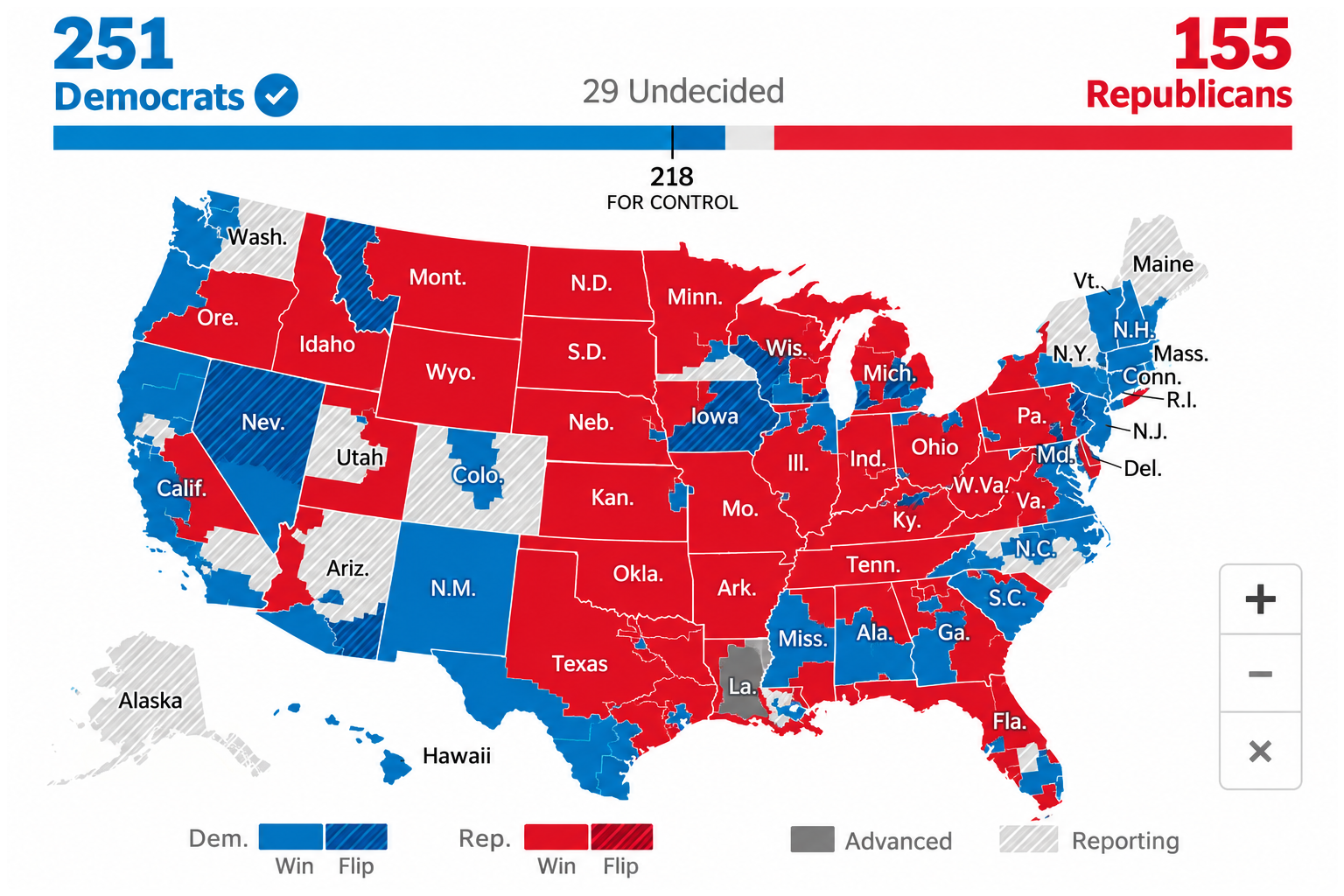
Donald Trump will return to Washington in January facing a House of Representatives substantially different from the one that has supported his presidency. Democrats have crossed 250 seats following Tuesday's midterm elections, turning what began as a contest for a narrow majority into one of the party's strongest congressional performances in decades.
By Thursday, November 5, election projections had awarded Democrats at least 251 of the House's 435 seats, comfortably exceeding the 218 required for control. Decision Desk HQ projected 251 Democratic victories and estimated that the party could ultimately win more than 260 seats as outstanding races were resolved.
House Minority Leader Hakeem Jeffries says Democrats have reclaimed the House, predicting they will win at least 255 seats and calling it a “historic majority” that polls failed to anticipate. https://t.co/ud32g1wyi3
— Breaking911 (@Breaking911) November 4, 2026
That would give Democrats their largest House majority since 1990, surpassing the 257 seats they secured in the 2008 elections.
The scale of Republican losses is especially striking because the party entered the elections with an extremely narrow majority. Democrats needed only a handful of additional districts to take control. Instead, they defeated Republican incumbents across the country, including in constituencies where Trump had performed strongly in 2024.
Pennsylvania, Michigan, Wisconsin and New Jersey delivered important gains, while Democratic candidates also broke through in parts of the South and West. In California, the party benefited from a new congressional map that targeted Republican-held districts, while several Republican redistricting efforts failed to produce their anticipated advantages.
The Pennsylvania Department of State's election returns and California's official election information provide the underlying state-level records as counting and canvassing continue.
For Republicans, the defeats raise questions about a campaign built around defending Trump's record on immigration, trade and national security. Democrats placed household expenses, healthcare and opposition to the administration's policies at the centre of their campaigns, while the war with Iran and higher energy prices added to public dissatisfaction.
The results cannot be explained by one issue alone. Candidates faced different local conditions, and the precise contribution of economic concerns, political preferences and redistricting will require more detailed analysis.
But the institutional consequences are already apparent.
Under the House's legislative rules, the majority party exercises considerable control over committees, legislation and the chamber's agenda. Democrats will be positioned to chair committees, demand testimony, investigate executive decisions and challenge administration spending once the new Congress convenes in January.
Their greater numbers will also reduce the leverage of individual lawmakers within the Democratic caucus. Even if some members disagree with party leaders, a substantial majority offers more room to negotiate than the narrow margins that have repeatedly complicated Republican leadership.
The Senate has also shifted towards Democrats, creating the prospect of sustained congressional resistance to Trump's domestic programme.
Yet the election has not transferred executive power. Trump retains the presidency, including his veto authority and substantial powers over foreign affairs. Democrats can block legislation and conduct oversight, but passing their own priorities into law will still require confronting the White House.
For House Democratic leader Hakeem Jeffries, the election offers an opportunity to exercise the authority Republicans have held since Trump's return to office. It also brings a demanding task: holding together a larger caucus whose members won elections on different political platforms.
With further House contests still unresolved, Democrats may yet expand their majority. Trump, meanwhile, faces a Congress in which Republican legislators will no longer determine the House's response to his administration.