Hyundai Motor Group will invest $15.5 billion in India over seven years, placing the country at the centre of its plans for manufacturing, research, exports and future mobility across emerging markets.
The investment, covering 2026 to 2032, will extend across Hyundai Motor India, Kia India and the group’s wider network of suppliers and technology businesses. Announced after Executive Chair Euisun Chung met Prime Minister Narendra Modi in New Delhi, it is among the largest long-term commitments made by a global vehicle manufacturer in India.
Hyundai’s plan extends well beyond adding assembly lines. The company intends to expand production, increase the use of locally manufactured components and strengthen Indian suppliers. It also wants India to serve as a leading export platform capable of supplying vehicles to markets beyond South Asia.
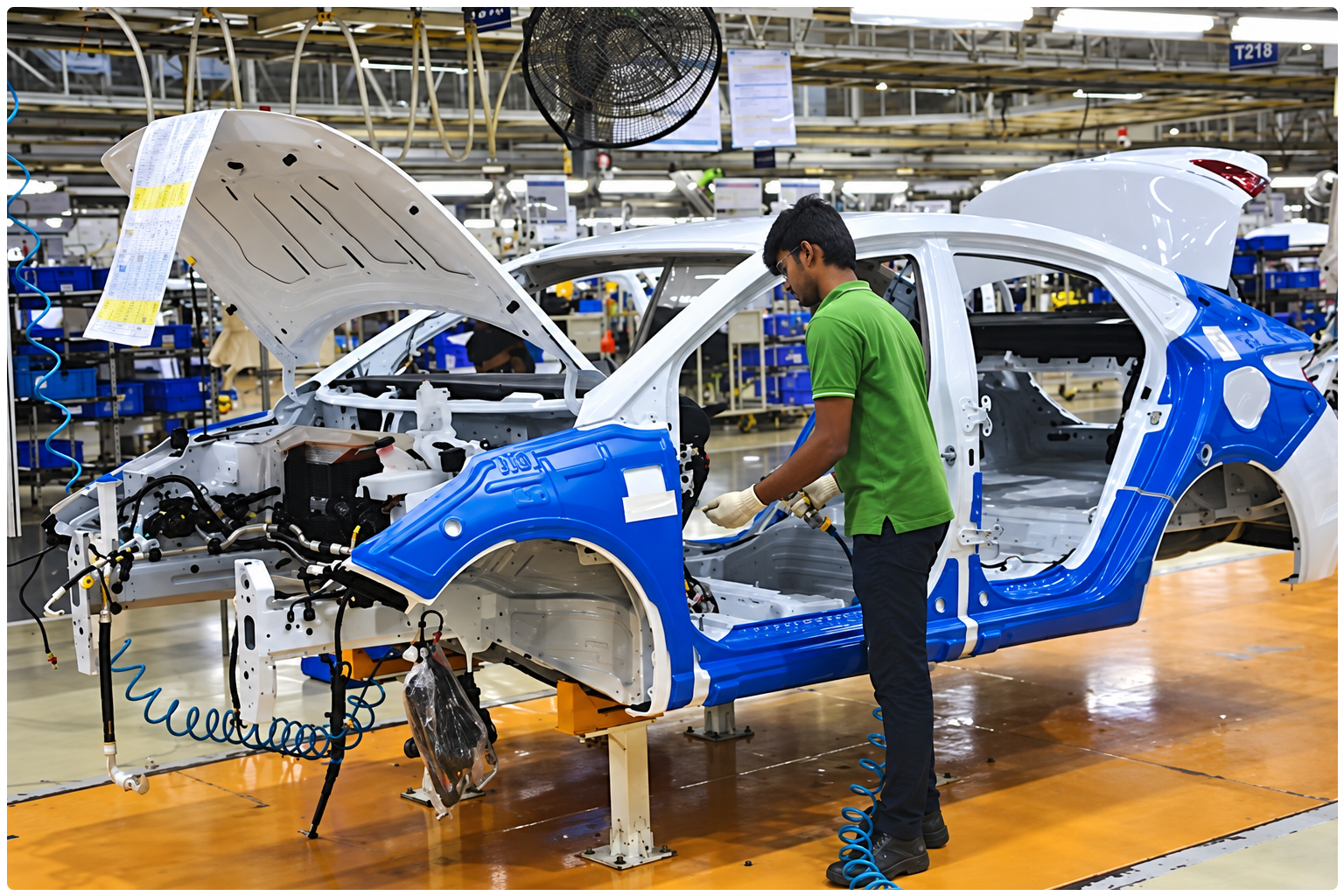
The group already has capacity to manufacture more than 1.4 million vehicles annually in India. Hyundai’s Chennai facilities account for 824,000 units, its recently acquired Pune plant can produce 170,000, and Kia’s factory in Anantapur has capacity for another 431,000. Production at Pune is expected to increase in phases.
Approximately $700 million will be directed towards Hyundai’s Indian research and development operations, including an expanded engineering centre and a new vehicle-testing track. The investment is intended to give Indian teams a larger role in developing next-generation automotive technology rather than limiting the country’s contribution to manufacturing.
The company’s investment strategy also covers electric-vehicle charging, vehicle recycling, specialised automotive finance, new mobility services and support for promising Indian start-ups. A dedicated investment entity will coordinate capital deployment, identify local partners and manage collaboration across the automotive ecosystem.
Hyundai currently employs more than 24,000 people in India. It has not provided a specific job-creation target, but expects the programme to generate employment across manufacturing, engineering, research and supply chains.
The scale of the commitment reflects a wider shift in India’s industrial position. The country is already the world’s third-largest passenger-vehicle market, while rising incomes and relatively low rates of car ownership offer considerable room for future demand.
Manufacturing momentum has also strengthened. India’s industrial output increased 8% in August, with production of motor vehicles, trailers and semi-trailers rising 25.2%. Strong investment and manufacturing activity also contributed to Moody’s raising India’s growth forecast for the current financial year.
Hyundai is not alone in expanding. Global manufacturers are reassessing supply chains and seeking production bases that can combine a large domestic market with competitive exports. India wants to capture more of that investment, although it continues to compete with China, Vietnam and other Asian manufacturing centres on logistics, supplier depth and access to major export markets.
That competition makes trade policy important. New Delhi has sought more favourable US tariff terms than its Asian rivals, recognising that even small differences in import duties can influence where companies build factories and source components.
Questions remain over how much of the $15.5 billion represents entirely new capital. Hyundai has previously announced significant investment plans for its Indian operations, and the company has not published an annual spending schedule, exact capacity target or breakdown showing how the new commitment overlaps with earlier programmes.
The direction, however, is clear. Hyundai increasingly sees India not simply as a market where it sells cars, but as a base for designing, financing, manufacturing and exporting them. Whether the country becomes a true global automotive hub will depend on how quickly the investment produces deeper local supply chains, advanced engineering capabilities and internationally competitive vehicles.