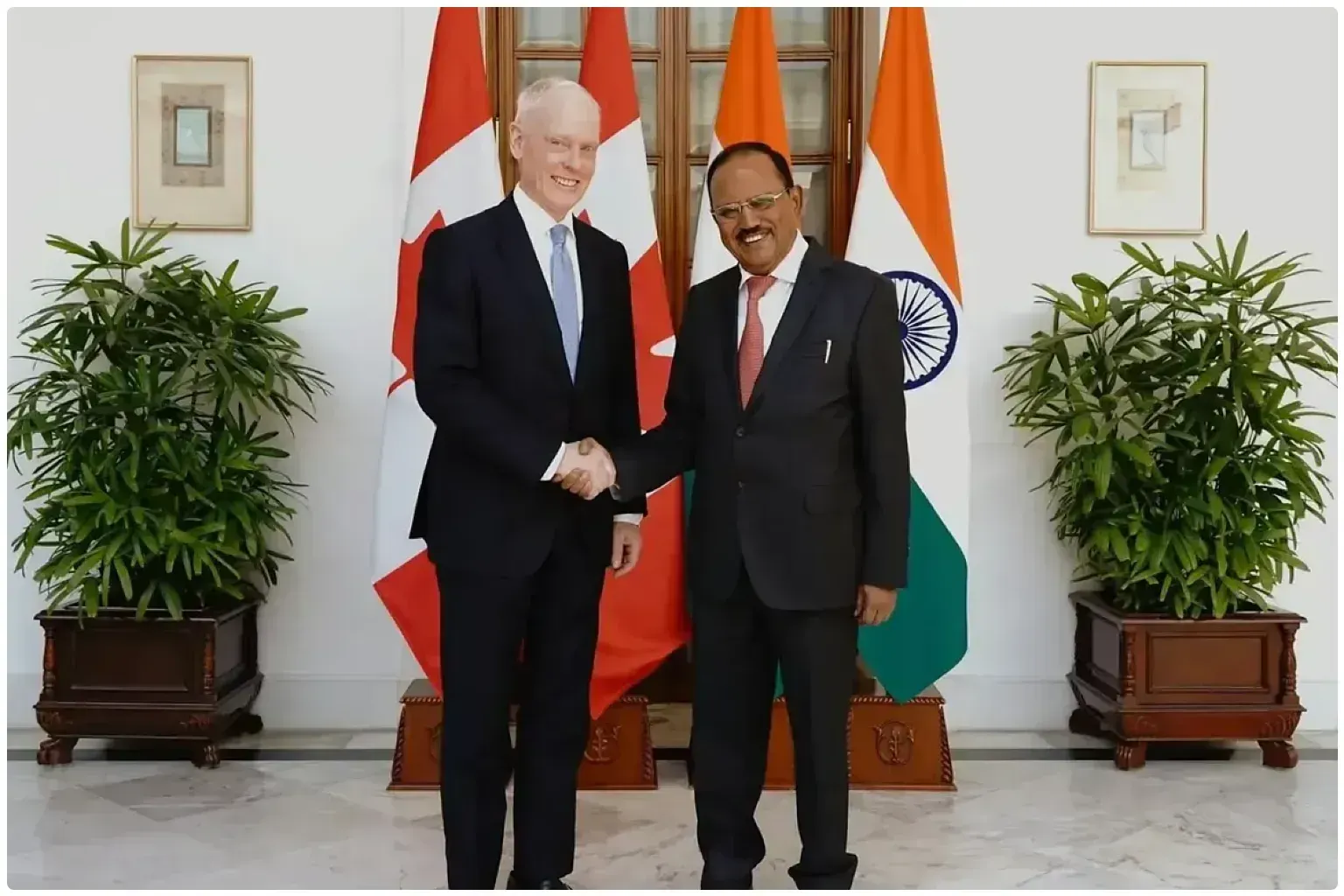
India and Canada have agreed to deepen cooperation against transnational organised crime, terrorism and violent extremism as the two countries rebuild security ties after one of the most damaging diplomatic disputes in their recent history.
The agreement emerged from talks in New Delhi between Indian National Security Adviser Ajit Doval and David Morrison, senior diplomatic and international affairs adviser to Canadian Prime Minister Mark Carney. Morrison visited India from October 5 to 7 for the latest round of the bilateral security dialogue.
The two sides reviewed implementation of a shared Security Work Plan formalised during Doval’s visit to Ottawa in February. They agreed to expand coordination against human and drug trafficking, cybercrime, extortion and related criminal networks, while strengthening cooperation over the extradition of offenders.
India and Canada will also explore structured dialogues on cybersecurity and economic security. Existing institutional mechanisms are to be strengthened, while new communication channels may be established to allow faster information-sharing between security and law-enforcement agencies.
The language is significant because security disputes were at the centre of the breakdown in relations. In 2023, then Canadian prime minister Justin Trudeau alleged a possible connection between Indian government agents and the killing of Khalistani separatist Hardeep Singh Nijjar in British Columbia. India rejected the accusation and accused Canada of allowing separatist and extremist networks advocating violence against India to operate from its territory.
The confrontation eventually resulted in reciprocal diplomatic expulsions, reduced representation and the suspension of trade negotiations. Ottawa raised allegations of foreign interference and transnational repression, while New Delhi repeatedly sought action against people accused of financing extremism, issuing threats and using Canada as a base for separatist activity.
The dispute made routine law-enforcement cooperation increasingly difficult even as criminal networks operated across both countries. Extortion, drug trafficking, financial fraud and gang violence have become particular concerns within parts of Canada’s South Asian community.
Canadian authorities said an enforcement initiative targeting extortion-linked cases had produced 188 removal orders and 111 removals by early September. However, those figures cover several grounds of inadmissibility and were not presented as India-specific.
Relations began improving after Carney became prime minister. NSA-level dialogues were held in New Delhi in September 2025 and Ottawa in February 2026, followed by meetings between Modi and Carney in New Delhi in March and at the G7 summit in Évian in June.
During their March meeting, the two prime ministers endorsed cooperation against violent extremism, terrorism, narcotics and fentanyl-precursor trafficking, cybercrime, extortion, financial fraud and human trafficking. The latest talks focus on implementing that broader political commitment through regular contact between their agencies.
Security coordination is advancing alongside efforts to conclude a Comprehensive Economic Partnership Agreement. India and Canada are working to finish the trade negotiations before the end of 2026 and have set a target of raising bilateral trade to C$70 billion by 2030.
A possible Modi visit to Canada has also been discussed, although no date has been formally announced.
Doval and Morrison additionally considered developing a more substantial defence relationship. However, no defence agreement, extradition decision or joint investigative mechanism was announced.
The effectiveness of the framework will therefore depend on what follows: whether requests receive timely responses, actionable intelligence is shared and investigations result in prosecutions or extraditions.
For now, the meeting establishes a formal route for cooperation on the same security issues that previously drove India and Canada apart.