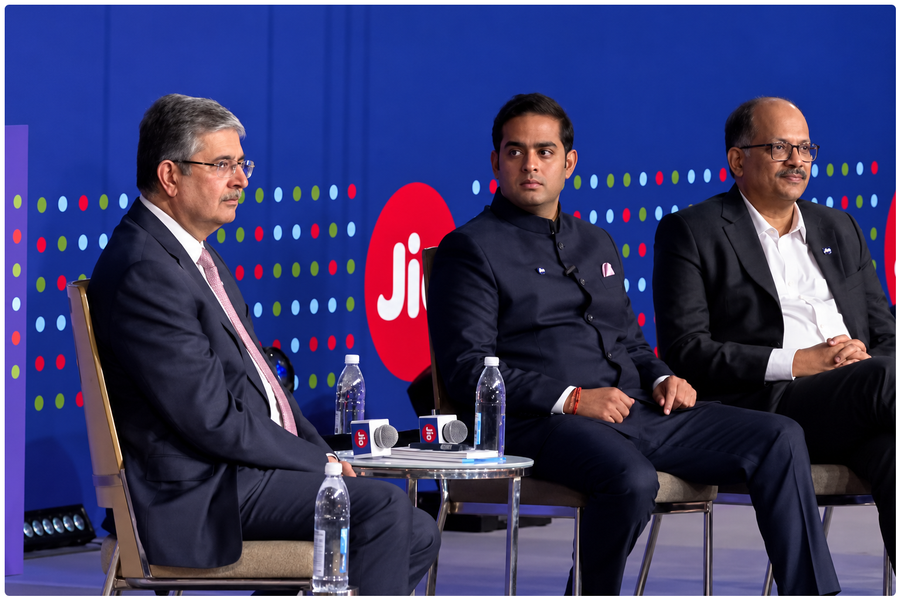
Jio Platforms has reportedly attracted around ₹2.5 lakh crore in institutional bids ahead of its stock-market debut, more than 30 times the ₹8,110 crore worth of shares available to anchor investors. The demand places Mukesh Ambani's digital services business at the centre of one of India's largest capital-market events.
The figures, reported on October 19 by people familiar with the bidding process, come two days before Jio's initial public offering opens to retail and other investors. Global asset managers, sovereign wealth funds, domestic mutual funds and insurance companies are understood to have participated in the anchor allocation.
BlackRock, Fidelity Investments, Singapore's GIC and the Abu Dhabi Investment Authority are among the institutions reported to have submitted bids. Their individual allocations have not yet been independently confirmed.
Jio is seeking to raise approximately ₹30,213 crore through the sale of 27 crore new shares, with a price band of ₹1,065 to ₹1,119 apiece. According to Reliance Industries' stock-exchange disclosures, the public offering will open on October 21 and close on October 23.
The scale of the anchor demand is substantial, but the ₹2.5 lakh crore figure represents investor bids, not capital already received by Jio. Anchor investors receive allocations before the public offer opens, and the value of bids can considerably exceed the shares ultimately allotted.
At the upper end of the price band, the offering would value Jio Platforms at approximately $108 billion, making it one of India's most valuable companies upon listing.
Investors are being offered exposure to a business that has expanded considerably beyond mobile connectivity. Jio Platforms combines India's largest telecom network with broadband, digital entertainment, cloud services and growing investments in artificial intelligence.
Its scale provides a substantial foundation for that expansion. Jio reported 533.3 million subscribers at the end of June 2026, while average revenue per user reached ₹215.6 in the April–June quarter, compared with ₹181.7 in the 2023–24 financial year.
Higher revenue per customer is particularly important for a company that has already established a commanding position in the Indian telecom market. Future earnings growth will depend increasingly on converting its customer base into higher-value subscriptions, home broadband connections and enterprise services.
The offering is structured as a fresh issue rather than a sale of existing investors' shares. Jio plans to use most of the proceeds for debt repayment, which would reduce financing obligations and strengthen its balance sheet as it pursues further investment.
The proposed listing follows years of investment in Jio by international technology and financial institutions. Meta and Google became major shareholders during the company's earlier fundraising phase, helping establish its position as a broader digital technology business.
Reliance chairman Mukesh Ambani formally outlined the company's public-listing ambitions in June, presenting the IPO as an opportunity to demonstrate the scale of Indian technology enterprises.
The next indication of demand will come when subscriptions open to the wider market on Wednesday. Institutional bidding has established considerable interest in Jio's shares, but the public offering will provide a broader test of investor appetite at the proposed valuation.