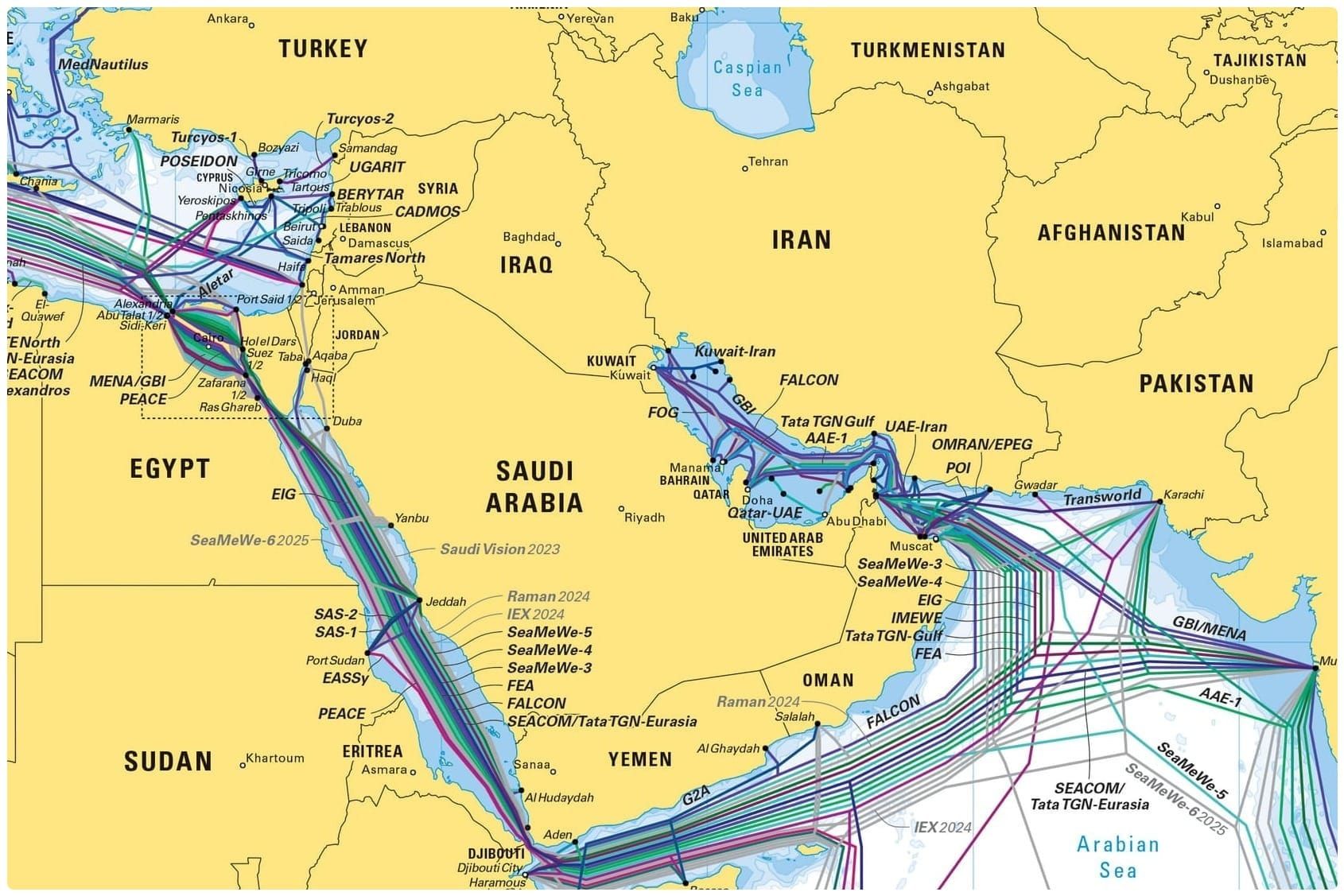
Iran has drawn up plans to attack undersea communications cables in the Persian Gulf if the United States and Israel resume military strikes, according to two senior Iranian security officials. The plans reportedly extend beyond damaging the cables to obstructing repairs, potentially leaving Gulf countries facing prolonged disruptions to internet connectivity, financial transactions and digital services.
The officials disclosed the plans to Reuters on October 23 on condition of anonymity. Neither provided operational details or identified specific targets, but one said Tehran intended to prevent damaged cables from being repaired, prolonging the disruption to regional communications.
The warning follows increasingly direct threats from senior Iranian military figures. On Wednesday, October 21, Yadollah Javani, deputy head of political affairs for the Islamic Revolutionary Guard Corps (IRGC), said Iran could target seven major internet cables beneath the Strait of Hormuz if Iranian infrastructure came under attack.
Iranian security chief Mohsen Rezaei has also identified American-linked data centres and artificial intelligence facilities across the Gulf as potential targets in another confrontation with Washington.
The threats place the region's expanding digital economy alongside oil installations, ports and military bases among the infrastructure that could be exposed to renewed hostilities.
Undersea fibre-optic cables carry more than 99 percent of international data traffic, according to the International Telecommunication Union. They support banking, cloud computing, commercial communications and government services, making their uninterrupted operation essential for economies investing heavily in digital infrastructure.
The Strait of Hormuz, however, accounts for a relatively small share of that global network. The International Cable Protection Committee identifies five active submarine cable-system segments crossing the strait and estimates that they carry less than one percent of worldwide international bandwidth.
Disruption would therefore be concentrated primarily in Gulf countries rather than causing a worldwide internet shutdown. Alternative submarine and land-based connections could absorb some displaced traffic, although their effectiveness would depend on available capacity and the number of cables damaged.
Repairing the infrastructure during wartime presents additional difficulties. Specialised vessels must locate damaged sections, recover the cables and reconnect them, often requiring permission to operate in territorial waters. Military restrictions, insurance costs and threats to repair crews could delay restoration.
The latest Iranian warnings come amid unresolved negotiations with Washington and continuing American maritime restrictions against Iranian shipping. US forces have also disabled commercial vessels accused of violating the blockade, intensifying disagreements over access to the Strait of Hormuz.
Iran has portrayed its threats against regional infrastructure as a response to the possibility of renewed American and Israeli military action. Tehran's warnings also place pressure on Gulf governments hosting US military facilities and attracting major American technology investments.
No independent evidence has established the operational readiness of the reported cable-attack plans. The Iranian officials did not disclose whether specific cable routes had been selected or what military capabilities would be used.
For Gulf governments, the prospect of attacks against communications infrastructure introduces another vulnerability into an already strained security environment. Their economies depend increasingly on the reliable movement of data, even as the region's diplomatic future remains tied to negotiations over Iran's nuclear programme, sanctions and the possibility of renewed war.