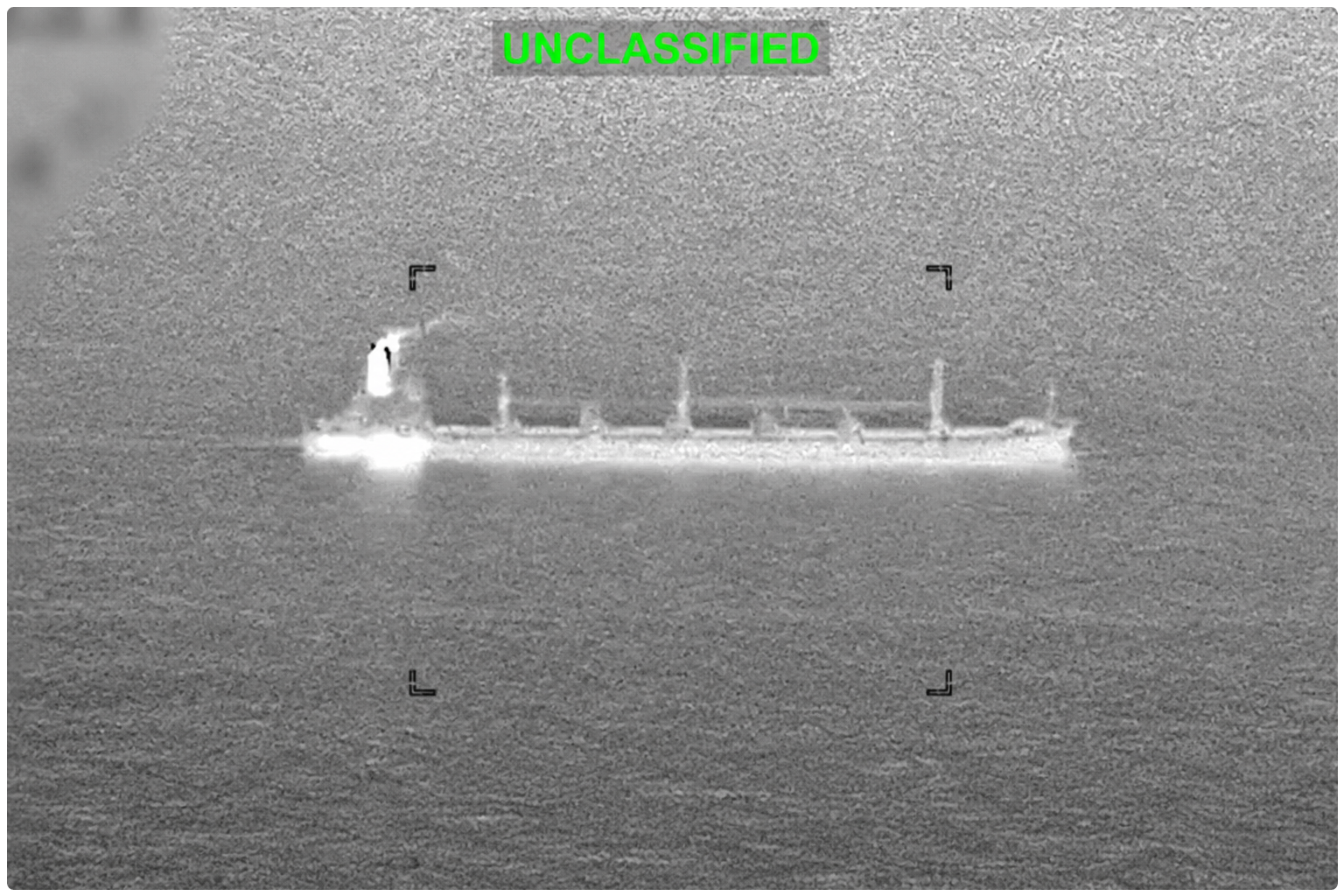
A US military fighter jet has struck and disabled a commercial cargo vessel in the Gulf of Oman after its crew allegedly ignored repeated warnings and attempted to breach Washington’s naval blockade against Iran.
The Panama-flagged M/V Ocean Molica, also known as the Arika Sun, was hit in the stern with a precision-guided munition on October 10. The strike disabled the ship’s propulsion system but did not injure any crew members, according to US Central Command.
CENTCOM said the vessel had departed an Iranian port and was attempting to transit regional waters when American forces intervened. It did not disclose the ship’s cargo, its intended destination, how many warnings were issued or how long the vessel had been under surveillance.
The American military released a short video showing an explosion near the rear of the ship. US forces did not board the vessel, which was reportedly left without propulsion after the strike. Its location, condition and arrangements for towing or crew assistance were not immediately disclosed.
U.S. Forces Disable Cargo Vessel Attempting to Violate Blockade TAMPA, Fla. — U.S. Central Command (CENTCOM) forces disabled a commercial cargo vessel in the Gulf of Oman, Oct. 10, after the ship’s crew ignored repeated warnings and attempted to run the ongoing naval blockade against Iran. A U.S. military fighter jet struck the stern of Panama-flagged M/V Ocean Molica (also known as the “Arika Sun”) with a precision munition, fully disabling the ship’s propulsion without harming the crew. The large cargo vessel was attempting to transit regional waters after having previously departed an Iranian port. CENTCOM forces resumed America’s blockade against all ships entering or departing Iranian ports on July 14. Four commercial vessels have been disabled and 135 ships have been turned around during three months of strict enforcement. Additionally, U.S. forces have destroyed 10 tankers linked to the Islamic Revolutionary Guard Corps' multibillion-dollar shadow network over the same period. All mariners are advised to heed blockade warnings from CENTCOM forces. Crews should also continue to monitor Notice to Mariners broadcasts and contact U.S. naval forces on bridge-to-bridge channel 16 when operating in the Gulf of Oman and Strait of Hormuz approaches.
— U.S. Central Command (@CENTCOM) October 11, 2026
The account provided by Washington has not been independently verified. Iran, Panama and the vessel’s owner or operator had not issued detailed public responses at the time of publication.
CENTCOM urged commercial ships approaching the Gulf of Oman and Strait of Hormuz to monitor maritime warnings, maintain communication with US naval forces and follow instructions connected to the blockade. The military has previously intercepted, redirected, boarded or attacked vessels that it accused of travelling to or from Iranian ports.
The United States first imposed the blockade in April during the war with Iran and reinstated it in July after an interim understanding between Washington and Tehran collapsed. The operation is intended to restrict Iranian trade, particularly oil exports that provide revenue to the government and Islamic Revolutionary Guard Corps.
The blockade forms part of a wider American campaign combining military pressure with sanctions against Iranian shipping, energy and financial networks. Washington recently sanctioned another 17 vessels accused of transporting Iranian crude, petroleum products and petrochemicals.
American forces have also directly attacked Iranian oil tankers during previous confrontations, particularly after alleged Iranian missile attacks against US warships. The strike on the Ocean Molica is significant because it involved a foreign-flagged commercial vessel rather than an Iranian naval ship.
A naval blockade is treated as an act of war under international law. Its enforcement against neutral commercial vessels remains especially contentious. Blockading forces are generally expected to provide clear notice, apply restrictions impartially and avoid attacks that cause disproportionate harm to civilian crews.
Washington maintains that vessels receive repeated warnings and opportunities to change course before force is used. Iran considers the blockade unlawful and has responded by restricting shipping through the Strait of Hormuz, laying mines and attacking vessels it accuses of ignoring Iranian navigation controls.
The competing restrictions have turned the Gulf of Oman and Strait of Hormuz into one of the world’s most dangerous commercial shipping regions. Traffic through the strait has fallen sharply, while insurance, freight and energy costs have risen.
Before the war, approximately one-fifth of global oil consumption passed through Hormuz. The disruption has consequently pushed governments to seek alternative export routes and prompted international efforts to reopen Hormuz and Bab el-Mandeb.
The strike also came as another tanker reportedly suffered an explosion after encountering a suspected mine in the Strait of Hormuz. Each new incident increases the risk that a confrontation involving one commercial vessel could trigger wider retaliation.
The immediate questions concern the Ocean Molica’s cargo, the warnings issued to its crew and what evidence established that it was deliberately violating the blockade. Until those details are released, the alleged breach remains the US military’s account of an increasingly dangerous maritime enforcement operation.