North Korean leader Kim Jong Un has issued a new warning to his country’s adversaries after overseeing the test of an unidentified missile system that Pyongyang claims represents a major advance in its military technology.
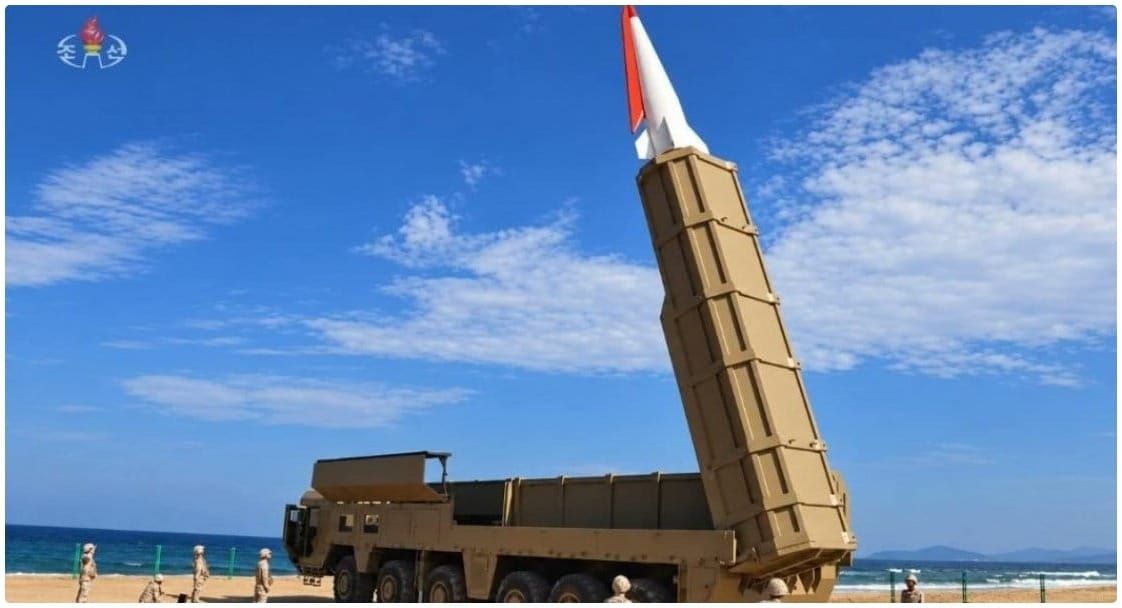
The test took place on September 20 and involved two missiles launched from the Wonsan area on North Korea’s eastern coast. Kim described the weapon as an example of “ultra-modern defence technology” and said its development would give the enemy an “incurable headache” and deliver what he called a “very cruel and unavoidable blow”.
North Korea did not identify the countries covered by the warning. However, Pyongyang routinely uses the term “enemy” when referring to the United States, South Korea and Japan, particularly when criticising their joint military exercises and missile-defence cooperation.
North Korea appears to have tested an upgraded hypersonic ballistic missile capable of evading interception and conducting precision strikes across the Korean Peninsula, experts said Tuesday.https://t.co/pYptKsABhr pic.twitter.com/7rOPipViJs
— The Korea Herald 코리아헤럴드 (@TheKoreaHerald) September 22, 2026
South Korea’s military detected the first missile at around 3 pm local time and said it travelled approximately 450 kilometres before falling into the sea. A second missile was launched nearly three hours later and flew more than 600 kilometres. Japan said the projectiles landed outside its exclusive economic zone, and no damage was reported.
Pyongyang described the exercise as a successful test of a “new-type weapon” conducted by its Missile Administration. It said the launch had not endangered neighbouring countries, although the North’s technical claims have not been independently verified.
Photographs released after the test appeared to show an upgraded version of the Hwasong-11Ma, a short-range ballistic missile believed to carry a manoeuvrable hypersonic glide vehicle. Unlike a conventional ballistic warhead, such a vehicle can alter its course while travelling at high speed, potentially making it more difficult for existing missile-defence systems to track and intercept.
The development would be particularly relevant to South Korea and Japan because the missiles’ reported ranges place military installations and population centres in both countries within reach. North Korea has also described some members of the Hwasong-11 family as capable of carrying tactical nuclear warheads.
The warning followed a series of statements condemning military exercises conducted by the United States and its regional partners. Kim Yo Jong, the North Korean leader’s influential sister, recently accused Washington of expanding military pressure around the Korean Peninsula and warned that Pyongyang could adopt measures that were “proportional or more offensive” if its security interests were threatened.
One of the exercises criticised by North Korea was Pacific Vanguard 2026, a multinational naval drill near Guam involving forces from the United States, South Korea, Japan, Australia, Canada and New Zealand. The participating countries described the exercise as preparation for combined maritime operations, while Pyongyang portrayed it as evidence of an increasingly hostile military alignment.
The latest test comes despite efforts by South Korean President Lee Jae Myung to revive dialogue through a gradual approach that would link limits on North Korea’s nuclear development to political and economic incentives. Washington has also indicated that it remains open to renewed contact.
Pyongyang, however, insists that its status as a nuclear-armed state is irreversible and has shown little interest in returning to denuclearisation negotiations. The latest warning suggests that North Korea intends to strengthen its missile arsenal while using weapons tests to increase pressure on Washington and its allies.