Poland has declared two days of national mourning after a gunman opened fire on pedestrians in Kraków's historic centre, killing six people and injuring 15 others. The attack on Saturday afternoon has also led investigators to three additional deaths at the suspect's home, raising questions about the circumstances preceding one of the country's deadliest shootings in recent years.
The violence began shortly after 3pm on November 7, when an armed man drove into Kraków's Main Market Square and fired at people in the surrounding streets. The square, known locally as Rynek Główny, is among Poland's most visited public spaces, surrounded by historic buildings, restaurants and pedestrian routes.
Saturday, 3 p.m., Krakow Main Market Square, full of tourists and horse carriages. A man in military-style clothes drove onto the square and fired at random people from his car window. 6 dead, 15 wounded, two of them police officers. Police shot him and took him alive. November 7, 2026. Poland second-largest city. The historic center is a UNESCO World Heritage Site. On a Saturday afternoon it's packed: cafes, restaurants, carriages for tourists. Around 3 p.m. police start getting calls. A car on the square. Shots from the driver's side. A witness, Konrad, told Interia: "I saw shots being fired from the driver's side window, and smoke was coming out." He ran to the police station on the square. "When I burst inside, it was full of people hiding on the floor." Police got there fast. There was a shootout. One officer was hit. Another took three bullets and went straight into surgery in very critical condition. They shot the attacker and arrested him. He's in the hospital. Then they looked inside his car. Police spokesperson Katarzyna Cislo: "Many weapons and ammunition were found in his vehicle too." The dead: four women and two men. The suspect is a Polish citizen. Police say the only known attacker is in custody. No motive yet. Donald Tusk headed to Krakow from Warsaw. To politicians of every party he said: "Do not exploit this tragedy." A man with a car full of weapons drove into the most crowded square in the country. How do you stop someone like that before the first shot?
— ohall (@lctrnotes) November 7, 2026
According to Kraków's official account of the shooting, the attacker also fired at a passing tram near Plac Wszystkich Świętych, shattering a window in the driver's cabin. Neither the driver nor the passengers was injured.
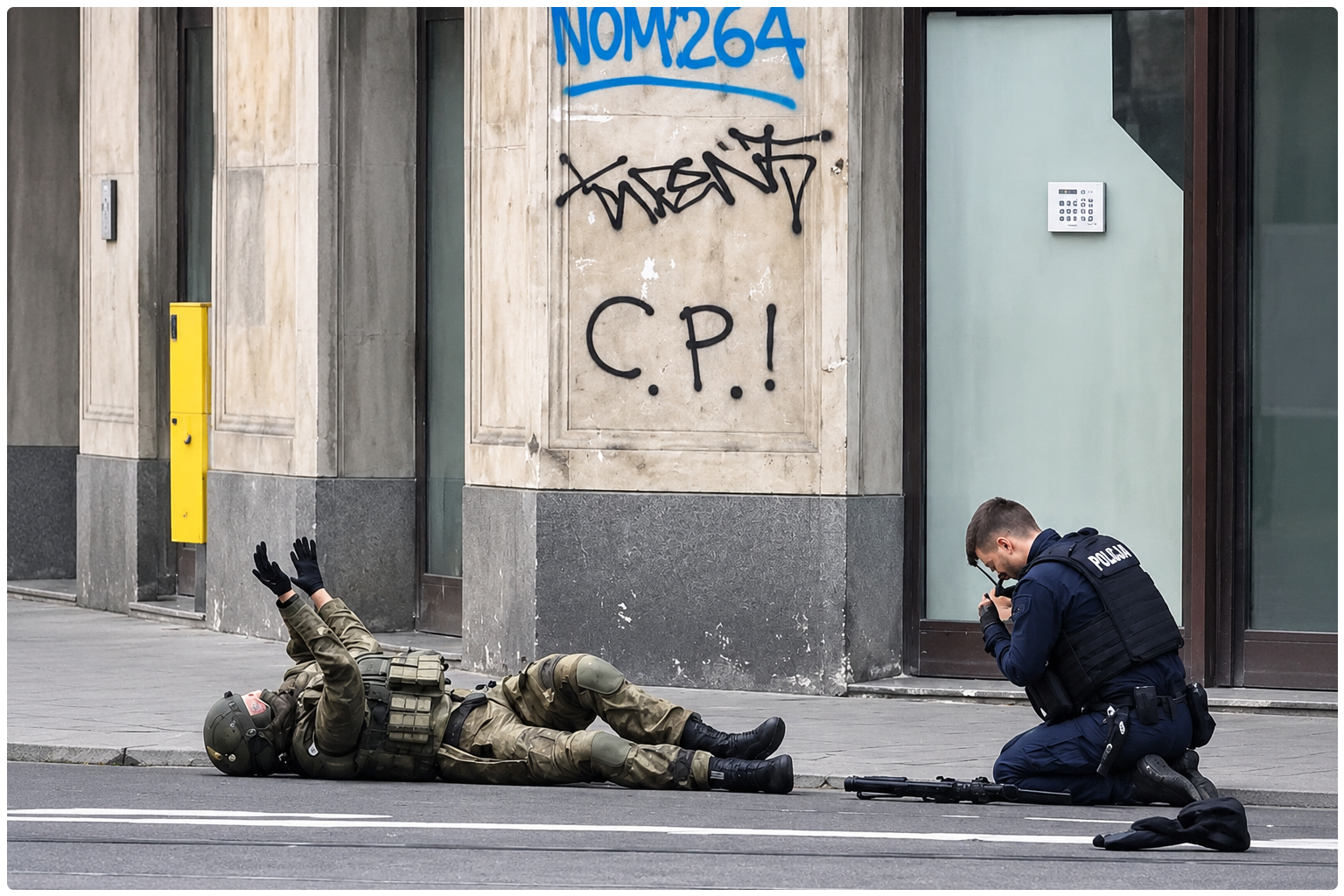
The gunman was eventually intercepted near the intersection of Dietla and Stradomska streets, where police shot and detained him. Two officers were seriously injured during the intervention, with one reported to be in critical condition.
Authorities identified the suspect as a 24-year-old Polish national. He was taken to hospital under police custody.
The six people killed in the attack were four women and two men. In a statement following an emergency security briefing, Prime Minister Donald Tusk confirmed that three Polish women and a British national had been identified among the dead. The identities of two other victims remained unconfirmed.
Investigators subsequently searched the suspect's residence in Ostrowiec Świętokrzyski, approximately 150 kilometres northeast of Kraków, and discovered the bodies of two women and a man believed to be members of his immediate family.
Those deaths are being investigated separately. Authorities have not established their precise circumstances or publicly confirmed how they relate to the shooting in Kraków.
The investigation is being conducted by police, prosecutors and Polish security services. Seven prosecutors have been assigned to the case, with investigators examining the suspect's background, possible connections and preparations for the attack.
Interior Minister Marcin Kierwiński has indicated that investigators are examining possible far-right ideological influences. However, no definitive motive has been established, and authorities have not confirmed that the suspect acted on behalf of an organised extremist group.
The attack has prompted an extensive public response. President Karol Nawrocki declared national mourning for November 8 and 9, while Kraków's mayor, Łukasz Gibała, announced a longer period of municipal mourning until November 11.
Municipal events have been cancelled, flags lowered and psychological assistance arranged for residents affected by the violence. Polish authorities have also appealed for restraint in circulating unverified claims about the suspect and his motives.
Investigators are continuing to reconstruct the attack and the deaths discovered at the suspect's home. Their findings will determine whether the shootings formed part of a wider plan or were carried out independently of any organised network.