Manila will place Prime Minister Narendra Modi at two different diplomatic tables on the same day. The first will focus on India’s partnership with Southeast Asia; the second will bring together the region’s principal powers at a time when maritime disputes, trade tensions and security risks are testing the Indo-Pacific order.
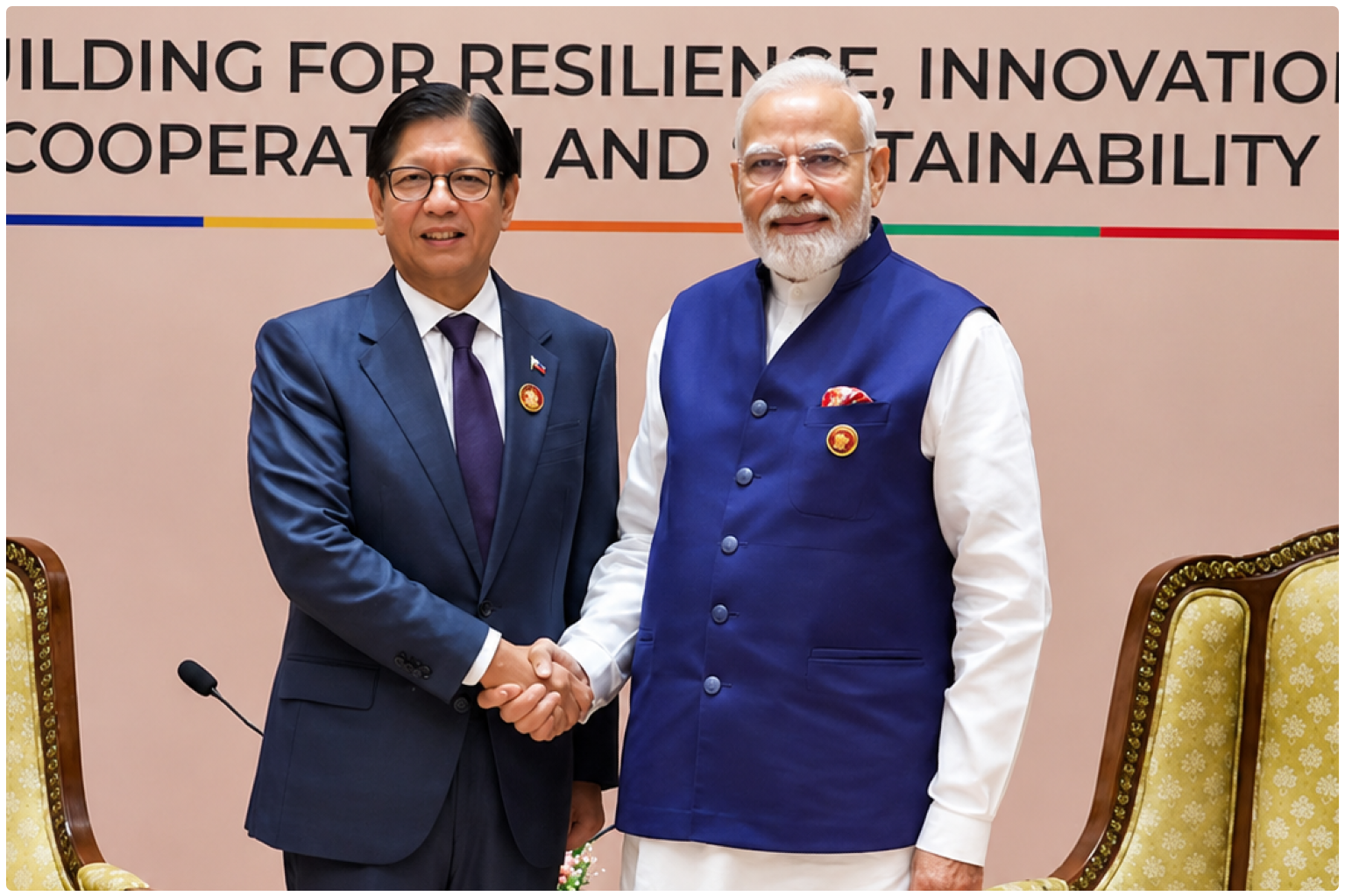
Modi will visit the Philippines on November 16 and 17 at the invitation of President Ferdinand Marcos Jr. According to the Prime Minister’s Office, he will attend the 23rd ASEAN-India Summit and the 21st East Asia Summit on November 17. The Philippines is hosting both meetings as ASEAN chair for 2026.
The ASEAN-India meeting will review the first year of the 2026-2030 Plan of Action, which covers political cooperation, maritime security, trade, digital connectivity, energy, health and education. It also prepares the relationship for two anniversaries in 2027: 35 years of dialogue relations and five years since ASEAN and India established their Comprehensive Strategic Partnership.
Trade will be difficult to keep away from the leaders’ discussions. India-ASEAN commerce reached $128.38 billion in 2025-26, accounting for 10.55 per cent of India’s global trade. Negotiators are reviewing the ASEAN-India Trade in Goods Agreement, with New Delhi seeking a more balanced arrangement that reduces unnecessary barriers and responds to trade asymmetries while preserving access to an economically important region.
The larger setting is maritime. India and ASEAN designated 2026 as their Year of Maritime Cooperation, while the Philippines has made peace, security and maritime domain awareness central to its chairship. The ASEAN Leaders’ Declaration on Maritime Cooperation calls for disputes to be resolved peacefully and in accordance with international law, including the UN Convention on the Law of the Sea.
India’s position fits that framework. It depends on secure shipping routes connecting the Indian Ocean with the Pacific, supports freedom of navigation and has expanded naval and coastguard engagement across Southeast Asia. The partnership with Manila has also moved beyond diplomacy: the two countries cooperate on maritime security, military training and defence technology, while the Philippines has become the first foreign buyer of the BrahMos missile system. Their expanding India-Philippines defence partnership gives Modi’s visit a bilateral strategic context even though no separate leaders’ meeting has yet been formally announced.
The East Asia Summit widens the discussion. It includes ASEAN members alongside India, China, Japan, South Korea, Australia, New Zealand, Russia and the United States. Unlike a treaty alliance, it operates as a leaders-led forum where governments with sharply different interests discuss regional security and economic questions without surrendering their independent positions.
For India, that format supports strategic autonomy. New Delhi can strengthen cooperation with ASEAN, the United States, Japan and Australia while continuing separate relationships with Russia and China. It also reinforces India’s preference for an ASEAN-centred regional architecture rather than an Indo-Pacific shaped exclusively by rivalry between Washington and Beijing.
The Philippines has organised its chairship around peace and security, economic corridors and public resilience. India arrives with practical proposals already under discussion, including the ASEAN Power Grid, digital connectivity, disaster-resilient infrastructure and stronger maritime cooperation. Manila will show whether those projects can move from summit language towards implementation.