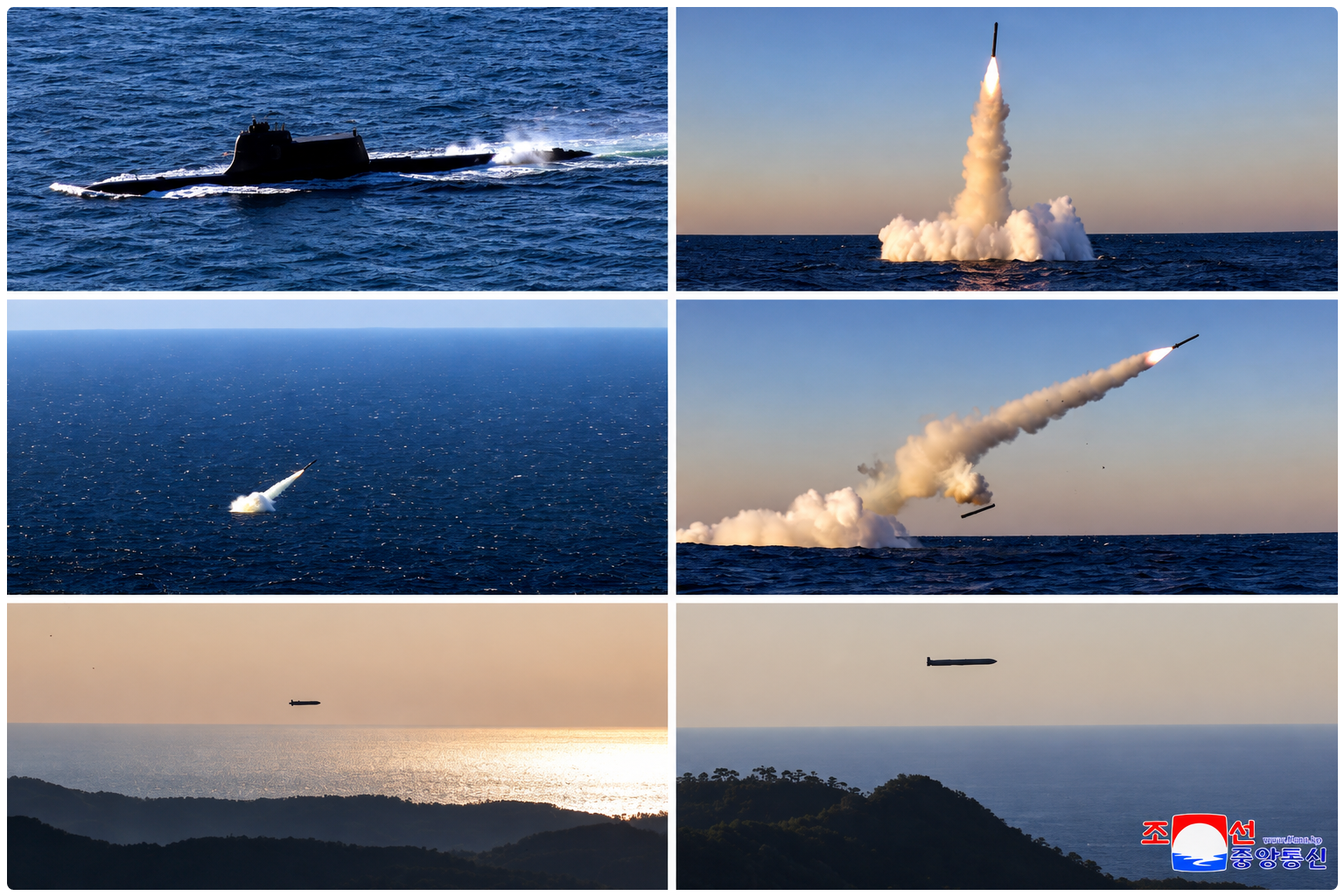
North Korea fired approximately ten short-range ballistic missiles towards the sea off its eastern coast on Thursday, October 29, demonstrating its ability to launch multiple weapons in quick succession while tensions with South Korea deepen over military activity along their shared border.
South Korea's Joint Chiefs of Staff said the missiles were launched from the Wonsan area at approximately 12:30 pm local time and travelled around 250 kilometres before falling into the East Sea, also known as the Sea of Japan. Seoul increased military surveillance and began examining the weapons' flight characteristics in coordination with the United States and Japan.
The Japanese Defence Ministry's October 29 assessment independently confirmed the detection of a suspected ballistic missile launch. Tokyo said the projectile appeared to have fallen near the Korean Peninsula's eastern coast, with no confirmed entry into Japanese territory or its exclusive economic zone. Authorities also reported no immediate damage to aircraft or ships.
South Korean military officials are investigating whether the launches involved North Korea's KN-25 system, a 600-millimetre multiple rocket launcher whose large guided rockets follow ballistic trajectories. Pyongyang has presented the system as capable of carrying tactical nuclear warheads, although no evidence has been released indicating that Thursday's launches involved nuclear payloads.
The number of weapons launched is relevant to regional defence planning. Multiple projectiles fired within a short period require air-defence networks to detect, track and assess several potential threats simultaneously. The reported flight distance, however, does not establish the missiles' maximum operational range or demonstrate that they could defeat South Korean or Japanese interception systems.
The launches followed a South Korean proposal for military talks intended to reduce the risk of accidental clashes near the Demilitarized Zone. Relations have deteriorated since a September 21 landmine explosion injured three South Korean soldiers. Seoul has attributed responsibility to North Korea, which rejects the accusation.
Pyongyang has also threatened to resume propaganda broadcasts and reposition tactical units along the border, further straining relations with Seoul. The military movements and renewed warnings have complicated South Korea's efforts to reduce tensions along the heavily fortified frontier.
Thursday's missile firings were the third reported launch event in October. On October 12, North Korea launched at least two ballistic missiles, one of which travelled more than 910 kilometres, according to Japan's official flight assessment. Japanese authorities said the longer-range projectile might have followed an irregular trajectory, a characteristic that could complicate missile tracking and interception.
The latest launches prompted South Korea's National Security Office to convene an emergency security meeting. Seoul condemned the activity as a violation of United Nations Security Council resolutions, which require North Korea to abandon its ballistic missile programme. The restrictions are established under Resolution 1718, adopted following Pyongyang's first nuclear test in 2006.
North Korea's state media also reported a military technology demonstration involving attack drones, cruise missiles and large-calibre rocket systems, attended by leader Kim Jong Un. The timing raises the possibility that Thursday's launches formed part of a broader weapons demonstration, but neither the precise relationship between the events nor the missiles' technical performance has been independently established.
With Seoul still awaiting a response to its military dialogue proposal, the latest firings add another obstacle to efforts to stabilise the border. South Korean and Japanese defence authorities continue analysing the launches, while the operational capabilities of the weapons involved remain uncertain.